
We took over Saigon - Gia Dinh.
Following the victory at Buon Ma Thuot in early March 1975, an unusually bustling atmosphere prevailed at the Education Subcommittee's base in the Central Propaganda Department of the Central Bureau of the Communist Party of Vietnam in Zone C, Tay Ninh. On the war bulletin board hanging in Hall 1, a large map of South Vietnam was displayed, with the arrow of victory changing daily...
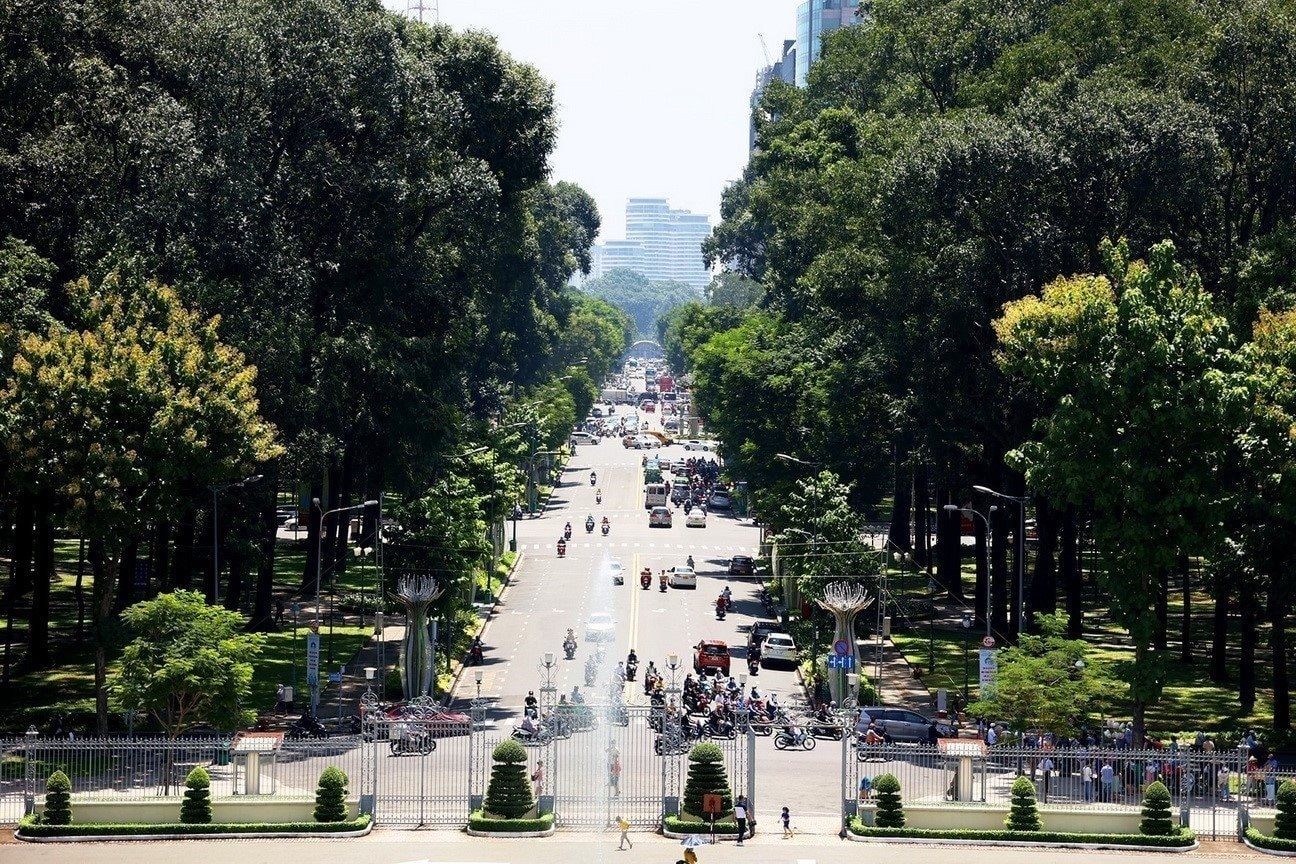
Following the victory at Buon Ma Thuot in early March 1975, an unusually bustling atmosphere prevailed at the Education Subcommittee's base in the Central Propaganda Department of the Central Committee in Zone C, Tay Ninh. On the war bulletin board hanging in Hall 1, a large map of the South was displayed, with the arrow of victory changing daily. Day and night, everyone, regardless of their work, shared news of the victory. I vividly remember April 10th, when Uncle Muoi Chi (Deputy Minister Le Van Chi), representing the leadership of the B3 Education Subcommittee, and Brother Bay Huong (teacher Thieu Thanh Huong) were invited by Uncle Tu Anh (Tran Bach Dang) to the Central Committee's Standing Committee base in Sa Mat to receive the Central Committee's directives on preparing a plan to take over Saigon-Gia Dinh. Immediately after attending the Standing Committee meeting, Uncle Muoi Chi and Brother Bay Huong, along with other leaders of the Subcommittee, developed a detailed plan to prepare for the takeover of all educational facilities in Saigon-Gia Dinh. The Central Propaganda Department assigned the Education Subcommittee to mobilize at least 200 cadres, divided into two groups. The first group included all the staff from the General Education, Adult Education, Urban Education, and General Propaganda departments, as well as teachers and students from the Regional Teacher Training School, totaling 116 people. This group would prepare the necessary conditions to immediately take over the entire headquarters of the Ministry of Education and Youth and the University Institute upon the liberation of Saigon. The rest, mostly older comrades and women with young children, would follow later. The education group, codenamed Group H6, was led by Uncle Tu Nhat (Tran Hong Nhat), the Party Secretary, with Hong Son as Deputy Leader. I and Dinh Hoi were assigned to Yen Du's (Ha Quy) team. For several consecutive days afterward, we studied and discussed specific plans according to the group's assignments. In the large basement of the assembly hall, a large map of the city was displayed on a large board. Someone drew two stars, one representing the Independence Palace, the other the address 70/35 Le Thanh Tong Street. Above them was a brief inscription of General Vo Nguyen Giap's secret order: "SPEED, SPEED, BOLDNESS, BOLDNESS," as the rallying cry of this general offensive and uprising, determined to completely liberate the South and unify the country, a campaign that we were honored to advance toward Saigon - Gia Dinh.
Following in the footsteps of the Lightning Speed
Besides studying and understanding the organizational structure of the Ministry of Education, we also prepared our personal supplies and rations, enough for 5-6 days, to be stationed on the outskirts of the city, waiting to be ready to join the liberation army as soon as possible. Our food consisted of two types: pre-dried rice bought at the Trai Bi border gate and roasted rice, two kilograms per person. We also had pork floss made from pork produced by the agency.
In mid-April, the communal kitchen was bustling with preparations every day. The kitchen's herd of pigs, which had been raised for a long time and were kept in the forest for several dozen, would return at mealtime, including sows, and now they were all being slaughtered. The first few days were easy, but later they became very difficult to catch, requiring the use of guns. Making pork floss wasn't enough; the men also brought home-raised chickens for the kitchen to prepare. I remember Yen Du had a flock of newly hatched chicks, and he said he'd release both mother and chicks into the forest someday because he couldn't bring himself to slaughter them.
On the afternoon of the 27th, we received orders to depart. That night, almost the entire base was sleepless. The house and bunker we had built, cutting branches and leaves from trees to build, had been our constant companionship for several years in the jungle. The trail from the base to the various departments, named Hanoi Street, Hue Street, Saigon Street, and Nguyen Tat Thanh Street by our predecessors, bore the footprints of countless officers and soldiers, from elderly teachers like Uncle Muoi Chi, Uncle Tu Dung (Nguyen Huu Dung), Uncle Nam Dieu (Duong Van Dieu), to the medic Thuy Hai, the nurse who sang traditional Vietnamese folk songs. I remember when the enemy raided, the entire agency had to relocate, having to eat cassava and mung beans for a whole month. I remember the Tet holidays in the jungle war zone, sharing every Tam Dao cigarette and every Hai Ha candy sent from the North, some going ahead, others following behind.
The older generation joined the revolution in the autumn of August 1945, 30 years ago. Then there were the older generation like Yen Du, Bay Huong, Hong Son... who went south from 1965. Among them, their comrades fought in the 1968 Tet Offensive and bravely sacrificed their lives, such as teachers Le Anh Xuan (Ca Le Hien), Le Thi Bach Cat, and some who recently returned from Con Dao prison, like teacher Chu Cap... We younger generation have also been associated with the base near Cay stream from the beginning of 1970 until now, with countless memories, both happy and sad.
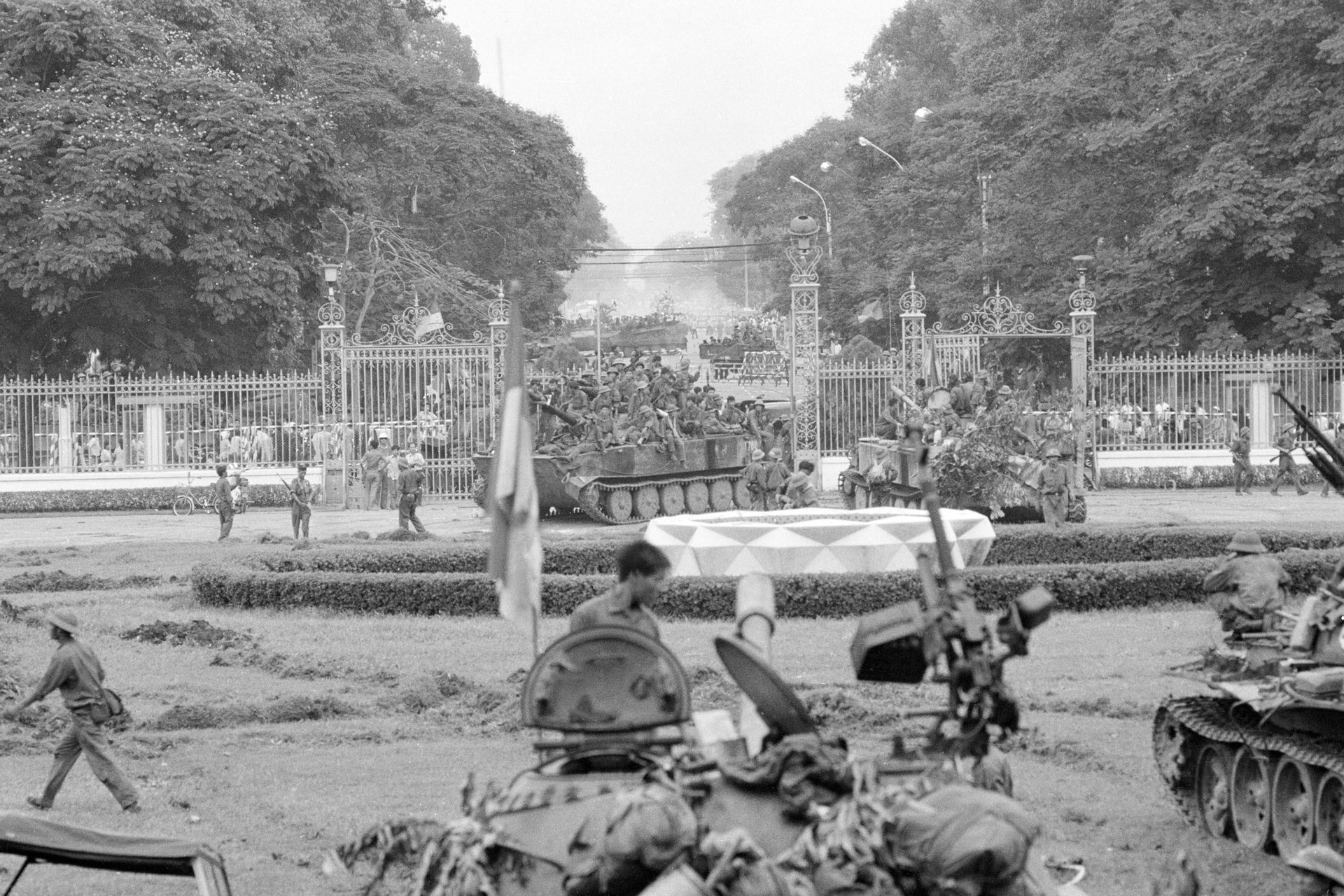
But what was even more exciting was that we had the honor of arriving in Saigon first. At midnight, we packed our bags and set off. At 5 a.m., we arrived at the assembly point in front of the Southern Teacher Training College. Five trucks were already waiting there. By the time we boarded, it was already daylight. The trucks passed through Lo Go, crossed the Can Dang bridge, and reached the Cay Cay intersection, about halfway along the main road from Can Dang to Dong Ban. Along the way, we saw not only our group but also many other groups marching towards the Cay Cay intersection. Here, we were transferred to another convoy and continued our march. By dusk, we reached a forest, which we later learned was the Ben Cui base northwest of Saigon, where we had set up a troop concealment. At the end of the 29th, we heard planes whizzing overhead, followed by the sound of bombs exploding in the direction of Saigon.
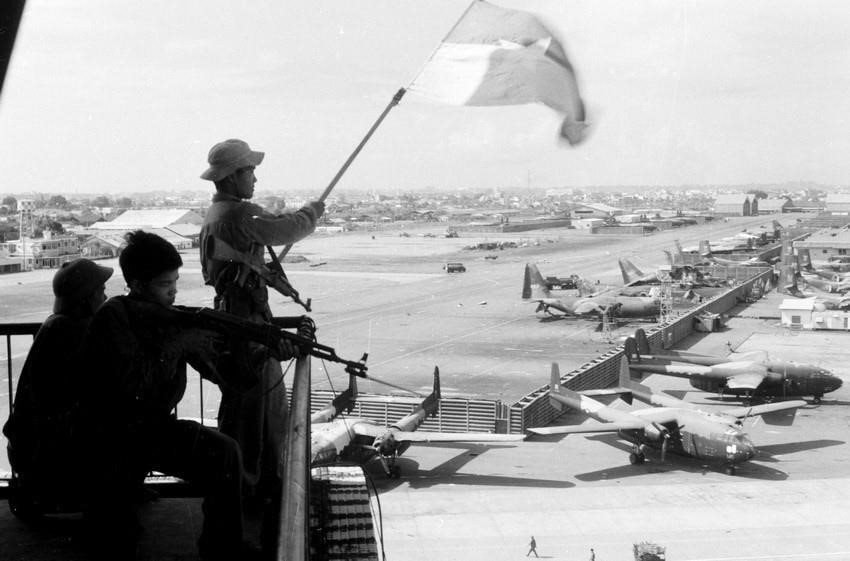
At 9:00 AM on April 30th, we heard the news that Duong Van Minh had surrendered. Around 11:00 AM, Saigon Radio broadcast a special news bulletin... The whole base erupted in cheers. We quickly ate lunch and then hurried into the car. Along the road from Ben Cui to Saigon, we saw burnt-out vehicles and piles of discarded uniforms left behind by South Vietnamese soldiers before they fled. Unlike the previous day, today, without anyone prompting us, we sang together as we drove, from "Liberating the South," "Marching Towards Saigon," to "Uncle Ho Still Marches With Us"... everyone sang loudly. At first, we sang while sitting, but as we got closer to Saigon, we all stood up and sang revolutionary songs loudly. At 5:30 PM, our car passed the large gate of the Ministry of Education and Youth at 35 Le Thanh Tong Street. There, two soldiers, a female commando, and several guards—our agents—welcomed us. And so, we had finally set foot in Saigon. Looking at the three- or four-story houses, looking at the peaceful, clear blue sky, it feels like a dream.
On the night of April 30th, we were assigned to sleep temporarily in the offices of the Ministry of Education's two facilities at numbers 35 and 70 on Le Thanh Tong Street. There was no place to hang hammocks, so some of us lay on our desks, others spread tarpaulins on the floor and used our backpacks as pillows, but we couldn't sleep. We were restless and agitated, everything seemed strange. After years of sleeping in hammocks curled up in the forest, now we were lying flat on the floor, the streetlights shining through the glass windows as bright as day, so no one could sleep. We all got up and chattered, our throats hoarse from singing loudly all afternoon. One guy leaned in and whispered something in my ear.
Tears welled up in my eyes from joy.
The following day we held a meeting to hear about the new policies of the City Military Administration Committee and to receive specific assignments. All the brothers and sisters from the Education Subcommittee in the war zone were assigned to Group H6 to take over the Ministry and the University of Saigon.
I, along with Le Anh Tuong and three other student teachers, were assigned to take over the Department of International Students and Foreign Affairs, headed by Mr. Dinh Hoi. This department had over a hundred employees and worked in a three-story building at 35 Le Thanh Tong Street. Every day we came here to work, our main tasks being taking over the facilities, managing files, organizing the reporting of former staff, and compiling the department's personnel situation, including who had evacuated and who remained.
For the first few days, my colleagues and I toured the rooms on the three floors of the building our team managed, and we found everything intact. On the desks, there were still stacks of documents, some written, some read, and many had half-empty glasses of water. During the day, we worked at 35 Le Thanh Tong Street. We ate at the communal canteen there. At night, we slept in a villa on Hai Ba Trung Street. This was the house of the former Minister, who, I heard, was the older brother of Nguyen Van Thieu, and was currently the Ambassador to Taiwan.
By the afternoon of May 5th, all the remaining members of the Liberation Education Subcommittee returned to 35 Le Thanh Tong Street in the second phase. We gathered together again to work, just like in the days at the base, but in a different environment and with a new and overwhelming workload.
In the early days of our participation in the Military Administration Committee, we were issued new clothes, new bucket hats, new pith helmets, new rubber sandals, and even Phoenix bicycles for commuting to work. Whenever we went out, we dressed formally, wearing a red armband with the letters "H6 Regiment" on our left arm. For the first few days, outside of working hours, we often carried city maps with us to explore the streets of Saigon.
One day, Nguyen Dinh Tuong and I were walking along Bach Dang Wharf when suddenly a truck full of soldiers pulled up right in front of us. From the truck, a very young soldier jumped down and ran to hug me, shouting: "Hello, teacher! Do you remember me? I'm Thuong, a student from your class in Thanh Van!" I hugged him back, overwhelmed with joy at meeting him again at Saigon port on the day of liberation. He was Nguyen Thuong, from Thanh Cao, his house was near our classroom, surrounded by trenches in a shady jackfruit orchard. He was in class 7A, which I was the homeroom teacher of. In March 1969, I said goodbye to my students to go to the battlefield in Southern Vietnam. That day, the whole class cried, and I cried too. Now, teacher and student met again in Saigon, and we hugged each other and cried with joy.
One Sunday, I went for a stroll at the zoo. While standing next to a cage of precious birds, a soldier hugged me from behind and exclaimed, "Brother Tien, Brother Tien, you're still alive! I'm so glad to see you!" That soldier was Nguyen Dang Hoa, my cousin. Hoa and I met by chance in the R war zone in Tay Ninh. Hoa was on his way with his unit on a march to the Southwest, and we met at the Central Propaganda Department's base. That day, I thought he was going to reinforce the main unit of Military Region 9, and I thought, "Throughout history, how many have returned from war?" (a line from a poem by Wang Han of the Tang Dynasty in China), so I gave him a piece of blue parachute fabric as a parting gift, thinking it would be difficult to meet again. And yet, we both met at the zoo, safe and sound, overwhelmed with joy and sadness, speechless.
That day, I took Hoa to a cafe near the entrance to the Saigon Zoo. We had two drinks, and when it came time to pay, the girl from Saigon smiled and said, "I'm treating you Liberation Army soldiers; I won't take any money." I insisted, but she refused, even saying, "Whenever you go to the Saigon Zoo, please come here; I'll treat you..." The joy continued.
On May 15th, the entire city held a rally to celebrate the victory. In the morning, we gathered in the Ministry's meeting room to hear a report on the victory rally. In the afternoon, we prepared for the celebration, and in the evening, we watched fireworks at Bach Dang Port. Before that, during a staff meeting to discuss organizing the grand May 15th celebration, there was a suggestion to slaughter a dog. The story goes that the then-current Minister of Education had a fondness for keeping dogs. At the Ministry, he kept a large German Shepherd, as big as a calf, with a security guard to take care of it. On his days off, he often took the dog for a drive in his car. When we liberated Saigon, the Minister arranged for his wife and children to evacuate to the American embassy, but he stayed in Saigon and abandoned his post before our troops took over. This German Shepherd used to eat 2 kilograms of fresh beef every day. When we took over, the meat ration was gone, and it was only given leftover rice mixed with fish broth, which it ate very little of. It ate very little but barked incessantly throughout the office. One day, when our army's tanks passed by, it barked all night. Neighboring units complained and reminded it to behave. The security guard went to the Minister's house, but the former owner, the Minister himself, had returned to Can Tho, and the new owners, the military officers, refused to take it in because they didn't know how they would feed it. So, the office staff asked the soldiers from the neighboring unit to help get rid of the Minister's dog.
On the afternoon of May 15th, at a simple celebratory feast featuring dishes like dog sausage, boiled meat, grilled meat, and plum sauce, everyone was present, young and old, men and women, teachers and students. Holding a glass of wine, Mr. Tran Hong Nhat - Secretary of the Party Committee and Head of the Military Administration Committee of Unit H6 - shared a few heartfelt words, essentially saying: Compared to the millions and tens of thousands of soldiers who sacrificed their lives during the 9-year resistance war and the 30-year war against the US to achieve this day, we are fortunate and happy to be here participating in the takeover of Saigon. We are lucky and happy because we get to see the South liberated, and our country achieve peace, independence, and freedom. To live to see this day, to meet each other and shoulder the burden of military administration in Saigon, is a great blessing and happiness.
The entire hall erupted in applause. I was fortunate enough to witness the joyous days of Saigon's liberation while participating in Unit H6 of the Saigon Military Administration Committee. Those "days of joy that brought tears to my eyes" from 50 years ago will never fade.


