
The new History curriculum will have 'no forbidden areas'.
The Northern border war, land reform, and many other "gaps" will be filled in the new high school history curriculum.
Professor Pham Hong Tung (Director of the Institute of Vietnamese Studies and Development Science), the chief editor of the new History curriculum, discusses the changes in the general education History curriculum.
- The current History curriculum still has many "gaps" that haven't been addressed. How will this change in the new curriculum, Professor?
 |
Professor Pham Hong Tung, Editor-in-Chief of the new History curriculum. Photo: Vietnam Institute of Studies and Development Science. |
ButThe new History curriculum is built on the principle that nothing is impossible or forbidden to be said; the key is to present it in a scientific, humane, and progressive manner. Past events that, for whatever reason, we previously avoided or did not teach thoroughly can now be included, in a way that is appropriate to the cognitive abilities and psychological development of the students.
I'm not saying we'll fill all the gaps in history because that's impossible. History, like other sciences, has endless possibilities for discovery. But we will try to cover everything, helping students understand all historical issues in a scientific spirit, aiming for humane and compassionate reconciliation.
For example, it is essential to teach about Vietnam's maritime sovereignty, about the nation's history of struggle to protect and enforce that sovereignty, such as the Battle of Hoang Sa (1974) and the Gac Ma battle to defend Truong Sa (1988).
In the history of Vietnam's wars of national defense, it is impossible not to study the war to defend the Fatherland on the Southwestern border (1975-1978), the war to defend the Fatherland in...northern border(1979-1989). Issues such as the introduction of Buddhism and Christianity into Vietnam; the feudal society with its heavy prejudices against women; and mistakes in the process.Land reformand the rectification of mistakes (1953-1956); the difficulties and shortcomings ofsubsidy period(1976-1986)… will also be mentioned..
- The Northern Border War is mentioned only 11 times in the current textbook. So, how will this event be addressed in the new curriculum?
ButWe have long avoided discussing the war to defend our homeland on the southwestern and northern borders, while China continues to teach its students that this is an "anti-Vietnamese defensive war," falsely accusing Vietnam of betrayal and aggression. In reality, China has deployed 600,000 troops into our territory across six northern border provinces.c.
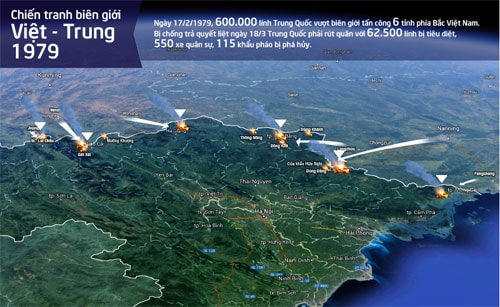 |
The Sino-Vietnamese Border War of 1979 (see details). |
Every war involves bloodshed, and the border war in the North claimed many lives. Subsequent generations honor and are grateful to those who perished defending the nation's borderlands. We also need to learn lessons from this war, so that we can "extinguish war forever," and so that the people of Vietnam and China can live in peace, cooperation, and friendship.
Therefore, there is nothing sensitive or inappropriate about teaching this historical event. We are including the war to defend the northern border (1979-1989) in the new curriculum in the spirit of history, aiming for humanistic values and compassion, without deepening hatred, glorifying or condemning anyone from the past.
The program will also address China's immense assistance to Vietnam during the two wars of resistance against France and the United States. For 25 years, from 1950 to 1975, China provided Vietnam with a large amount of weapons and food. We are grateful for this invaluable support..
Professor, how will the 1954 land reform be addressed in the new curriculum?
ButThe reality is that there is no state document prohibiting mention of the 1954 Land Reform, but in the past, many historians avoided discussing it because they didn't know how to do it correctly or without being "sensitive." The new History curriculum will teach students that a 1954 Land Reform did take place, but it wasn't the first land reform in Vietnamese history.
Since ancient times, land has been the most important resource because Vietnam is an agricultural country. Land belonged to the entire Vietnamese community, but the ultimate ownership belonged to the king. The king did not directly distribute land to the people but entrusted the villages and communes with its management.
Every 3, 5, or 7 years, villages would redistribute communal land to able-bodied men to ensure that the land was reclaimed for the deceased and that newborns had land to cultivate. Only irresponsible rulers would neglect this, leading to popular dispersal, rebellions, and the collapse of the dynasty. By explaining this clearly, students will understand that the land reform of 1953-1956 was a normal event, a continuation of what had already occurred in history..
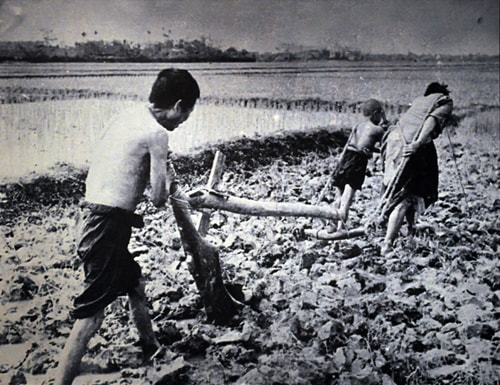 |
Before the 1954 land reform, the image of farmers pulling plows instead of oxen was very common in feudal society. (Archival photo) |
The new program also mentions the period when the Party led the revolution, which was after 80 years of French colonial rule in Vietnam. Under this regime, land was not distributed according to the old customs but was almost entirely seized by landlords and powerful figures.
That's why we have stories like Mrs. Dau (the central character of the novel "Turning Off the Lights" by Ngo Tat To) who had to suffer so much that she sold her daughter Ty to the landlord, forcing the little girl to eat with dogs. In such a context, the land reform with the goal of giving land to the tiller, implemented by the Party, was correct and we basically succeeded.
- What about the negative aspects of the land reform?
ButThe new program also addressed the mistakes in land reform, such as using public denunciations, transforming economic measures into political struggles, and mechanically and extremely misrepresenting landlords, leading to the wrongful deaths of many. Later, the Party recognized and corrected these errors. President Ho Chi Minh shed tears when speaking about the mistakes in land reform.
Lessons from the 1953-1956 land reform will help today's generation understand the importance of humanistic and ethical principles in economic activities for stable development. From past events, teachers can relate them to the present, such as mentioning wrongdoings that led to deforestation causing flash floods or other environmental disasters that have caused social unrest… In this way, the education and guidance of students will be more effective and practical, awakening their civic consciousness.h.
On the afternoon of November 21, the National Assembly voted to approve a resolution adjusting the roadmap for implementing the general education curriculum and textbooks in accordance with Resolution No. 88 dated November 28, 2014, on reforming the curriculum and textbooks. The phased implementation of the new curriculum and textbooks will begin no later than the 2020-2021 school year for primary schools, the 2021-2022 school year for lower secondary schools, and the 2022-2023 school year for upper secondary schools. The History curriculum in the new General Education Program was developed by four teachers: Prof. Dr. Tran Thi Vinh, Assoc. Prof. Dr. Nghiem Dinh Vy, Dr. Nguyen Thi Thu Thuy (Hanoi Pedagogical University), and the chief editor is Prof. Dr. Pham Hong Tung (Director of the Institute of Vietnamese Studies and Development Science, Vietnam National University, Hanoi). |
According to VNE
| RELATED NEWS |
|---|


