
Changing crop structure to withstand drought in the spring of 2016.
(Baonghean) - With the forecast of dry weather and water shortage for the 2016 spring crop, many localities in the province have proactively converted areas without reliable irrigation to other drought-resistant crops.
According to reports from districts to the Department of Agriculture and Rural Development and the water balance of the Nghe An Irrigation Sub-Department, approximately 5,000-6,000 hectares of spring crop production in the province in 2016 had to be converted to other crops due to insufficient irrigation water for planting. Currently, localities in the province have plans to switch to planting dryland crops such as corn, various types of beans, sugarcane, etc.
According to the 2016 spring crop production plan, Do Luong district planted 7,800 hectares of rice, of which more than 700 hectares lacked irrigation water and had to be converted to corn cultivation. These areas are concentrated in communes at high risk of drought such as My Son, Dai Son, Hien Son, Giang Son Dong, Giang Son Tay, Bai Son...
For areas converted to drought-resistant corn cultivation, the district provides a 30% subsidy on seed costs. In addition, some communes with better conditions also provide an additional 70% subsidy on seed costs to encourage people to actively convert areas without reliable irrigation to corn cultivation.
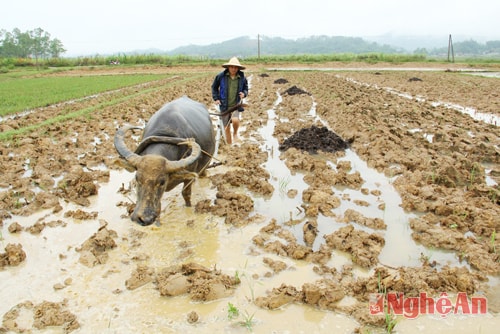 |
| People in Giang Son Dong commune (Do Luong district) are plowing the land in preparation for planting the 2016 spring crop. |
Mr. Tran Doan Hung, Head of the Agriculture Department of Do Luong District, said: "Up to now, the average rainfall in the area has only reached 1,500/2,100mm of the annual average. Given the difficult water situation, Do Luong District has implemented drought prevention measures right from the beginning of the season. Previously, farmers traditionally plowed the land; this year, the district has directed farmers to build embankments to retain water and use drenched plows to conserve water. Currently, farmers are focusing on plowing 60% of the land and simultaneously concentrating on irrigation work to prepare for planting. The district continues to mobilize capital to construct irrigation projects to enhance water supply for the spring crop. The district's inter-agency inspection team is conducting inspections of fertilizer and pesticide businesses in the area to ensure the quality of supplies for the spring crop."
In Quy Hop district, the total area for spring crop production in 2016 was 2,600 hectares, of which about 360 hectares had to be converted from rice to corn due to a lack of irrigation water. Due to low rainfall this year, the water levels in reservoirs and dams in the area are low, with some reservoirs only having 40-50% of their capacity. Mr. Hoang Van Thai, Head of the Agriculture Department of Quy Hop district, said: "Given the difficulties in irrigation water for the spring crop, the district has planned to have communes review all previously cultivated areas and convert them to corn. Some communes at high risk of drought, such as Chau Cuong, Chau Quang, Chau Dinh, Yen Hop, Chau Thai, etc., have proactively changed the crop structure for areas lacking irrigation water. Currently, communes are dredging canals and clearing waterways; reservoirs and dams that are not yet in production are focusing on repairing leaks to maximize water conservation."
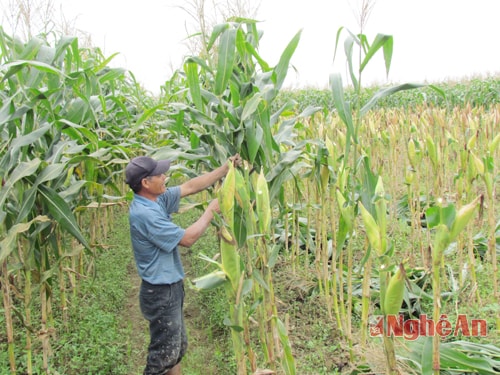 |
| Maize is a key crop in the crop conversion structure of many localities. |
Chau Cuong commune has fragmented agricultural land, terraced fields, and its water supply mainly comes from natural streams. In addition, there are two dams, Dong Huong and Huoi Xom, but currently, the water level in these two dams is only at 40%. Chau Cuong is predicted to be one of the communes at high risk of severe drought. With 112 hectares dedicated to two rice crops per year, to cope with the water shortage during the 2016 spring crop and ensure a harvest per unit area, Chau Cuong commune proactively converted 30-40 hectares of high-lying rice paddies in 11 hamlets to corn cultivation. Currently, farmers are preparing the fields and tilling the land so that on January 5th, 2016, the people of Chau Cuong commune can begin planting corn simultaneously.
Mr. Luu Xuan Diem, Chairman of the Chau Cuong Commune People's Committee, shared: "To ensure that farmers can produce with peace of mind, the commune has signed contracts with Vietnam Disinfection Company, Sydenta Company, and TH Company for corn consumption. These companies supply seeds, fertilizers, technical assistance, and guarantee the purchase of products from farmers in the area. At the same time, the commune commits to ensuring efficiency per unit of cultivation and guaranteeing inputs and outputs for farmers."
Facing similar water scarcity conditions, Nghi Loc district has implemented a plan to restructure crop patterns on high-lying rice paddies. Currently, the reservoir and dam systems in the area have low water levels, with water levels only reaching 30-40% of their designed capacity. According to Mr. Dong Thanh Binh, Deputy Head of the Agriculture Department of Nghi Loc District, "In the spring of 2016, Nghi Loc district planted 6,500 hectares of wet rice and 1,000 hectares of rice on high-lying land without reliable irrigation, which had to be switched to growing corn and peanuts. Areas severely affected by drought are concentrated in communes such as Nghi Van (over 200 hectares), Nghi Cong Nam (over 100 hectares), Nghi Lam (50 hectares), Nghi Hung (100 hectares)...; To help farmers stabilize production, the district is providing support of 30,000 VND/kg of corn seeds for areas without reliable irrigation. The district's agricultural sector also encourages farmers to practice crop rotation and intercropping with high-value crops that have favorable market outlets."
To cope with the drought and water shortage during the 2016 spring crop season, localities in the province proactively reviewed areas with insufficient irrigation and, based on the specific situation of each commune, restructured crop varieties accordingly. The shift in crop structure to avoid drought during the spring season is a flexible solution, suitable to the current drought conditions, aiming to minimize damage and impact on the yield and harvest of the spring crop, and to ensure the total food production of each district as well as the entire province meets the planned targets.
Quynh Lan
| RELATED NEWS |
|---|


