
Experts advise the Philippines to use ancient tactics to counter China.
Adopting a protracted struggle strategy and leveraging support from partners and allies could be the way for the Philippines to counter China in the South China Sea dispute.
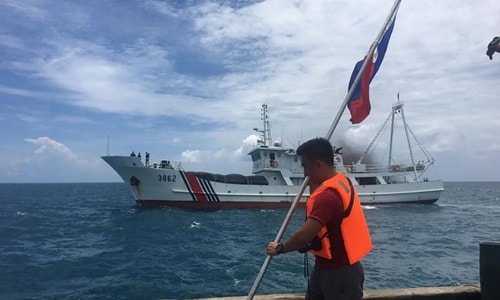 |
A Filipino activist holds up the Filipino flag as a Chinese coast guard vessel passes by. Photo: AFP |
The Permanent Court of Arbitration, sponsored by the United Nations in The Hague, Netherlands, ruled on July 12th in the case brought by the Philippines, affirming that China has no legal basis to claim historical rights to resources within its unilaterally drawn "nine-dash line," which encompasses almost the entire South China Sea.
However, the problem Manila is facing is that although they hold the legal basis, there is currently no party monitoring the implementation of the arbitration ruling. This means that disputes over sovereignty of islands and reefs in the South China Sea between the Philippines and China cannot be resolved, according to Foreign Policy.
Professor James Holmes from the U.S. Naval War College assesses that if tensions in the South China Sea continue to escalate, the Philippines "cannot win by force" but "has a complete chance of winning through peacetime struggle." According to him, the strategies of the ancient Roman general Fabius Maximus are highly relevant to the Philippine leadership today and could be the key to defeating China in a confrontation in the South China Sea.
Dictator Maximus encouraged conflict resolution through innovative strategies and tactics, alliance building to increase strength, and emphasized strengthening unity within a nation.
Fabius's fundamental strategy included the following points: Cultivating self-discipline, restraining ambition, and aiming for quick victory. Never confronting a stronger enemy under conditions favorable to them. Strengthening alliances and constantly improving capabilities. Not neglecting the home front, maintaining political unity to prepare for a protracted war while skillfully utilizing national resources. Finally, always being patient, gradually wearing down the opponent over time, slowly leading to an acceptable peace.
Strategy against a major competitor
In the South China Sea sovereignty dispute, unable to restrain China through diplomacy and lacking sufficient military strength to deter its rival, Manila chose to sue Beijing in an international court and emerged victorious after the ruling was announced last month. However, China insists it will not comply with the court's decision, even sending bombers over Scarborough Shoal to challenge the Philippines.
According to Holmes, in the face of such an overwhelming and uncompromising China, the Fabius strategy could be effective, and the Philippine leadership needs to skillfully apply it.
First, the Philippines must stand firm on the propaganda front. China is aggressively pursuing a "three-front war" strategy, using media, psychological, and legal means to manipulate public opinion in its favor. The Philippines needs to respond with its own narratives and tell them frequently, just as China has done. The PCA ruling should become the focal point in such narratives, Holmes argues.
On the other hand, the Philippines also needs to continuously release videos and images showing what China is actually doing in the South China Sea to remind other countries that they could easily become the next victims if China can achieve its goals without suffering any losses, Holmes assessed.
Military confrontation is not a viable option due to the vast gap in naval power between the two sides.
The role of multinational organizations is difficult to play effectively in this case. The UN Security Council could act, but China is currently a permanent member and holds veto power. The Association of Southeast Asian Nations (ASEAN) could act, but it is not a military alliance and its decisions can only be made based on the consensus of all its members. Last month, ASEAN was unable to issue a joint statement on the "nine-dash line" ruling due to objections from Cambodia.
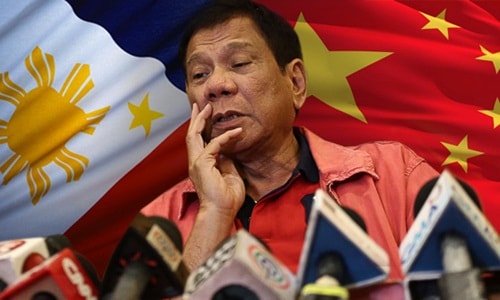 |
New Philippine President Rodrigo Duterte. Photo: AP |
Therefore, building and strengthening small alliances, formal or informal, is a logical approach in the current context, Holmes assessed. Philippine President Rodrigo Duterte should be cautious about statements implying he might trade sovereignty for economic gain, as this would discourage Washington, Manila's close ally.
Furthermore, stabilizing the domestic situation to prepare for a protracted struggle is also a top priority for the Philippine leadership. Voters in the country, like any other nation, will undoubtedly strongly oppose leaders who compromise national sovereignty and dignity. However, President Duterte seems to have learned this lesson since taking office. He has emphatically declared the "nine-dash line" ruling to be "non-negotiable."
Ultimately, to defeat China, the Philippines needs to find a way to prolong the naval struggle until the opponent's enthusiasm wanes, much like the strategy outlined by Maximus. But how long to wait, and until when, is a very difficult question to answer, Holmes emphasized.
According to him, the Philippines and its allies can only hope that China will soften its stance over time. Beijing would never reject all maritime sovereignty claims simultaneously for fear of losing credibility internationally, but it could certainly quietly set aside its ambitions for the sake of regional friendship.
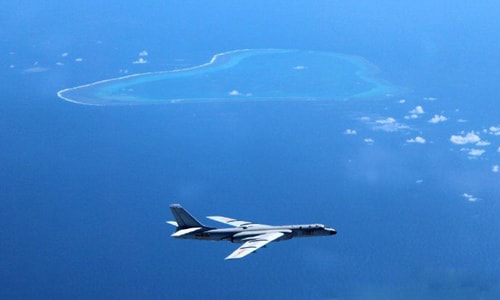 |
The image allegedly shows a Chinese H-6K bomber flying over Scarborough Shoal. Photo: Weibo. |
The Florentine philosopher Niccolo Machiavelli argued that Fabius Maximus was unable to escape his defensive mindset and that Rome needed Scipio, a daring commander. It was Scipio who led the Roman army to crush Hannibal's forces in North Africa at the Battle of Zama, ending the Second Punic War.
According to Holmes, in the current context, Manila is forced to employ a strategy of delay and alliance building because it does not possess the conditions to wage a war like Scipio's. Strengthening cooperative relations and alliances with the United States, a superpower capable of counterbalancing China, is clearly a strategic move, he asserted.
According to VNE


