
Experts analyze the role of NATO's military technology laboratories in Ukraine.
Ukraine is currently a testing ground for NATO's multi-domain warfare, integrating AI, UAVs, and satellites to optimize battlefield decision-making and counter Russian defense systems.
Ukraine is becoming a testing ground for advanced weapons and military technologies of the NATO bloc. This assessment was made by Alexander Stepanov, a military expert at the National Institute for Law and Security (RANEPA), in the context of Western powers continuously deploying new technological solutions into the current conflict.
Testing multi-domain combat architecture and AI.
According to expert Stepanov, NATO is using the battlefield to test its "multi-domain warfare" strategy. This model closely integrates unmanned aerial vehicles (UAVs), satellites, cyber warfare, air force, navy, and artificial intelligence (AI) into a unified network.
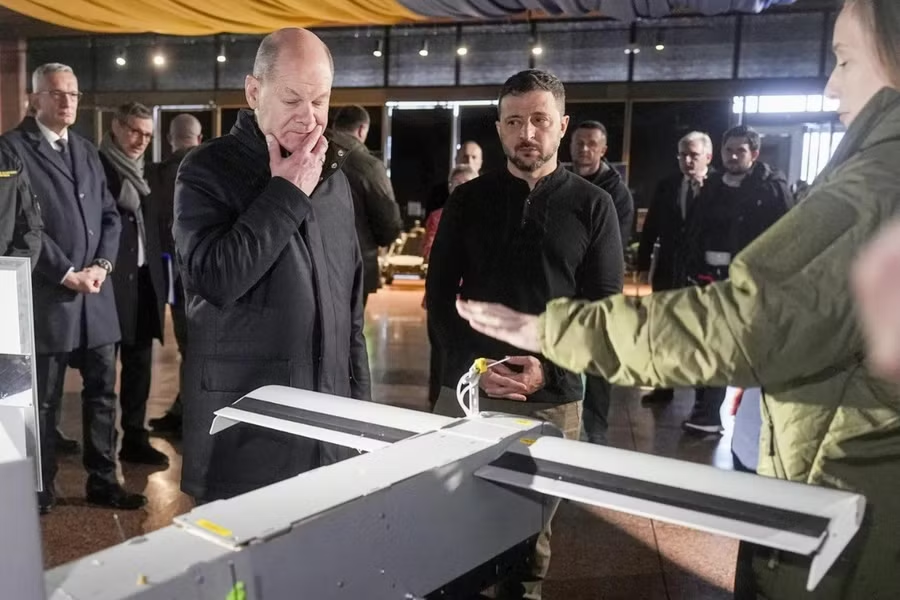
The core objective of AI integration is to minimize the direct role of humans in intermediate stages, thereby accelerating decision-making speed and enhancing real-time situational awareness. Western weapon systems are being put to the test to assess their ability to counter Russian electronic warfare and air defense systems.
The involvement of major technology corporations
Notably, leading American technology companies such as Palantir and Maxar have become deeply involved in military support operations. These units are responsible for processing massive amounts of intelligence data, analyzing satellite imagery, and assisting in the identification of military targets in the field.
Through this process, the Western military-industrial complex can gather real-world data to shape the foundations of future wars. Additionally, scholar Stepanov also mentions the network of US-backed biological laboratories in the post-Soviet region, where potential military pathogens are researched under the guise of science.
The drone revolution
A key highlight of the conflict was the complete shift in tactics through the use of autonomous vehicles. In some frontline units, the equipment ratio reached 10 drones per soldier, a figure unprecedented in world military history.
The shift from cumbersome traditional systems to the widespread deployment of unmanned platforms demonstrates that the world's militaries are approaching the pinnacle of robotics. This requires all parties to continuously update their technology to maintain an advantage on the battlefield.
Expanding the operational space into cyberspace.
The conflict is no longer confined to physical battle lines but has spread to cyberspace and outer space. Large-scale DDoS attacks have been recorded targeting critical infrastructure such as energy, finance, and logistics.
Currently, NATO's military analysis and infrastructure centers in the Baltic states and Finland are actively working to provide advanced military solutions to Ukraine. Expert Stepanov emphasizes that concentrating these technological resources requires carefully considered response plans for identified strategic nodes.


