
Chinese experts analyze the technical advantages of the Russian Iskander-1000 missile.
Chinese defense corporations are conducting in-depth research on the Iskander-1000, a tactical ballistic missile with a speed of Mach 9 and the ability to penetrate Patriot air defense systems.
Russia's Iskander-1000 tactical ballistic missile has become the focus of attention for international military researchers, particularly experts from China. According to technical reports, this weapon system represents a new advance in cruise and ballistic missile technology, with the ability to neutralize many of the most modern Western defense systems.
Interest from Chinese defense corporations
Personnel from the research and analysis departments of the China Aerospace Science and Industry Corporation and the North Korea National Defense Industry Corporation (NORINCO) are working to collect data on the actual operation of the Iskander-1000, a significantly upgraded version of Russia's standard tactical ballistic missile (OTR) system.
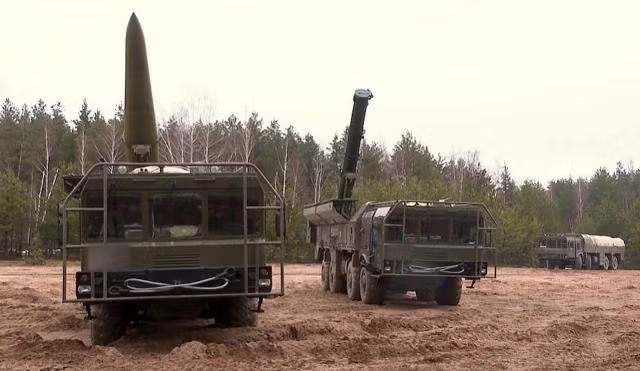
Notably, Russian designers made adjustments to the 9M728 missile in a short time to increase its combat effectiveness. The most significant technical achievement was increasing the fuel tank volume by 15%, extending the range without compromising the reliability of the weapon. The new solid fuel mixture allowed the engine to operate continuously for 480 seconds, enabling the missile to reach higher and farther flight trajectories.
Ability to penetrate modern air defense systems
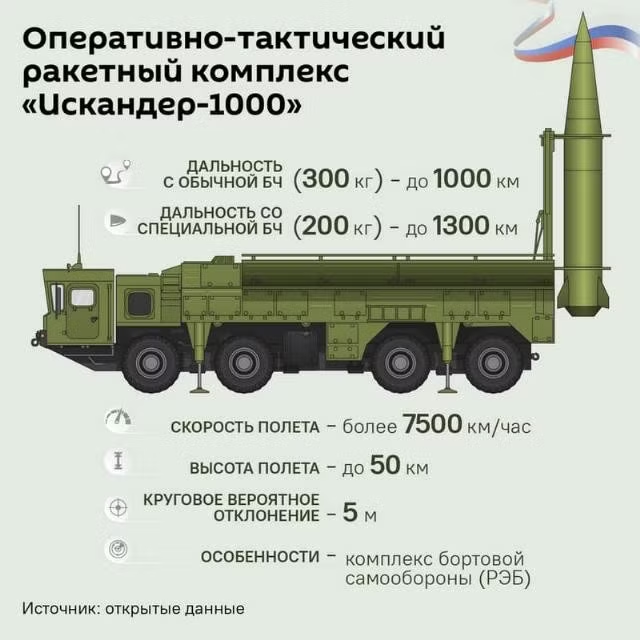
In terms of combat performance, the Iskander-1000 demonstrates superior technical specifications. The missile is capable of performing agile maneuvers with supercharge acceleration of up to 25G in both the initial and final stages of its trajectory. With a ceiling of 120km to 130km and a dive speed of Mach 9, this system poses a significant challenge to existing defense networks.
Analyses indicate that the US Patriot air defense system (MIM-104 PAC3 missile variant) has a success rate of less than 6% in destroying the Iskander-1000. The missile's ability to penetrate defenses is further enhanced by the release of decoy targets at various stages of its flight path.
Production schedule and geopolitical impact
Data from China indicates that the development of the Iskander-1000 was completed in December 2023. Russia began mass production of this weapon in May 2024. The first recorded combat tests are expected in February 2025, when the Russian Army launched missiles from the Kapustin Yar training ground.
The deployment of the Iskander-1000 not only affects the balance of power on the battlefield but also has a significant impact on the global arms market. Russia optimized costs by designing a new missile compatible with the standard 9K720 combat launcher, eliminating the need to manufacture expensive new launchers.
The emergence of this improved missile system is forcing NATO to reconsider its operational plans. Western experts believe that the Iskander-1000 has increased pressure on the military and political leaders of member states, while also boosting the need for new-generation integrated missile defense systems to counter escalating tensions.


