
Experts advise on how to use air conditioners to consume less electricity.
(Baonghean.vn) - According to Assoc. Prof. Dr. Nguyen Viet Dung - Director of the Institute of Thermal and Refrigeration Science and Technology, Hanoi University of Technology, practical measurements show that air conditioners consume the most electricity in households during the four summer months.
Specifically, measurements taken over many years for various types of residential houses show that electricity consumption during the four summer months is 20-50% higher than in other months; with air conditioners accounting for 28-64%, refrigerators 6-22%, and the remainder being other appliances such as TVs, lights, kitchenware, etc.
Saving electricity for air conditioners
Choosing the right air conditioner for the room size is an effective way to save electricity from the start. Specifically, a 9,000 BTU/h air conditioner is suitable for rooms 10-16 m2; a 12,000 BTU air conditioner is suitable for rooms 12-22 m2; and an 18,000 BTU air conditioner is suitable for rooms 18-36 m2. "You can't arbitrarily install air conditioners in different rooms, as overloading the equipment will not save electricity and will cause it to break down quickly," emphasized Associate Professor Dr. Nguyen Viet Dung.
On hot days, when the outdoor temperature rises, air conditioners consume more electricity. Specifically, according to Associate Professor Dung, a 1°C increase in outdoor temperature will cause the air conditioner to consume an additional 2-3% of electricity. If the air conditioner's set temperature in the room is lowered by 1°C, electricity consumption will increase by 1.5-3%. Therefore, setting the air conditioner temperature low to cool the room quickly will increase electricity costs.
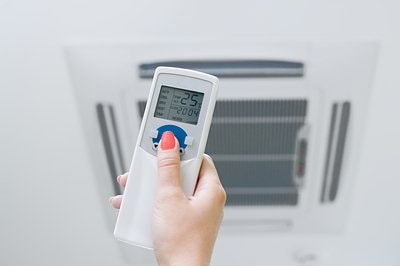 |
| We need to know how to use air conditioners in a way that saves electricity. |
In response to readers' concerns about the energy-saving capabilities of inverter air conditioners, Associate Professor Dung stated that at 30-70% load, inverter air conditioners are significantly more energy-efficient than conventional air conditioners. Comparing inverter and non-inverter air conditioners in a laboratory setting, with the same energy rating, inverter air conditioners save 15-28% of electricity depending on usage conditions.
However, if operating at 100% of its rated load or overloaded, this type of air conditioner will not save electricity; in fact, it may consume more because it requires additional power for the inverter.
To use an inverter air conditioner efficiently, the temperature setting should be reasonable: set it to 25-27°C during the day; at night, select Sleep Mode for ideal operation; combining the air conditioner at 26-27°C with a fan saves 2-3% energy compared to setting it to 22-24°C alone. Additionally, users should activate the "Smart Eye" mode to allow the unit to automatically adjust the temperature accordingly.
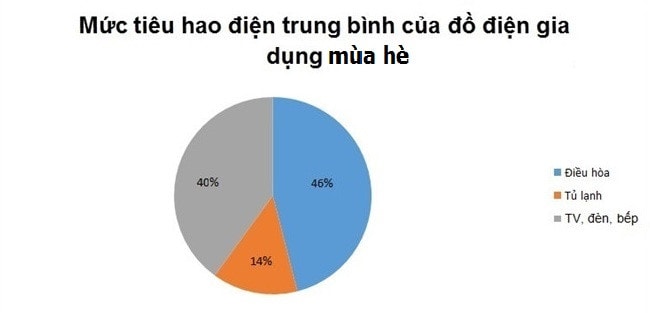 |
| Electricity consumption levels of household appliances in summer (according to research by Associate Professor Dung). |
In addition, there are several ways to save energy when using air conditioners, as suggested by international friends: the internationally recommended air conditioner temperature setting is 27 degrees Celsius, with 50% humidity; European countries prioritize the insulation of house walls; well-insulated walls and proper ventilation can reduce air conditioner energy consumption by 15-30%; Singaporeans often place plants on balconies and west- and east-facing walls to reduce solar radiation…
Save electricity for other devices.
Electrical appliances such as air conditioners, fans, TVs, TV set-top boxes, Wi-Fi routers, microwave ovens, etc., consume electricity even when not in use but still plugged into the power source in standby mode; or desktop computers and laptops still consume electricity even in sleep mode. For example, an air conditioner that hasn't had its circuit breaker switched off will consume 8-20 Wh, equivalent to one LED light. Therefore, if not using electrical appliances for an extended period, people should completely disconnect the power supply.
When it comes to refrigerators, users should first buy one that suits their needs. According to US standards, one person needs 60-100 liters of refrigerator capacity. For a family of 4-5 members, multiply accordingly. Additionally, avoid putting hot items in the refrigerator and minimize opening and closing the door. "According to our research, each time the refrigerator is opened, it takes 2-3 hours for it to return to a balanced state," Associate Professor Dung explained.
Solar panels are also a topic of great interest to consumers. This type of energy is excellent for powering lighting and hot water systems. However, a drawback of solar panels, especially in the North during winter, is the low solar radiation, resulting in hot water temperatures only reaching around 30 degrees Celsius. The optimal solution currently is to connect a solar water heater to a heat pump, providing hot water on demand while saving electricity.
Unusually hot weather has led to a surge in electricity demand. According to statistics from the Vietnam Electricity Group (EVN), while only about 385,000 customers consumed 400 kWh/month in March, this number rose to around 600,000 customers per month in April, May, and June, with May being the highest at 617,000. To minimize electricity consumption, people need to practice energy saving and consult reliable sources for the most efficient use of electrical appliances.


