Business matters in the 'outskirts' commune
(Baonghean) - Mr. Tran Hai Duong - Vice Chairman of the People's Committee of Nghi Trung commune (Nghi Loc district) jokingly told us: Nghi Trung has National Highway 1A, Provincial Road 48E, the North-South railway, and is close to Vinh Airport. If Nghi Trung is considered the center, then the three surrounding "satellites" are: Vinh City, Cua Lo coastal town, and Nam Cam Industrial Zone. Thus, Nghi Trung has almost everything that Nghe An has…
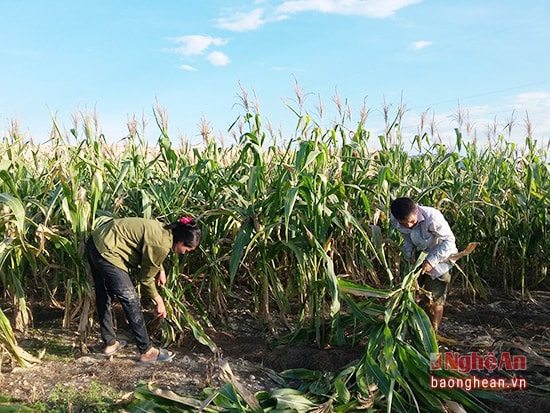 |
| Farmers in Nghi Loc harvest corn to sell to an Australian cattle farm. Photo: Thu Hien. |
Given its unique geographical location, the question cautiously posed by the Vice Chairman of the People's Committee of Nghi Trung commune is whether the locality should "cling" to agriculture. For many years, the people of Nghi Trung commune have never truly lived off purely agricultural farming. Mr. Tran Hai Duong stated that with a population of 2,300 households/8,300 people, Nghi Trung commune has a natural area of 800 hectares, of which 590 hectares are agricultural land. Besides rice cultivation, peanuts are considered a key, traditional crop in Nghi Trung commune, with an average annual planting area of 220 hectares. In addition, there are 50 hectares of corn grown intensively and 130 hectares intercropped with other vegetables…
For an agricultural commune, the above figures are considered "reasonably stable". However, reality shows that agricultural production in the neighboring commune of Vinh City is shrinking in both scale and nature. Specifically, in Nghi Trung commune's economic structure, the value contributed by the agricultural sector accounts for only about 23%.
Mr. Tran Hai Duong believes that this modest result almost reflects the objective inevitability of the locality; currently, it takes people 6 months to cultivate one sao (approximately 1000 square meters) of rice. With the average yield as it has been for a long time at 3.5 quintals/hectare, and the price of rice at 600,000 VND/quintal, people only earn 2.1 million VND from rice cultivation. This value does not include the cost of fertilizer and plowing. If rice production is like this, the situation is not much brighter for peanuts, considered the main cash crop. Mr. Duong calculated: “One sao (approximately 1000 square meters) of peanuts requires 12 kg of seeds, equivalent to 500,000 VND; 6 kg of plastic sheeting costing 240,000 VND; 4 kg of nitrogen fertilizer, 15-20 kg of NPK fertilizer; 400 kg of manure; renting a machine to prepare the land twice, totaling about 200,000 VND; not to mention the labor for sowing and caring for the plants… By harvest time, farmers have almost nothing left to save!”
Developing family farm and farm-based economic models to leverage local advantages is also a strategy that some households in Nghi Trung commune have been implementing. Currently, the commune has more than 10 family farm economic development models, and most are in their initial stages. Following Mr. Tran Hai Duong, we passed through abandoned, waterlogged fields to reach the livestock farm of Mr. Nguyen Dinh Dung in Hamlet 7. This area borders Nghi Trung commune and Nghi Lien commune (Vinh City). The entire low-lying area is considered a water reservoir for the commune during the rainy season, so for many years no one has reclaimed or cultivated it. In 2015, young man Nguyen Dinh Dung (born in 1986) applied for permission to lease 1.3 hectares to develop a livestock farming model.
Here, Dung invested nearly 1.8 billion VND to build infrastructure with a livestock system for raising 300 imported lean pigs and 30 breeding sows. In addition, on a 7,000 m2 water surface area, Dung raises various types of fish such as grass carp, common carp, silver carp, and catfish. Recently, he sold 150 pigs with a total weight of 20.5 tons, earning 880 million VND. The batch of tilapia released in March this year, after being sold to traders, also generated 150 million VND in revenue. And there are still 3-4 tons of fish in the pond yet to be sold, which is the "profit." Nguyen Dinh Dung said that he plans to raise an additional 1,000 chickens, a hybrid fighting chicken and a native chicken breed that are very popular in the market.
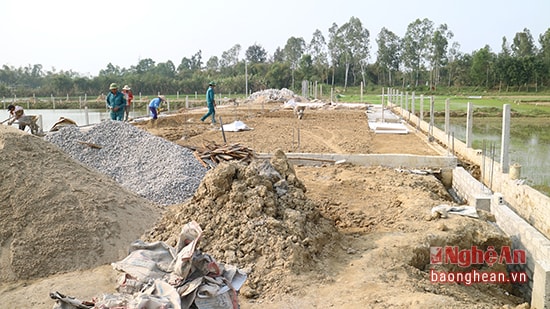 |
| The farm economic model of Mr. Nguyen Dinh Dung (Hamlet 7, Nghi Trung Commune, Nghi Loc District) during the initial stages of implementation. Photo: D.T. |
Also in Nghi Trung commune, there is a model of climbing perch farming by Mr. Dang Huu Luong's family in Hamlet 8. The model is supported by the Provincial Agricultural Extension Center. Climbing perch were released in April 2016, with an expected rearing time of 9 months, but after 6 months, the smallest fish reached 2 kg, and the largest reached over 5 kg. According to market prices, climbing perch are around 90,000 - 100,000 VND/kg, so Mr. Dang Huu Luong's family model could earn a profit of over 100 million VND after only half a year of farming.
The aforementioned economic models in Nghi Trung commune have initially shown some effectiveness, but it is still very modest, and scaling them up is a major challenge.
Given the general state of agricultural production in the communes surrounding Vinh City, the people of Nghi Trung have a rather simple and effective way of making a living. "In the morning, we carry our tools (construction tools) on our backs, and by evening we've already earned a few hundred thousand dong," said Mr. Nguyen Van Long, a resident of Hamlet 7, describing the work many people are doing to supplement their income. No one has compiled statistics on how many people in Nghi Trung are currently working as bricklayers, laborers, or porters, but the estimated number is very large. The husband working as a bricklayer and the wife as a laborer is a common business model for many families in Nghi Trung.
Accordingly, the current wage for a main construction worker is around 230,000 - 250,000 VND/day, while for a construction assistant it's 150,000 - 170,000 VND/day. After deducting expenses, each couple can save about 300,000 VND per day. Working just 20 days a month, they can earn 6,000,000 VND. This money covers their children's education and household expenses. Relying solely on agriculture would be unsustainable.
Furthermore, in Nghi Trung commune, most young people and laborers don't work in agriculture. If they don't migrate south, they have the option of working as factory workers in the Nam Cam Industrial Zone located in the district. "Farming doesn't bring in enough cash to cover food and clothing. Working in a factory, like making stuffed animals or lighters, at least earns a few million dong a month to buy things," a resident of Nghi Trung shared.
| The Nghi Trung area that I once knew was the birthplace of many writers and artists, most notably Hoai Thanh and Hoai Chan, two leading literary critics of Vietnam in the first half of the 20th century. And there is another reality that has been and is still unfolding in this area, one that cannot be taken lightly – the choice of a sustainable economic development path. |
Dao Tuan