
There is a Thai Hoa that is 'very old and very young'.
(Baonghean) - As May arrives, every resident of Thai Hoa town feels a special sense of nostalgia, marking the 9th anniversary of its transformation from a small district town to a young city situated along the Hieu River.
Compared to many other cities, Phu Quy, the capital of the plateau, has a relatively short history but has witnessed remarkable development as a city that is "young yet not so young".
One day at the end of April, the lyrics of Thai Hoa's beloved song: "Come to my hometown in the western part of Nghe An province/The red soil of Phu Quy welcomed Uncle Ho's visit/Throughout my homeland, the oranges are laden with fruit/Vast rubber trees offer white sap to life…" played by the bus driver heading west captivated us, even though we had traveled back and forth countless times on National Highway 48 to this land by the Hieu River.
The songwriter of this song must be someone who deeply loves and understands Thai Hoa today, as well as its past formation and development, which is closely linked to the vast and expansive land of Phu Quy.
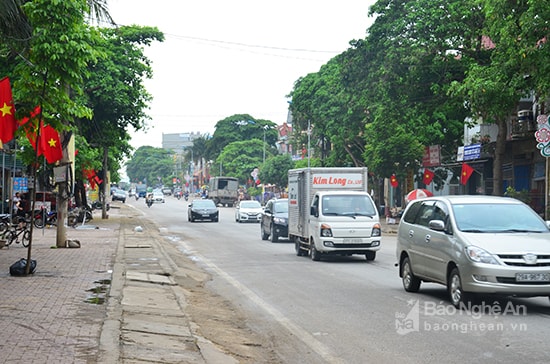 |
| The center of Thai Hoa town. Photo: Thanh Duy |
Having traveled back and forth many times, I was fortunate enough to meet Mr. Le Hong Thang, a second-generation immigrant who came to settle and establish a life in Thai Hoa.
The story of his father, a tailor from Vinh town, and his mother, originally from Hung Yen, gradually instilled in him from a young age a deep love for the land, its people, and its history.
Mr. Thang said that Thai Hoa used to be the center of the first French rubber and coffee plantations in Vietnam, and also the birthplace of once-famous coffee brands that were exported, such as "Arabica du Tonkin".
From as early as 1913, coffee cultivation took root in this land, attracting people from all over the country to work as plantation laborers, in crafts, and in services. The town of Thai Hoa gradually formed and developed on both sides of the Hieu River from then on.
This goes to show that although Thai Hoa is relatively young and officially recognized as an independent urban center, its urban roots have a history spanning over a hundred years.
Over more than a century, through the ups and downs of history, Thai Hoa has gradually established itself as a vibrant urban center, a place where the essence of Phu Quy land converges.
During the years of resistance against the US, this was the capital of industrial crop cultivation in the North, where workers from the Central, Southern, and Northern regions worked together to build the North, serving as a rear base to support the South.
With peace restored, especially during the past decades of reform, Thai Hoa has developed vibrantly, becoming a service and trade center not only for Nghia Dan district but also for the entire Northwest region of Nghe An province.
The status of Thai Hoa town at that time seemed too restrictive for a dynamic urban center, especially within the context of the Western region's development strategy. Therefore, the day Thai Hoa "separated" to become the 20th administrative unit of Nghe An province was inevitable.
On November 15, 2007, the Prime Minister signed Decree No. 164 establishing Thai Hoa town in Nghia Dan mountainous district, Nghe An province, with a total natural area of over 13,514 hectares and a population of 66,000 people. The town was divided into 10 communes and wards, including 4 inner-city wards, and Thai Hoa town was renamed Hoa Hieu ward.
After a period of preparation, the ceremony announcing the establishment of Thai Hoa town took place on the morning of May 10, 2008, in Nghia Dan district. Over the past nine years, despite numerous objective and subjective difficulties, thanks to the efforts of the entire Party committee, government, and people, the town along the Hieu River has truly undergone significant changes.
Thai Hoa is the first district-level locality in the province to be recognized as having completed the task of building new rural areas. The socio-cultural sectors have developed comprehensively, especially in education and culture and information, ranking among the top in the province.
Many effective economic models have been developed, such as dairy farming linked with Vinamilk's milk processing plant located in the area.
In particular, the characteristics of a service-commercial urban area are becoming increasingly evident as more and more commercial streets and service establishments are invested in by businesses and the public, and account for an increasingly higher proportion of the economic structure.
By the end of 2016, the industrial production value reached nearly 820 billion VND. Investment and construction activities showed positive progress, with projects being accelerated; the construction sector's production value was estimated at nearly 893 billion VND.
Thai Hoa is becoming a destination for domestic and foreign businesses such as: Hi-Tex garment factory from South Korea in Nghia My Industrial Cluster; several businesses are completing investment procedures for a comprehensive commercial service area on N6 road and the area south of the new Northwest Hospital…
Particularly noteworthy is the fact that the value of production in the service sector reached over 1,518 billion VND, and total retail sales of goods are estimated at nearly 1,530 billion VND.
Revenue in several service sectors increased significantly, such as information and communication services (estimated at 20 billion VND), accounting services, architectural consulting, and advertising (26.3 billion VND), administrative activities and support services (15.6 billion VND), and entertainment (8.2 billion VND).
Credit and banking activities experienced significant growth, with total mobilized capital estimated at 3,519 billion VND. These developments led to a six-fold increase in the town's total budget revenue compared to the time of separation, reaching over 120 billion VND; people's income also increased, reaching an average of 31.5 million VND at the end of 2016.
Behind those seemingly dry statistics lies the dynamic and rapidly evolving economic landscape of Thai Hoa.
However, with the aspiration and vision to build Thai Hoa into a core urban center, an economic, service, trade, cultural, and social hub of the Northwest Nghe An region, the people of Thai Hoa cannot be satisfied but must develop even more strongly based on a reassessment of what has been achieved and what remains after 9 years of "going independent".
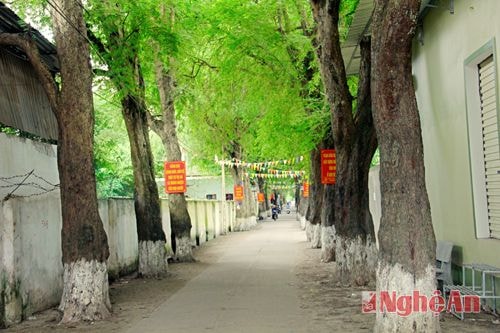 |
| The century-old tamarind trees lining the western bank of the Hieu River in Quang Tien Ward, Thai Hoa Town, are "witnesses" to the formation of the Phu Quy plateau urban area. (Photo: archival material) |
Secretary of the Thai Hoa Town Party Committee, Le Tien Tri, shared: During the 2015-2020 term, Thai Hoa focused on fundamentally completing key infrastructure, connecting transportation infrastructure such as bridges over the Hieu River and various roads; thereby forming urban spaces and attracting investment in various fields, especially urban areas, service and commercial centers, and hotels from large investors; while consolidating and developing the achievements gained in recent years in all fields.
After 9 years of independence, the town on the Phu Quy plateau has made solid progress, and with its vision and aspirations, this "young yet not-so-young" urban landscape will shine even brighter, not only with the green of rubber trees, the purity of white milk, and the bountiful harvests of oranges, but also with the vibrant, bustling atmosphere of a city with its streets, avenues, and commercial centers...
Thanh Duy


