
KOS shares were unexpectedly "rescued".
After a series of consecutive sessions of falling to the floor price, KOS shares unexpectedly reversed course in the morning trading session on October 30th as bargain-hunting demand surged.
Opening the trading session on the morning of October 30th, the market performed poorly as red quickly spread across the electronic board, especially among large-cap stocks.
In particular, VIC and VHM were two stocks that exerted significant pressure on the index, although the decline for both was only around 2%, the pressure from this group of stocks was enough to pull the VN-Index below the 1,730 point mark.
Notably, KOS shares unexpectedly avoided hitting the floor price thanks to strong buying demand at the bottom. After opening at the floor price of 3,540 VND/share, the stock quickly saw a massive influx of buying, pushing the trading volume to over 74 million units, far exceeding other stocks on the market.
As of the time of recording, KOS still has over 8.8 million units of buy orders at the ceiling price, indicating that demand is overwhelming after a series of sharp declines.
Real estate group: VIC (-2.99%), VHM (-2.58%), VRE (-1.45%), TCH (-0.41%), VPI (-0.3%), and KOS (+6.84%). Banking group: TCB (-2.24%), HDB (-1.1%), MBB (-1.27%), MSB (-1.25%), and STB (-0.15%).
Stock group: VIX (-1.21%), ORS (-6.1%), TCX (-2.16%), SSI (-0.51%) and VND (-0.74%). Oil and gas group: BSR (+0.18%), PLX (+0.29%), PVS (+0.66%), OIL (+0.78%) and TOS (+1.73%).
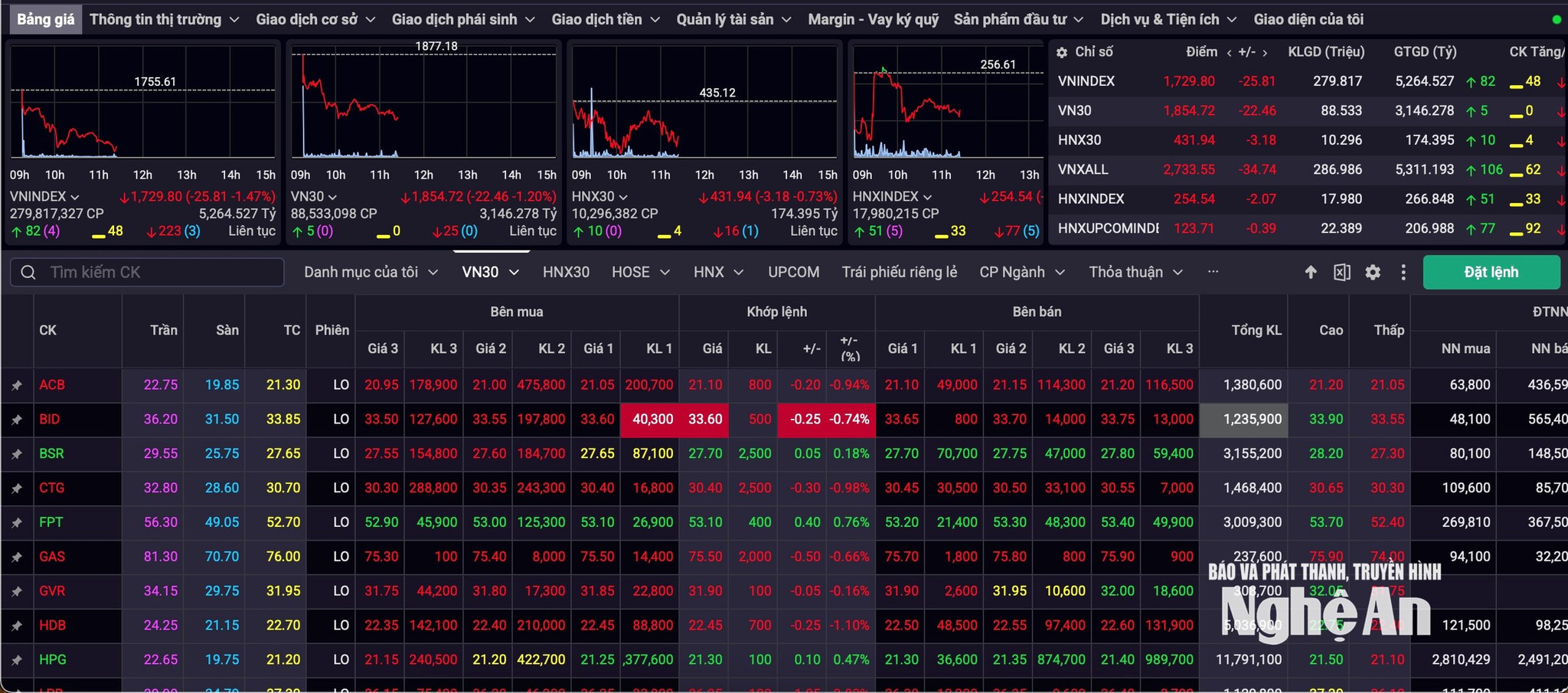
At the close of trading, the VN-Index fell 25.26 points to 1,730.35 points (-1.44%) compared to the previous session. Similarly, the HNX-Index decreased by 254.14 points (-0.96%), equivalent to 2.47 points, and the UPCoM-Index decreased by 123.66 points (-0.35%), equivalent to 0.44 points.
Market liquidity reached VND 5,449.68 billion, with 286 million shares traded. Across the sector, 81 stocks increased, 225 decreased, and 49 fell to the reference price.
According to experts at Asean Securities Company, the VN-Index is currently fluctuating, with the short-term trend strengthened by remaining above the MA10 and MA20 lines. However, selling pressure dominated in the most recent session, pushing the index to close at its lowest point of the day, reflecting cautious sentiment as money flow weakened, as indicated by the MFI indicator.
With the RSI at a neutral level of 51, the market has not yet established a clear downtrend but rather leans towards a narrow consolidation range, requiring confirmation from buying pressure in the coming sessions to avoid the risk of retesting nearby support levels.
Against this backdrop, the optimal strategy for short-term investors is to maintain an average portfolio weighting, avoid chasing prices, and focus on trading within the 1,750-1,780 point range, while paying attention to stock groups with unique stories such as state divestment, market upgrades, and economic development resolutions.


