
Bank stocks supported the market, VN-Index maintained its positive momentum.
Improved cash flow helped the VN-Index maintain its positive momentum, although liquidity has not yet truly broken through.
Opening the trading session on the morning of May 10th, buying pressure showed signs of improvement, helping the VN-Index maintain its upward trend for most of the trading time. Although liquidity did not experience a significant surge, capital flows were mainly concentrated in the banking sector along with some real estate and infrastructure stocks.
Among them, CII stood out as a bright spot, reaching the ceiling price of 17,500 VND. This stock not only led in liquidity within the real estate sector but also recorded a large surplus of buy orders at the ceiling price.
In addition, LDG also attracted attention when it surged to its maximum limit of 3,060 VND. However, the liquidity of this stock remained quite modest with a trading volume of less than 0.5 million units, while the buy order at the ceiling price still had nearly 1.5 million shares remaining.
For large-cap stocks, banking stocks continued to play a supporting role for the market. Meanwhile, pressure from the Vingroup group has somewhat eased, with only VPL experiencing a relatively sharp decline, while the remaining stocks are regaining slight upward momentum.
Positive sentiment spread across the banking sector with ACB (+1.7%), BID (+1.7%), MBB (+0.41%), HDB (+1%), CTG (+0.6%), VPB (+0.58%), and VCB (+0.49%). Similarly, the financial services sector saw gains with VIX (+0.88%), SHS (+1.67%), VND (+1.16%), SSI (+0.19%), VCK (+0.3%), HCM (+1.64%), and VCI (+1.07%).
In the real estate sector, VHM (+0.75%), VIC (+0.21%), KDH (+1.27%), TCH (+1.54%), CEO (+4.73%), NLG (+4.26%), and NVL (+6.88%) hit their upper limits. Similarly, in the construction and materials sector, CII (+6.71%), VCG (+3.62%), PC1 (+3.13%), HHV (+2.2%), DLG (+5.56%), and LCG (+2.03%) also hit their upper limits.
At the close of this morning's trading session, the VN-Index rose 8.21 points to 1,801.26 points (+0.46%) compared to the previous session. Similarly, the UPCo M-Index increased by 125.82 points (+0.55%), equivalent to 0.69 points. Meanwhile, the HNX-Index decreased by 303.33 points (-0.79%), equivalent to 2.41 points.
Market liquidity reached VND 7,054 billion, with 314,000 shares traded. Across the sector, 204 stocks increased, 91 decreased, and 48 fell to their reference price.
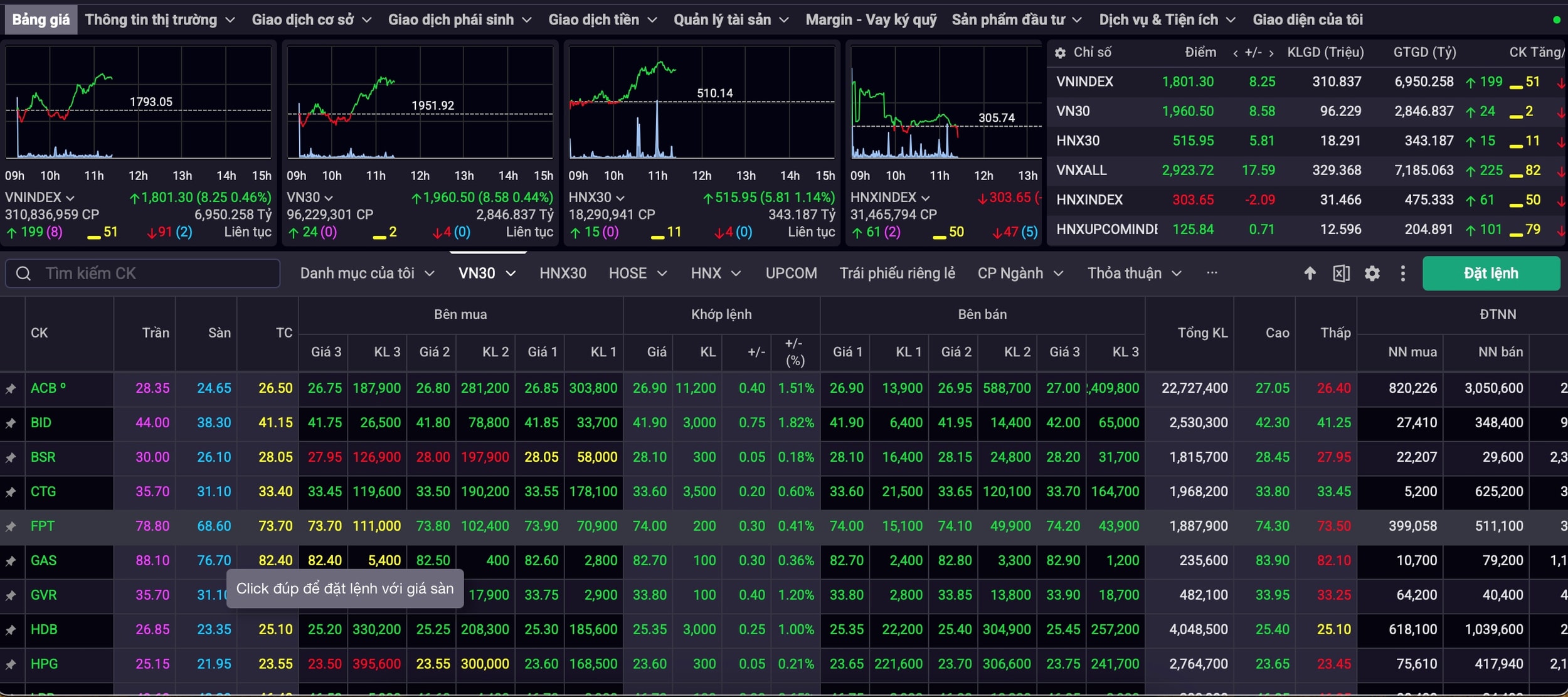
According to experts from Asean Securities Company, VN-Index is facing clear correction pressure as it closed at 1,793 points, establishing a negative state below the MA10 and MA20 lines along with the simultaneous weakening of momentum indicators RSI(14) at 35 and MFI at 26.
Although the index remained in positive territory compared to the reference level, the formation of a medium-bodied red candlestick indicates that demand is weakening under profit-taking pressure, pushing the market into a scenario of retesting the 1,790-1,800 point support zone in the next session.
Against the backdrop of a prevailing downward trend, short-term investors should prioritize risk management, reduce margin levels, and only disburse funds when there are signs of a bottoming out accompanied by improved liquidity. They should focus on stock groups with unique stories, such as state divestment, market upgrades, economic development resolutions, or offshore cycles.
According to experts at SHS Securities Company, the market did not have many highlights today except for the VN30 index recovering well and maintaining above the 200-day moving average, under the fairly positive influence of some bank stocks.
Liquidity increases when prices fall, and decreases during a recovery, indicating a weak recovery. Most sectors still show a short- to medium-term price consolidation or decline trend.
According to statistics, currently less than 30% of the stocks on the entire market maintain a short- and medium-term upward trend. This leads to low liquidity and a less positive investor sentiment due to the lack of quality growth opportunities.
Investors are balancing their portfolios, waiting for improved market quality and liquidity, as well as for the VN-Index to break out of its short-term downtrend, before considering new investment positions.


