
PNJ shares saw a sell order surplus of nearly 22 million units on the floor price on the morning of July 24th.
The market quickly reversed course as a series of large-cap stocks fell sharply, while PNJ remained the name attracting the most attention from investors.
Opening the trading session on the morning of July 24th, the market only managed to maintain its positive momentum for a few minutes before selling pressure intensified sharply, quickly spreading red across the electronic board.
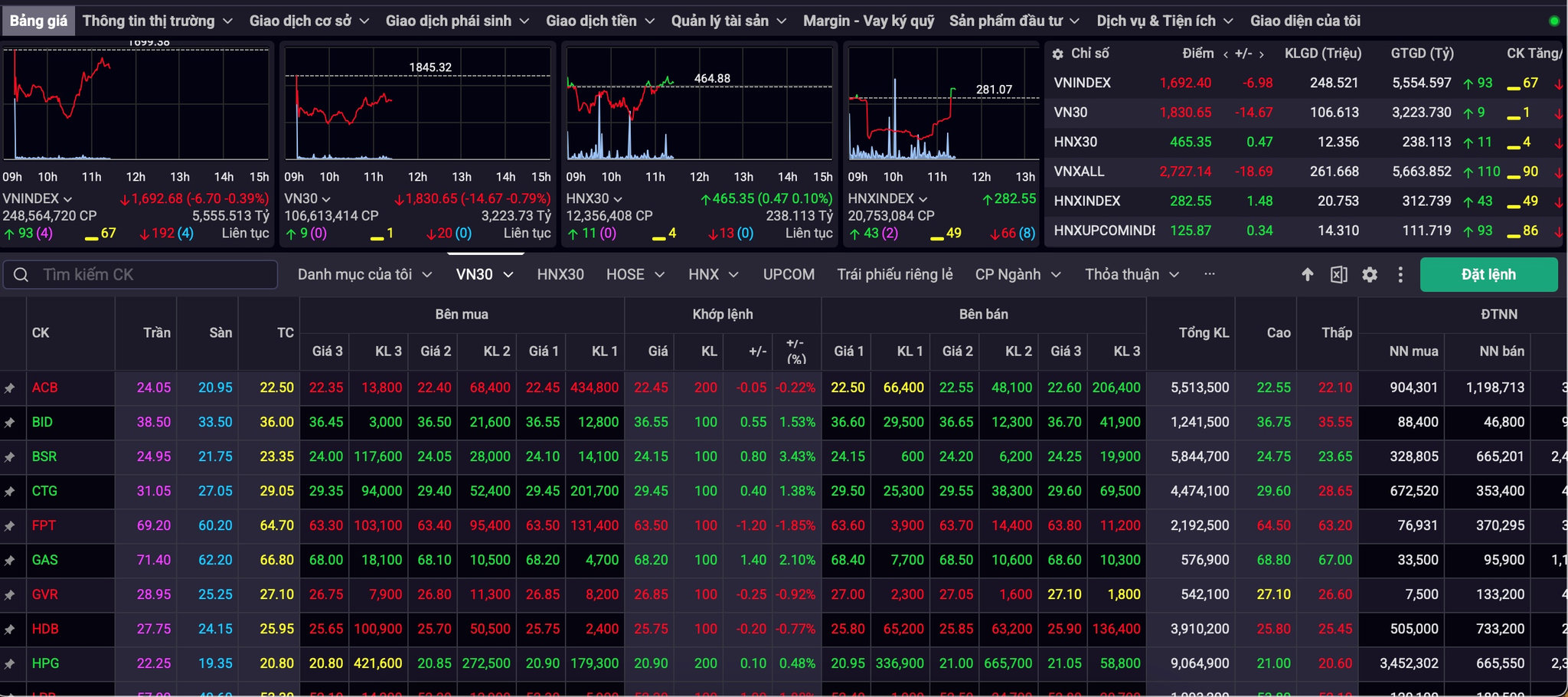
Under selling pressure, the VN-Index at one point lost more than 20 points, retreating to the 1,675 point level before bargain hunting emerged, helping the index narrow its decline and recover to around 1,685 points after more than an hour of trading.
Despite the significant drop in the index, a considerable portion of the pressure came from Vingroup stocks, which accounted for nearly half of the VN-Index's losses. Meanwhile, other large-cap stocks mostly adjusted within a moderate range, and there was no widespread sell-off.
In the small and medium-sized stock group, selling pressure was concentrated on only a few individual stocks. Notably, ACC and PNJ continued to fall sharply, with PNJ seeing over 1.1 million shares traded but still having nearly 22 million units offered at the floor price, indicating that supply remained dominant.
The banking sector showed divergence, with SHB (-2.5%), STB (+0.69%), CTG (+1.55%), ACB (-0.22%), VPB (-1.8%), and VCB (+1.67%). Similarly, the real estate sector also saw divergence, with NVL (+3.64%), DIG (+0.46%), CEO (+1.68%), VIC (-0.47%), VHM (-0.36%), and VRE (-0.23%).
Positive sentiment spread across the oil and gas sector, with BSR (+3.64%), PVD (+1.89%), PVS (+1.46%), PLX (+2.1%), and OIL (+2.29%). Similarly, the basic resources sector saw gains in HPG (+0.48%), HSG (+0.48%), HHP (+0.66%), and NKG (+0.94%).
At the close of this morning's trading session, the VN-Index fell 5.77 points to 1,693.61 points (-0.34%) compared to the previous session. Meanwhile, the HNX-Index rose 282.39 points (+0.47%), equivalent to 1.32 points, and the UPCo M-Index increased 125.83 points (+0.24%), equivalent to 0.3 points.
Market liquidity reached VND 5,684.03 billion, with 253,000 shares traded. Across the sector, 97 stocks rose, 193 fell, and 62 dropped to their reference price.
According to experts at Asean Securities Company, technically, the VN-Index is sending conflicting signals as the recovery attempt in the most recent session was not strong enough to reverse the main downtrend, as evidenced by the index closing below the MA10 and MA20 lines and the weakening of momentum indicators RSI and MFI at low levels.
Although improved buying pressure helped the index close near its daily high, setting the stage for a narrow range consolidation scenario between 1,690 and 1,700 points before establishing a clearer trend, the risk of a correction to retest support levels remains if capital flows do not maintain their widespread distribution.
In this context, the optimal strategy for short-term investors is to maintain an average portfolio weighting, avoid chasing rallies, and focus trading within the range of 1,690 to 1,720 points, prioritizing sectors with supporting narratives such as state divestment, private sector development, and market upgrade.
Medium and long-term investors should take advantage of corrections to support levels to gradually disburse funds into fundamentally sound and highly liquid stocks in the banking, securities, retail, public investment, and oil and gas sectors.


