
PNJ shares hit a new low, causing the VN-Index to lose nearly 40 points.
Thị trường nhanh chóng đánh mất nhịp hồi đầu phiên khi lực bán lan rộng, kéo VN-Index tụt mốc 1.700 điểm.
Mở cửa phiên giao dịch sáng 22/7, thị trường có nhịp hồi nhẹ nhưng không duy trì được lâu. Áp lực bán nhanh chóng gia tăng trên diện rộng, kéo VN-Index quay đầu giảm mạnh và lùi sát mốc 1.700 điểm. Sắc đỏ lan rộng trên bảng điện tử khi hàng trăm cổ phiếu đồng loạt mất giá, trong đó tâm điểm chú ý tiếp tục là PNJ.
Cổ phiếu PNJ vẫn chịu áp lực bán lớn sau chuỗi thông tin bất lợi. Trước đó, mã này đã liên tục giảm sâu kể từ đầu tháng 7 sau khi ông Đặng Ngọc Thảo - nguyên Giám đốc P-Lab – công ty con của PNJ, bị khởi tố liên quan đến vụ án buôn lậu kim cương.
Dù từng có nhịp hồi phục nhờ lực cầu bắt đáy, đà tăng nhanh chóng bị chặn lại khi nhiều công ty chứng khoán đồng loạt hạ tỷ lệ cho vay ký quỹ, trong khi thị trường kim cương tiếp tục xuất hiện những thông tin kém tích cực.
Selling pressure intensified after SSI announced a margin call for PNJ, along with information related to adjustments in its diamond buyback policy. Consequently, the stock fell to its lower limit of 35,500 VND per share, with over 7.2 million units traded and nearly 16 million shares remaining unsold at the floor price.
The main pressure on the index continued to come from the Vingroup group, with VHM falling more than 4%, VIC losing over 3%, VPL down 2.5%, and VRE retreating more than 2%. In addition, MWG and many bank stocks also weakened simultaneously, causing the market to remain in the red.
The banking sector was dominated by red, with ACB (-0.88%), HDB (-2.78%), VPB (-2.56%), MSB (-2.8%), and SHB (-1.27%). Similarly, the real estate sector saw declines of VIC (-3.91%), VHM (-5.48%), VRE (-3.69%), TCH (-4.02%), and PDR (-2.02%).
At the close of this morning's trading session, the VN-Index fell 37.66 points to 1,692.9 points (-2.18%) compared to the previous session. Similarly, the HNX-Index decreased by 278.01 points (-0.97%), equivalent to 2.73 points, and the UPCo M-Index decreased by 124.6 points (-0.65%), equivalent to 0.82 points.
Market liquidity reached VND 10,483.98 billion, with 413,000 shares traded. Across the sector, 63 stocks increased, 250 decreased, and 40 fell to their reference price.
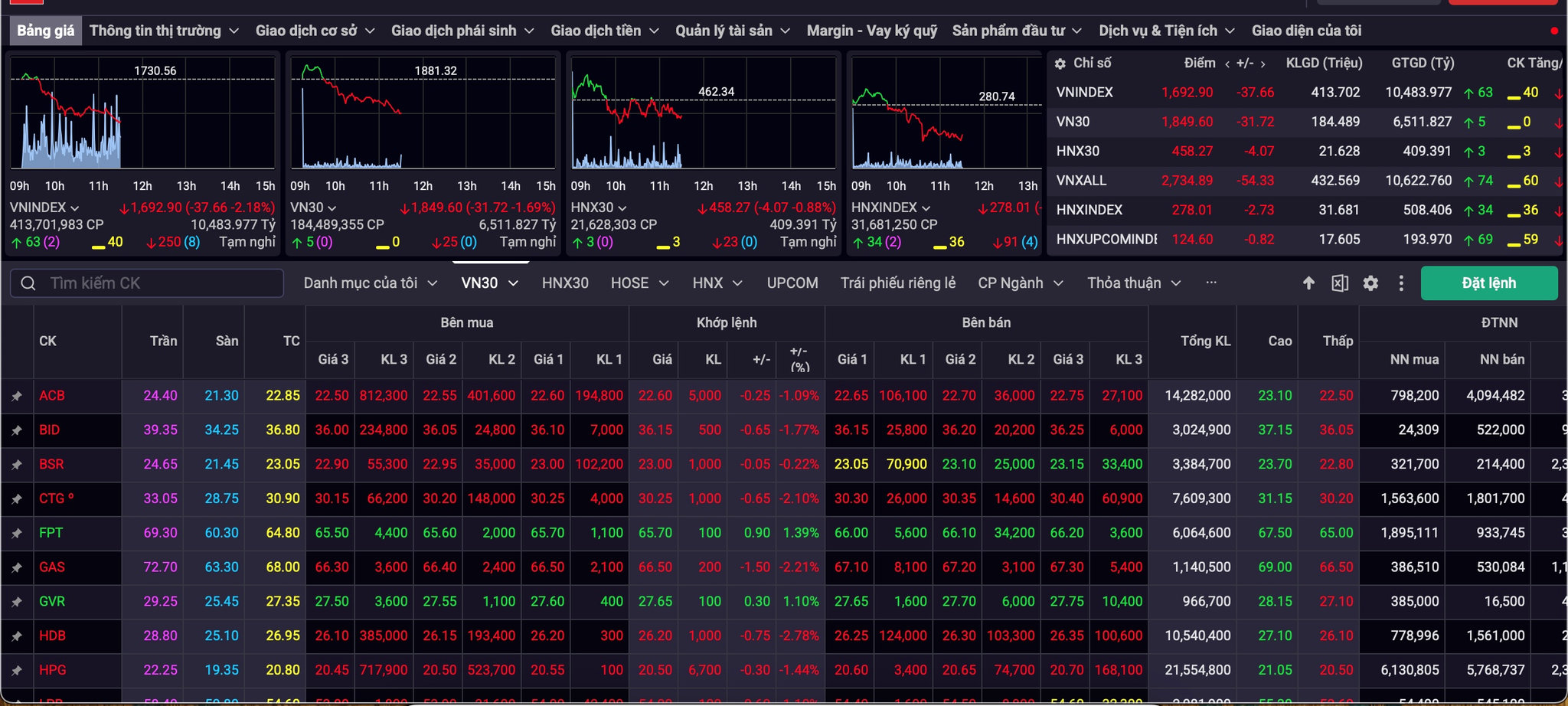
According to experts at AIS Securities Company, the VN-Index maintained its downward momentum, continuing to test short-term support levels amidst a prevailing trend of active selling pressure.
Red dominated the energy, technology, and infrastructure sectors, while investors began seeking opportunities in a few banking and securities stocks.
With selling pressure still ongoing, the psychological 1,700-point mark will be a key support zone, expected to trigger short-term bargain hunting as many stocks have fallen into an oversold state.
The top priority strategy remains risk management. Investors need to aggressively remove stocks with weak price trends.
According to experts at Asean Securities Company, technically, the VN-Index is showing clear signs of weakness as it closed at 1,731 points, forming a red Doji candlestick below the MA10 and MA20 lines, confirming that selling pressure is dominant amidst technical indicators such as RSI and MFI both falling into the oversold zone (below 30).
Although this situation has the potential for a short-term technical rebound, the downtrend remains dominant, making the risk of retesting nearby support levels real if demand does not improve soon.
In a less favorable scenario, the index could continue to retreat to the support zone at the beginning of the next trading session before establishing a clearer trend towards the end of the day. Therefore, the optimal strategy at this time is to prioritize risk management, reduce holdings when the market recovers, and absolutely avoid using leverage.


