
Blue-chip stocks put pressure on the index, which continued to correct.
Banking, securities, and real estate stocks all weakened simultaneously, putting pressure on the index.
Opening the trading session on the morning of August 17th, the market continued to be in the red as selling pressure emerged across the board. However, the decline was not too significant, and continuous bargain hunting helped the VN-Index recover slightly, maintaining a tug-of-war state as the continuous order matching session began.
After more than an hour of trading, selling pressure increased, causing the red color to widen on the electronic board, pulling the VN-Index back down to near the 1,720 point mark. VIC shares continued to be one of the main factors putting pressure on the index, deducting nearly 3.5 points.
In addition, many leading stock groups such as banking, securities, and real estate also simultaneously corrected, preventing the market from regaining its positive momentum.
In the banking sector, SHB (-0.85%), VPB (-1.2%), HDB (+1.13%), ACB (-0.9%), TCB (-1.25%), and CTG (-0.49%) saw declines. In the real estate sector, VIC (-1.95%), VHM (-1.91%), VPI (-0.99%), NVL (-1.51%), and BCM (-2.9%) experienced declines.
Financial services group: SSI (+1.28%), VIX (-0.37%), VCI (-0.92%), VND (-0.31%), MBS (-0.31%) and HCM (+0.4%).
At the close of trading, the VN-Index fell 9.81 points to 1,719.27 points (-0.57%) compared to the previous session. Similarly, the HNX-Index decreased by 276.19 points (-1.36%), equivalent to 3.8 points. Meanwhile, the UPCoM-Index increased by 127.18 points (+0.01%), equivalent to 0.01 points.
Market liquidity reached VND 6,062.3 billion, with 224 million shares traded. Across the sector, 101 stocks increased, 178 decreased, and 65 fell below their reference price.
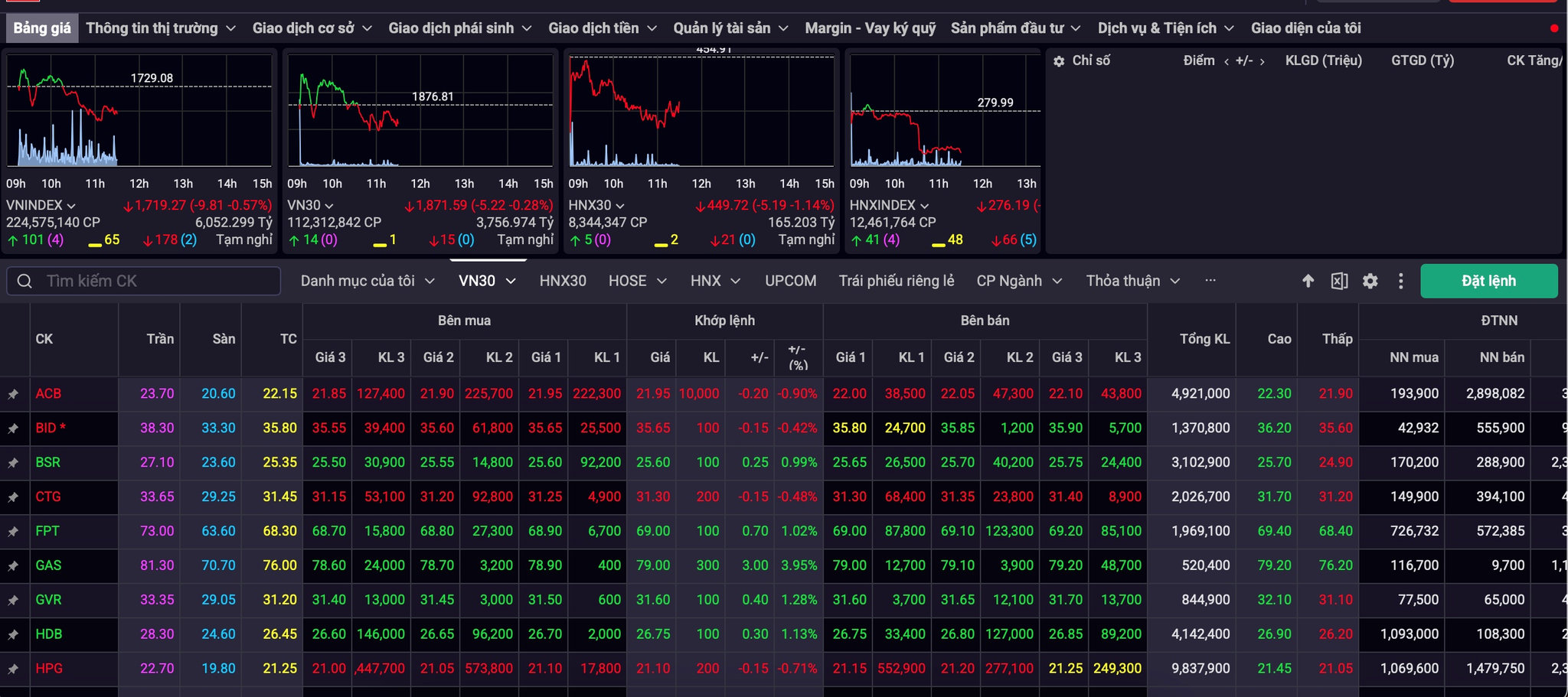
According to experts at Asean Securities Company, in the last trading session of the week, the VN-Index showed signs of weakness, closing at 1,729 points, lower than the MA10 and MA20 lines and leaning towards the lowest price of the day, indicating that selling pressure is dominant in the short term, although it has not yet formed a sharp downward trend.
With RSI(14) indicator retreating to 42 reflecting declining upward momentum, while MFI at 65 shows that money flow is still present, the market is likely to move in a sideways scenario within a narrow range at 1,720-1,730 points before establishing a clearer trend at the end of the session.
Given the current supply-demand equilibrium, short-term investors should maintain a moderate portfolio weighting, avoid chasing rallies, and focus on trading within the support zone of 1,720-1,730 points and the resistance zone of 1,740-1,750 points. They should also prioritize stocks with unique stories, such as those related to state divestment, economic development resolutions, and market upgrade roadmaps.


