
A double-edged sword
Nowadays, everyone understands the immense influence of social media. However, social media is like a double-edged sword; it must be used wisely.
.png)
Nhat Lan |Present:Huu Quan September 20, 2026
While on a business trip, a colleague saw me intently reading an article.The primary school in Vinh Phu ward explains the 30,000 VND lunch fee for students.In an article published in the local newspaper (Baonghean.vn, September 15, 2026), he asked: "Are you also interested in this issue?" Without waiting for an answer, he continued: "I also have a child studying at Ha Huy Tap 2 Primary School. Every day when my child comes home, he always asks about the food at school, and he always replies, 'The food at school tastes better than Mom's cooking...'"
To be honest, I initially didn't pay much attention to the information about the 30,000 VND school lunch at Ha Huy Tap 2 Primary School circulating on Facebook. The internet is full of unverified information, and countless manipulated images and videos... However, when the press started reporting on it, and even our local newspaper published an article, I couldn't help but read it. Even after my business trip, I still looked for comments and discussions on several Facebook accounts.
Among these, I paid particular attention to the status "Exposing Scandals" by Facebook account Nguyen Khac An, because it contained humorous, witty analyses, and importantly, they were accurate.
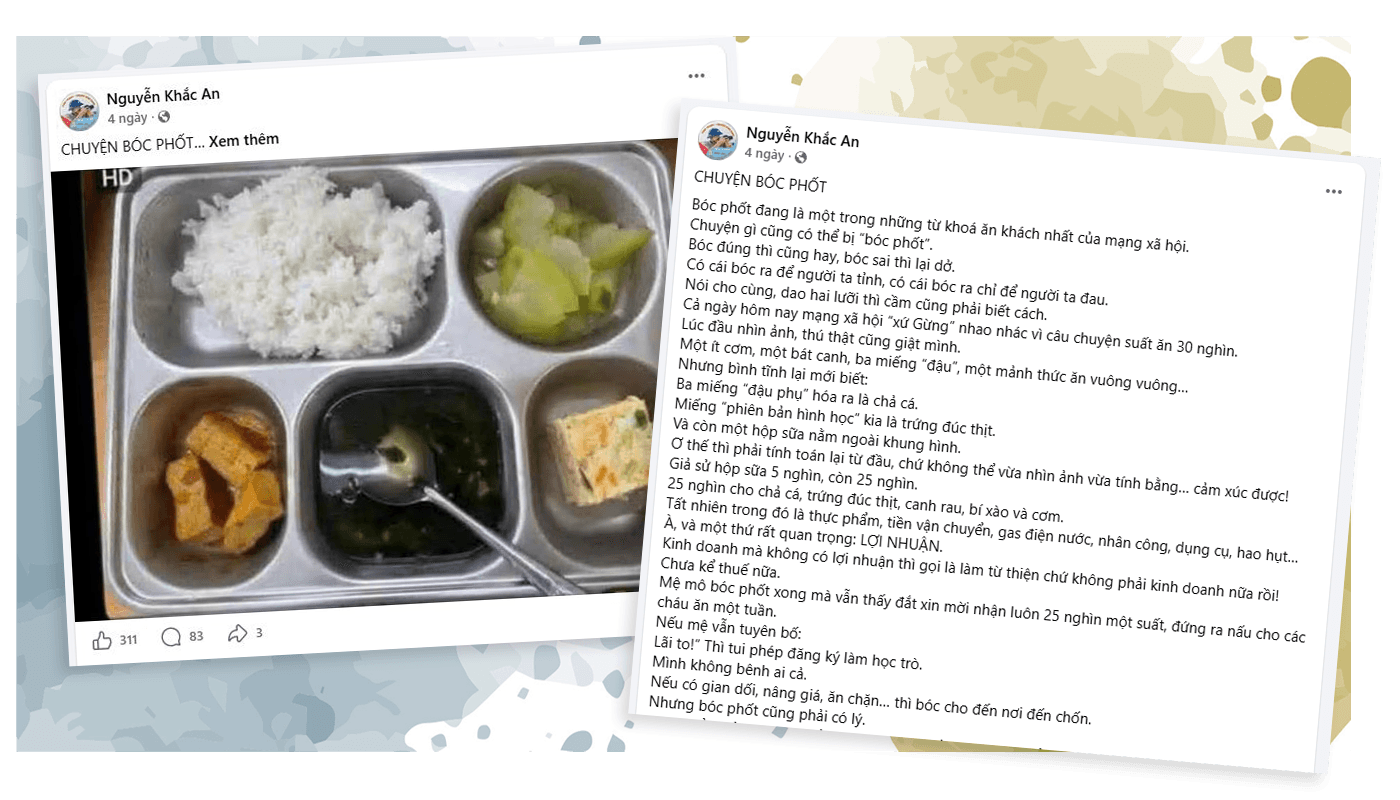
There, Facebook user Nguyen Khac An "confessed" that he was initially "shocked" when he saw the image of a small amount of rice, a bowl of soup, three pieces of "tofu," and a square piece of food. But when he learned that the three pieces of "tofu" were actually fish cakes; the "geometric version" was an egg and meat omelet, not to mention a carton of milk outside the frame, he asserted that one cannot judge a picture based on... emotion alone.
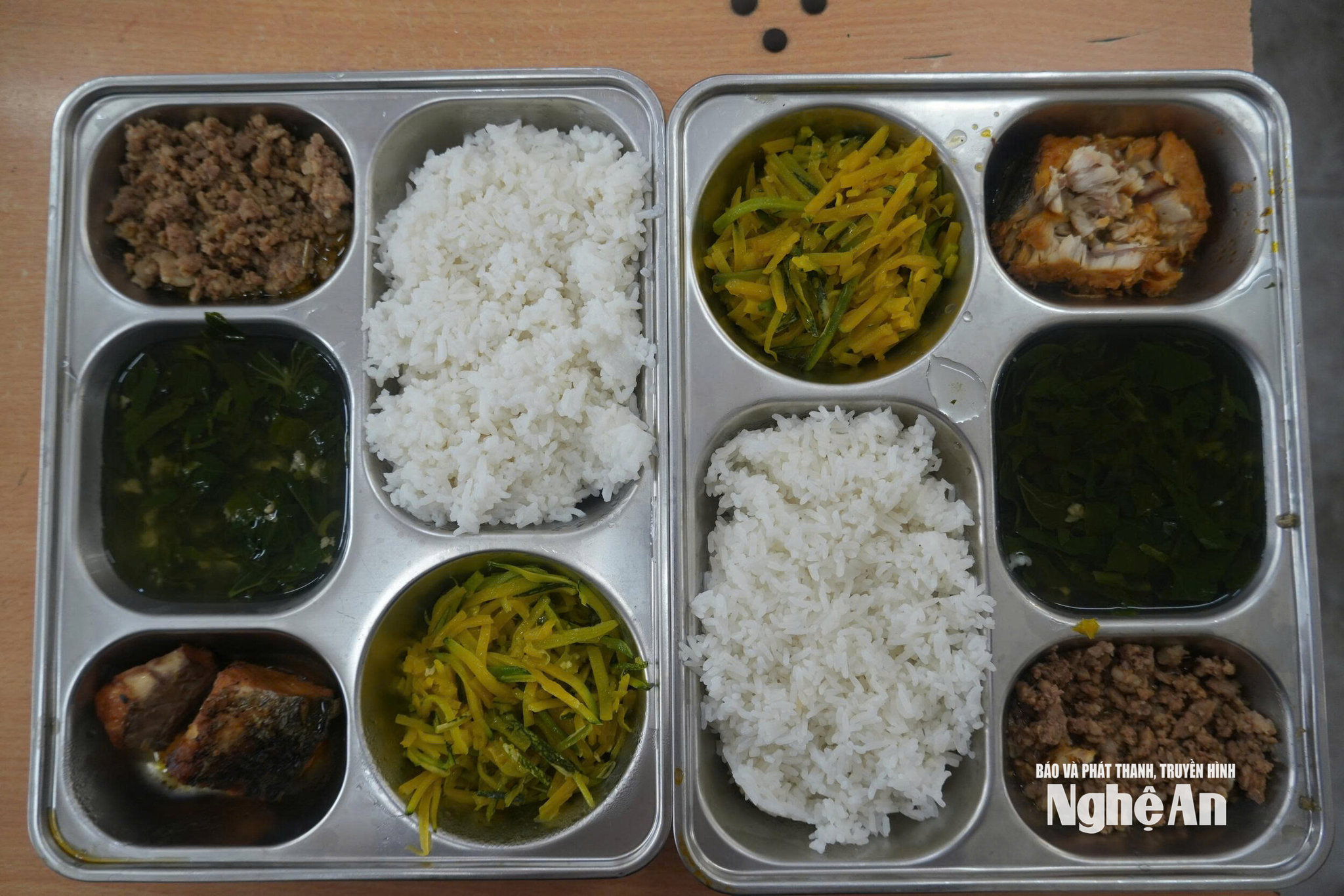
Facebook user Nguyen Khac An did the math: Assuming a carton of milk costs 5,000 VND, the cost of a meal with fish cake, meatballs, vegetable soup, and stir-fried squash is 25,000 VND; in addition, there are costs for transportation, gas, electricity, water, labor, utensils, spoilage, etc., not to mention taxes and business profit. In conclusion, Nguyen Khac An suggested: “If you’ve exposed the scam and still think it’s expensive, please accept 25,000 VND per meal and cook for the children for a week. If you still claim ‘Big profit!’, then I’ll gladly register as your student! And he added a summary: “Exposing the right things is good, exposing the wrong things is bad. Some things are exposed to make people realize the truth, some are exposed to cause pain. Ultimately, a double-edged sword must be handled with the right hand.”
Based on the above analysis, while I share parents' concerns for their children, I believe that posting images and comments on Facebook is an immature act that does more harm than good.
Nowadays, everyone understands the immense influence of social media. However, social media is like a double-edged sword; it must be used wisely.
A photograph of a school lunch tray cannot accurately reflect the nutritional quality of a meal, much less objectively and accurately represent the entire process of providing meals to a school of 1,800 students. Therefore, by hastily choosing to expose the issue on Facebook instead of engaging in direct dialogue with the homeroom teacher or school representatives, parents inadvertently deprived the school of the opportunity to explain the situation. This action did not improve the children's meals; on the contrary, it triggered an unnecessary media crisis.

The consequences of spreading unverified information are truly severe. The first to suffer are the educational environment and the students' psychological well-being. Schools value the teacher-student relationship and close cooperation between families and the school. When trust is shattered by accusatory articles, this relationship becomes strained and filled with suspicion. Teachers and school administrators face public pressure, which can lead to decreased morale and directly impact the quality of teaching.
More dangerously, the students themselves are subjected to gossip and whispers from society, inadvertently drawing them into adult conflicts. Not to mention, posting one-sided information on social media makes it easy for malicious individuals to manipulate public opinion in a negative direction.
.jpg)
Therefore, the most appropriate solution is civilized dialogue and respect for the law. Parents have every right to monitor and demand that the quality of meals be commensurate with the money they spend to ensure their children's health. Instead of venting their anger, parents should proactively report issues through the Parent-Teacher Association or directly meet with the school's administration to request the exercise of their right to monitor. A frank confrontation with the full participation of all relevant parties will help clarify all hidden aspects: from food inspection and processing procedures to the balance of revenue and expenditure.
If the school commits any wrongdoing, the authorities will handle it strictly according to regulations. If it's just a technical issue or perhaps a misunderstanding, both sides will easily find common ground. In short, in the educational environment, families and schools need to treat each other with respect, trust, and a constructive spirit; only then can they create the safest and most secure environment for children's development.
.jpg)


