
The craze for hunting wild chickens as a snack with drinks.
(Baonghean.vn) - 'Sơn kê' is the medicinal name for the meat of wild chickens. Currently, eating wild chicken and raising wild chickens as pets is a 'trend' among many people, especially wealthy individuals..
The "killers"
 |
| A trap for catching wild chickens. The trap is made from bicycle brake cables attached to a nylon rope to form a noose. Photo: Tien Dung. |
After traveling over 10 kilometers through the forest, we arrived at the home of Ha, a renowned chicken hunter in Tay Thanh commune, Yen Thanh district (Nghe An province). Ha's house nestled at the foot of a mountain, surrounded by vast forests of trees such as melaleuca, acacia, and eucalyptus. According to hunters, Ha currently owns the "best" rooster in the region because its crowing is so beautiful that it can attract both wild roosters and hens from afar. Ha covered his mouth with his hand and called out a few times, and suddenly a multicolored wild chicken on a branch in front of the house swooped down and landed on his shoulder. Ha affectionately stroked the chicken's back and said, "This 'Divine Rooster' has helped me earn millions of dong. Many people have offered to buy it for 5 million dong, but I won't sell it."
After a drinking session with the newly trapped chicken, Ha grabbed his tools, hopped onto his noisy motorbike, and we rode over 7 kilometers through the winding forest to the Bo Bo mountain range, the border between Yen Thanh, Tan Ky, and Quynh Luu, to conduct a wild chicken hunting experiment.
Ha's equipment was quite simple: a "divine rooster" as bait and 10 snare traps. The place we went to was a valley with many dense bushes, near the villagers' fields. Ha continued to lead me deeper into the forest, choosing an open space on a hill covered with melaleuca trees to set the snare traps.
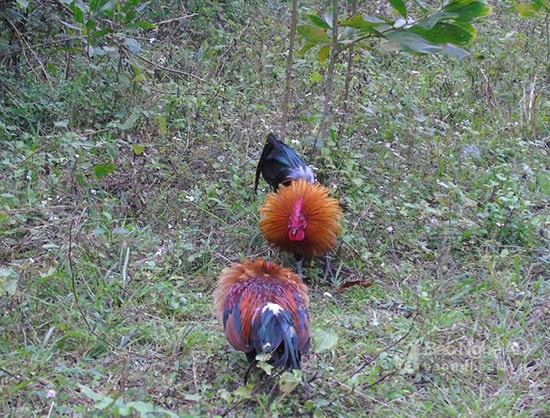 |
| A wild chicken is about to fall into a trap as it flies out to fight with the decoy chicken. Photo by Tien Dung. |
Ha tied all ten traps to tree trunks in the forest, hammered nails into the ground, and covered them with dry leaves. Then he placed a decoy chicken in the middle. Ha said: "Wild chickens are very clever, so you have to move quietly, avoiding noise. If you make any noise, they won't come." After setting the traps, we hid in a thicket, holding our breath and waiting.
True to its reputation as a legendary rooster, when Ha set the trap, the decoy rooster remained completely silent. But once we were hiding, Ha covered his mouth with his hand and signaled, and only then did the legendary rooster obey its master, stretching its neck and crowing loudly throughout the mountains and forests.
The decoy rooster crowed a few times, then stood still to rest. Every 5 minutes or so, it would crow provocatively again. About 20 minutes later, we heard the wild rooster's call from deep in the forest in response. It was exciting to see the beautiful wild rooster crowing and hopping from tree to tree before landing on the ground.
It ruffled its neck feathers, glaring at the decoy – the intruder in its territory – as if ready to strike, but still maintaining a distance to assess the situation. At that moment, the decoy also stretched its neck and crowed provocatively. Unable to bear it any longer, the wild rooster, enraged, lunged forward. Suddenly, with a "snap," it was caught by its leg, thrashing about and squawking loudly. Ha winked and smiled, then ran to free the wild rooster and put it in the cage.
Looking at his "prize," Ha exclaimed: "We're so lucky! This one is a five-colored variety, it should sell for over 500,000 dong." Ha added: "There are many five-colored chickens, but five-colored chickens with white ears are extremely rare these days. If you manage to trap one, each one could fetch over 1 million dong."
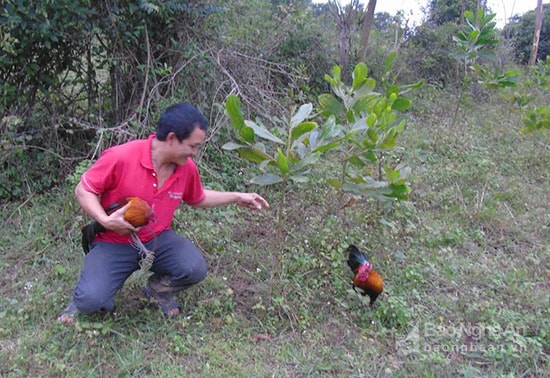 |
| Wild chicken hunters harvest their spoils. Photo by Tien Dung. |
After more than 5 hours of lying in wait, Ha finally managed to trap two roosters. With the current price of wild chicken meat at 300,000 VND/kg and ornamental roosters at 500,000 - 1,000,000 VND each, the two roosters he just trapped would fetch nearly 1 million VND if sold. It was truly a lucky day for a chicken hunter.
To learn more about the poaching of wild chickens, we traveled to the mountainous districts of Tan Ky, Do Luong, Anh Son... In these areas, the trapping of wild chickens is even more prevalent than in the lowland forest regions. Not only are traps used, but many people also carry flintlock guns and sporting rifles to hunt wild chickens.
Phuong, a hunter in Yen Thanh, said: "We go into the forest for a day and a night and can shoot around a few dozen chickens. These spoils can fetch over 200,000 dong per dead chicken when sold to specialty restaurants."
According to our research, hunting wild chickens is not only a livelihood for farmers but also a hobby for some wealthy individuals who drive luxury cars and carry sports rifles. These wealthy individuals even bring along imported liquor, electric grills, and other equipment for hunting trips lasting several days...
Are wild chickens going extinct?
Currently, the hunting of wild chickens is increasing like a fever throughout the forests of Nghe An province. According to an official from the Forest Protection Department of Tuong Duong district, the hunting of wild chickens not only puts this "forest bird" species at risk of extinction and disrupts the ecological balance, but it also poses many safety risks to the forests.
Reportedly, in response to the poaching of wild chickens, the Forest Management Board has coordinated with the Nghe An Forest Protection Department to implement various preventative measures.
However, in reality, the hunting of wild chickens is still increasing, and many markets and restaurants in Nghe An province still openly sell wild chickens...
Due to their rarity and soaring prices, some people have been quick to buy wild chickens they've caught and successfully domesticated them, like Mr. Nguyen Vinh in Hop Thanh commune, Yen Thanh district. Currently, he has bred dozens of wild chickens to sell as breeding stock and as ornamental roosters, earning tens of millions of dong in profit each year. This is considered a new direction for some farmers to expand the rare wild chicken breed facing extinction, and as a means of poverty alleviation and wealth creation.
The nutritional composition of wild chicken meat includes 24.4% protein, 4.8% lipids, 14 mg% calcium, 263 mg% phosphorus, 0.4 mg% iron, and several vitamins. The meat has a sweet taste and is considered warming. According to folk experience, wild chicken meat is used to treat leukorrhea, chronic diarrhea, and weakened libido when cooked. Wild chicken meat can also treat poisoning from wild lychees, and relieve muscle and bone pain, especially tremors in the limbs (rooster feet are best). |
Tien Dung


