
Where is the village gate now?
(Baonghean) - Along with the banyan tree, the well, the village square, and the village gate, these sacred landmarks are intimately connected to generations born in the village. For those who have left their hometown, these sacred relics evoke a deep and enduring longing when they remember them.
Anyone born in a village is undoubtedly familiar with the village gate. The village gate is the eye, the soul, and the character of the countryside. Through the ups and downs and changes of history, the village gate stands as a testament, a unique cultural imprint bearing the identity of the rice-farming agricultural society.
The elders still remember that, in the old days, the village would build a gate and assign guards to watch over it, to protect against invaders and thieves. If anything unusual happened, they would sound a drum or gong to alert the villagers. The gates were built with shells, or better still, with bricks or simply bamboo, extending on both sides to encircle the village, often surrounded by canals and ditches... In some places, the village gate was very simple, a hundred-year-old banyan or kapok tree casting its green shade was also considered the village gate.
For generations, the village gate has been the spiritual gateway, the heartbeat of time, and the very soul of the bamboo groves, tiled roofs, and rows of betel trees. The gate is where life, blessings, and good fortune welcome prosperity to the village. It has witnessed countless joys and sorrows since the village's founding. Every morning, villagers emerge from it to go to school and to work.
The village gate is where mothers stop on their way home from working in the fields, and where fathers rest after a hard day's plowing. There, village children find endless joy in traditional games. The village gate is also a place that children far away fondly remember...
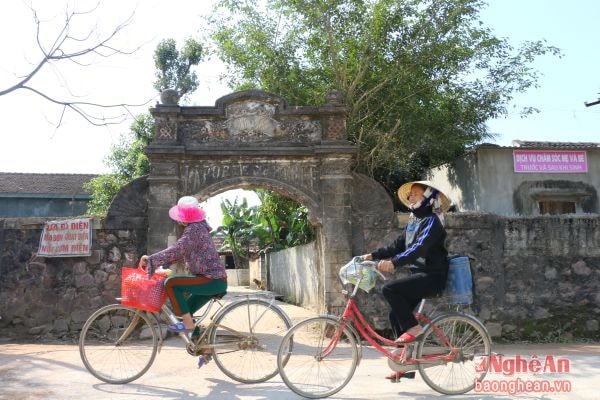 |
| The gate of Vinh Yen village, Dien Loc commune (Dien Chau district). Photo: Song Hoang |
Somewhere amidst the hustle and bustle of life, the image of home stirs in the mind, urging footsteps to return. How many people have been moved when standing before the moss-covered village gate, imbued with the colors of the past? The whispers of the ancient banyan tree, the deep bamboo groves of summer, the swaying kapok trees of March possess a powerful, unwavering force, transcending the boundaries of space and time. Simply because it is "a piece of the village soul"—a soul deeply imprinted, etched into the very blood and bones of every person far from home.
I once heard a story about an old soldier who had spent more than half his life wandering, nearing the end of his life. But he had a burning desire to return to his hometown, to personally roll up his sleeves and touch the steps of the village gate where he was born and raised one last time, so that he could die content. Finally, overcoming all difficulties and obstacles, his descendants brought him back to fulfill his wish. But when they arrived... the old man was still there, but where was the village gate? The old soldier, with a distant, melancholic gaze, his eyes welling up with tears at the changes, his white hair fluttering in the twilight of a cold winter day...
Because they believe the old, narrow village gates are no longer suitable for the widened concrete roads, hindering the access of motorbikes, cars, farm vehicles, and even heavy trucks serving the essential needs of modern life, many villages have now demolished their century-old gates and replaced them with large, welcoming gates.
There are village gates so huge it's hard to imagine, leaving passersby stunned and bewildered. Moreover, the gates built later are even grander and more imposing than the earlier ones, seemingly to "match" the new rural landscape, the high-rise buildings, and the villas in the village. Despite their size and grandeur, the new village gates still feel monotonous, soulless, and out of place.
In fact, many places don't even have village gates or entrance arches; there's just a straight, empty road leading into the village. Many people would surely get lost, unable to distinguish the boundaries between villages, not knowing where the beginning or end of a village is.
The village gates are gone; where will those who have left their homes find solace, where will they find the landmark of memories to return to? Will children, growing up, still remember they were born in the village, cherishing the profound values of their homeland? Don't blame the market economy and the rapid urbanization of rural areas for the disappearance of familiar village gates, because someone once said: "Love for one's home, village, and homeland becomes love for the Fatherland."
It would be incomplete and lacking in depth if love for one's homeland did not stem from objects imbued with cultural and spiritual significance, simple and rustic like village gates. Innovation is necessary, but it is essential to preserve and protect the values that constitute the soul and character of the countryside.
Nguyen Hoe
| RELATED NEWS |
|---|


