
COP21: 7 key points in the draft climate agreement
(Baonghean.vn) - On December 11, French Foreign Minister Laurent Fabius, also the President of the COP21 conference, announced that the release of the final draft on combating climate change would be postponed from December 11 to December 12 in order to allow time for "further consultation with all parties".
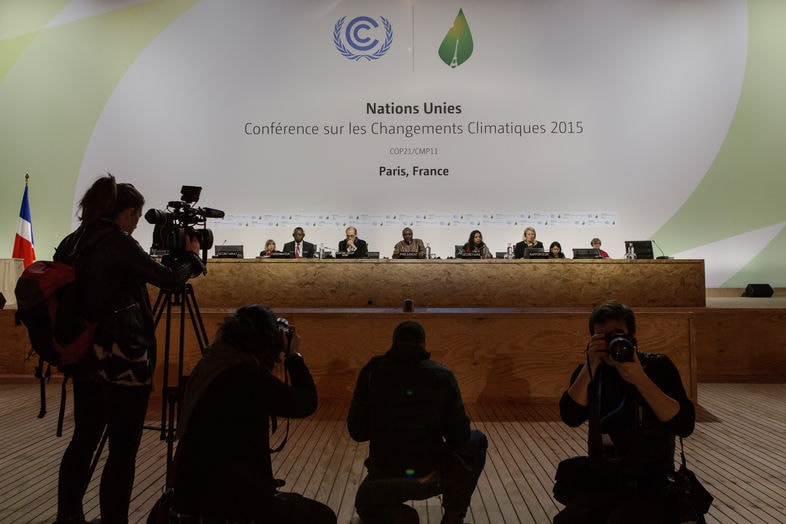 |
| The morning session of the COP21 conference on December 11th. Photo: Le Monde |
Earlier, on the evening of December 10th, Laurent Fabius announced a new draft agreement on combating climate change, now 27 pages long instead of 29 pages, with 7 main points.
First, regarding the overall ceiling for warming.
At the 2009 Copenhagen climate conference, negotiators agreed to keep global warming at a maximum of 2°C. However, the most vulnerable countries, including island nations threatened by rising sea levels, demanded that global warming be reduced to 1.5°C. Therefore, the draft agreement decided on an intermediate figure of “below 2°C.” This figure was considered “a fair compromise” by the World Wide Fund for Nature and Humanity and is stipulated in Article 2 of the agreement, becoming a universal target for all countries.
Secondly, regarding the distinction between rich and poor countries.
Since the start of the COP21 negotiations, this issue has been at the heart of the debates. Although Article 3 of the draft stipulates that "developed countries must continue to take the lead" in efforts to reduce greenhouse gas emissions, according to Foreign Minister Laurent Fabius, the parties have yet to resolve this question.
Thirdly, regarding finances.
Article 6 of the draft states that “developed countries shall provide (new), (additional), (adequate), (proposed), (simple), (sustainable), and (increasing) financing to support developing countries in mitigation and adaptation.” Negotiators have yet to decide on the wording in the parentheses to finalize Article 6. According to the draft, developed countries pledge to mobilize $100 billion by 2020 to assist poorer countries. This amount will increase after that period. Ultimately, the financial sharing between adaptation and mitigation must be balanced, strategically national, and prioritized.
Fourth, regarding damages and compensation,
This issue, which is inherently related to finance, is also a favorite concern for vulnerable countries already impacted by global warming. While countries recognize the importance of addressing this issue, conceptual differences between developed and developing nations prevent them from reaching a consensus.
Fifth, regarding long-term goals,
A plan to reduce greenhouse gas emissions will be put forward by countries participating in the COP21 conference before 2030. Article 3 of the draft on mitigating global warming proposes the goal of "neutralizing greenhouse gases (GHGs) in the second half of the 21st century" and then reabsorbing emitted GHGs.
Sixth, regarding the re-examination mechanism,
Article 10 of the draft establishes a “global review table” of progress toward the agreement’s goals, with the first meeting to take place in 2023 (the Paris Agreement, if successful, would enter into force in 2020) and then to be reviewed “every five years”.
Saturday, regarding the issue of transparency,
Article 9 of the draft provides three options: creating a framework that “distinguishes between developed and developing countries,” a “unified” framework, or one that “takes into account the differing capabilities of the parties.” The draft will leave transparency “flexible” for developing countries, depending on their capabilities.
Chu Thanh
(According to Le Monde)
| RELATED NEWS |
|---|


