
The revolution changed Russia.
The October Revolution of 1917 in Russia was a historical event that had a profound impact on the development of Russia and the entire world.
November 7th marks the 104th anniversary of the Russian October Revolution, which established the Soviet state. The event began on October 24, 1917, according to the Julian calendar, led by Vladimir Ilyich Lenin and the Bolshevik Party. The revolution was successful on October 25, 1917, according to the Julian calendar, which corresponds to November 7, 1917, according to the Gregorian calendar used today.
Early 20th-century Russia was an absolute monarchy under the rule of Tsar Nicholas II, who plunged the country into World War I, causing serious consequences. The Russian imperial economy was devastated by the war, famine occurred in many places, industry and agriculture stagnated, and the lives of the people were extremely difficult.
The Russian imperial family was also manipulated by the cleric Grigory Rasputin. Anti-war movements demanding the overthrow of the Tsar were widespread.
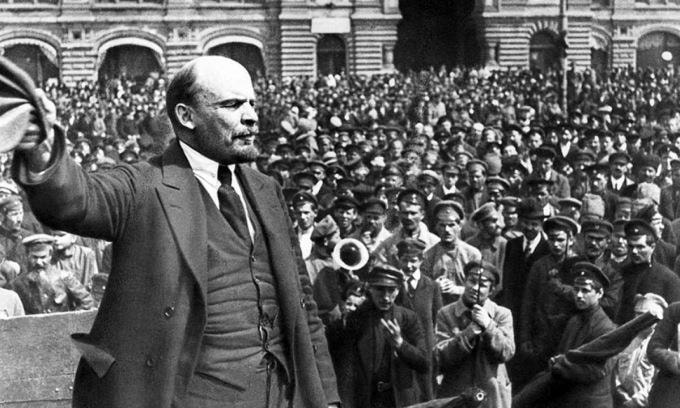 |
| Vladimir Ilyich Lenin speaking to the people in Petrograd in 1917. Photo: Britannica. |
In February 1917, the February Revolution erupted with large-scale anti-war demonstrations and collective strikes. The movement quickly transformed from a general political strike into an armed uprising, leading to the overthrow of the autocratic Tsarist monarchy. The February Revolution is considered a bourgeois democratic revolution.
Following the call of the Bolshevik party, workers and soldiers formed Soviets of Deputies, representative bodies to lead the country, while the bourgeoisie also formed a provisional government. After the February Revolution, Russia had two parallel governments led by these two forces.
The provisional government failed to address the issues it had promised, such as land reform for farmers and job creation for workers. Food shortages persisted, and the provisional government remained determined to continue the war.
Faced with this situation, Lenin, the leader of the Bolshevik party, determined that it was necessary to overthrow the bourgeois provisional government and transition from a bourgeois democratic revolution to a socialist revolution, with the slogans "All power to the Soviets" and "Peace, land, bread".
On October 24, 1917, the uprising began under the direct leadership of Lenin. The Red Guards, a volunteer armed force of workers and peasants, concentrated their forces to seize key areas, ministerial headquarters, telephone exchanges, train stations, and bridges. On October 25, 1917, they attacked the Winter Palace, arresting the ministers of the provisional government.
On the night of October 25, 1917, the Soviet government headed by Lenin was established. The first decrees passed were the "Decree on Peace," condemning war, and the "Decree on Land," aimed at resolving the land issue for peasants.
The Supreme National Economic Council was established to build a socialist economy. The Council was responsible for land reform, abolishing landlord ownership and returning land to farmers. In industry, they nationalized several large factories and implemented advanced labor policies such as an eight-hour workday, prohibiting arbitrary dismissals, and establishing leave entitlements for those engaged in strenuous work.
The Soviet government also implemented measures to eliminate remnants of the old regime, such as abolishing caste distinctions, ecclesiastical privileges, and implementing a policy of gender equality. Soviet Russia officially withdrew from World War I on March 3, 1918.

Bolshevik soldiers marching in Moscow in October 1917. Photo: TASS.
On January 10, 1918, the Third All-Russian Congress of Soviets opened, adopting the historic decision to reorganize the Russian Soviet Republic into the Union of Soviet Socialist Republics. The Union of Soviet Socialist Republics (USSR) was subsequently established on December 30, 1922.
The October Revolution was one of the most influential events of the 20th century, marking the birth of Soviet Russia – the world's first workers' and peasants' state – and supporting the national liberation struggles of colonial countries. At that time, most Asian and African nations were colonized by Western powers. The victory of the October Revolution provided impetus for their national liberation struggles.
According to the Communist Party of the Russian Federation, the October Revolution not only shook the world because of its scale, but also laid the foundation for the maintenance, stable development, and progress of the world, aiming to end exploitation between people and build a just society and socialism.
"The October Revolution illuminated humanity's path into the era of space exploration, creating a way to harness nuclear energy and use it for peaceful purposes, opening a path forward for everyone, towards peace and progress," a statement from the Communist Party of the Soviet Union in 2017 read.
In his book *History of the October Revolution*, historian Geoffrey Swain portrays the revolution as a combination of an uprising led by the Bolshevik party and the anger and discontent of the Russian working class with the Tsarist regime.
"No event in the 20th century could have changed the course of world history or had such profound results as the October Revolution," said Geoffrey Roberts, a history professor in Ireland.


