
The battle for the Moon is about to begin.
Amidst the growing number of countries and companies investing in lunar exploration and exploitation plans, organizations and experts have urged the United Nations (UN) to establish common laws to "manage" the Moon before it's too late.
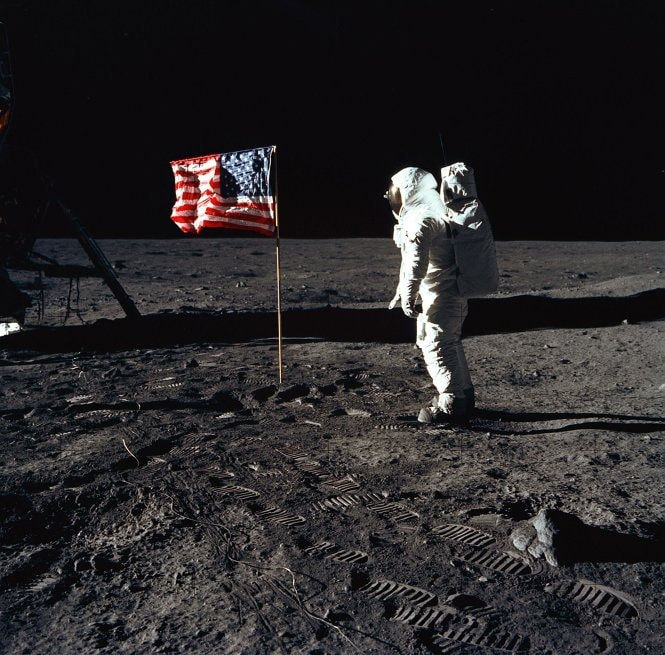 |
| Astronaut Neil Armstrong in this historic photo from July 20, 1969, when he set foot on the Moon and planted the American flag there - Photo: NASA |
One story that recently attracted much public attention was the auction of a bag containing soil and rock samples brought back by American astronaut Neil Armstrong in New York, held on the 48th anniversary of Armstrong's first steps on the moon.
The story wouldn't have been so sensational if it weren't for a past mix-up that led to NASA losing a lawsuit to regain ownership of the bag against the buyer, lawyer Nancy Lee Carlson in Chicago.
That legal battle was actually just a very small part of the larger issues related to the field of space exploration.
And that is likely why the For All Moonkind organization is urging the UN to quickly enact laws to protect the sites where the six Apollo missions landed and the artifacts recovered from the Moon, to avoid disputes similar to the Armstrong bag incident.
Is there a need for laws on lunar exploration?
According to Bloomberg, the fundamental legal basis for space activities is the 1967 UN Outer Space Treaty. The central tenet of this treaty is the assurance that outer space is not the sovereign or property of any single nation.
The treaty also prohibits testing nuclear weapons in space and does not restrict the use of the Moon or other space features for peaceful purposes. The United States has signed this agreement.
In 1979, the UN General Assembly also adopted the Lunar Agreement, which stipulated that the Moon's natural resources are "the common heritage of mankind."
At the same time, a new international body would manage the use of those resources “because the exploitation of these resources would become entirely feasible.” However, the U.S. and most countries with space programs did not sign that agreement.
On the other hand, some countries, including the United States and Luxembourg, have passed other laws that recognize the legal ownership of resources that private companies obtain from space.
While legal scholars are still debating whether such laws conflict with provisions already stipulated in the Outer Space Treaty that oppose states' claims to space resources, the reality is that nations and private companies are eagerly investing in and developing space exploration projects.
Michelle Hanlon, a lawyer in Connecticut, argues: "What we need to do is create, essentially, a UNESCO-like agency for space." She explains: "We need to discuss the commercialization of space; right now, there's nothing like that."
In fact, NASA raised this issue six years ago, at the time of the Apollo 11 mission anniversary, in a detailed report titled "How to Protect and Preserve the Historical and Scientific Value of U.S. Government Lunar Relics."
The Moon - a future mining opportunity?
Located approximately 239,000 miles (384,633 km) from Earth, the Moon is a large and relatively close planet with abundant reserves of helium and other resources. At least five nations currently have plans for lunar exploration and manned missions.
Among other things, China is also busy assessing the potential for exploiting helium-3, a non-radioactive isotope that is very rare on Earth, but extremely abundant in the Moon's outermost crust.
In 2013, China became the third country to successfully make a "soft" landing on the Moon, subsequently using a rover to explore the Moon for over two years. The country also plans to launch another probe, Chang'e 5, in 2018 and collect lunar soil samples.
According to its ambitious roadmap, Beijing plans to send a man to the moon by the mid-2030s.
Meanwhile, India's Chandrayaan-2 unmanned spacecraft is also being designed to make a "soft" landing on the Moon in 2018. American billionaire Elon Musk once announced that his space transportation company SpaceX had a contract to send the first two tourists on a trip around the Moon in 2018.
Also next year, Google's Lunar X Prize will award $30 million to engineering teams that can successfully launch, land, and operate a vehicle on the surface of the Moon.
Meanwhile, both Russia and Japan are also considering their own manned moon missions. Even the US has announced plans to return to the moon after NASA recently admitted it lacked the funds to send humans to Mars.
The UN's International Court of Justice could be the venue for international disputes; however, it remains unclear where disputes concerning cultural or commercial property related to the Moon would be heard.
And for concerned organizations like For All Moonkind, this legal vacuum is clearly no longer a story for the future.
|
According to TTO
| RELATED NEWS |
|---|


