
Electric vehicle software race: BYD leads the market with hundreds of OTA updates.
Electric vehicle manufacturers are shifting their competitive focus to the speed of over-the-air (OTA) software updates. BYD plans a record 200 updates in 2025 to extend vehicle lifespan and generate new revenue.
In today's electric vehicle era, software has become a key factor shaping the competitiveness of automakers. Corporations like BYD are leveraging over-the-air (OTA) updates to extend product lifecycles and unlock new revenue streams from services, rather than relying solely on traditional hardware sales.
The incredibly fast update speed of Chinese car manufacturers.
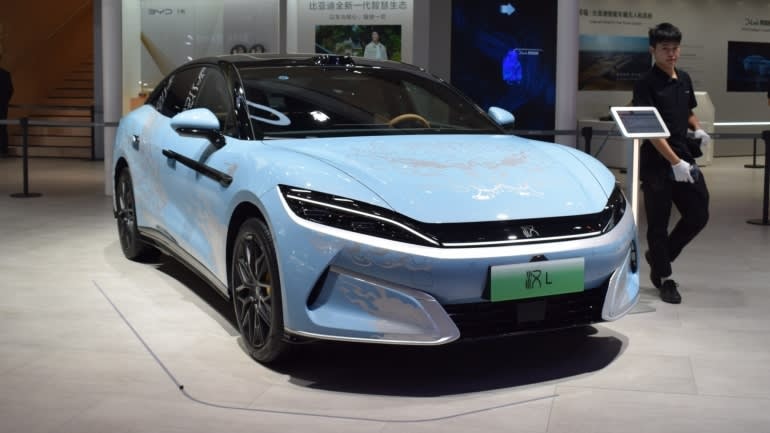
In mid-February, BYD announced the latest OTA update for the Han L sedan – a model expected to launch in April 2025. Notably, this is the fourth update in less than a year since the model's introduction. The focus of the upgrade is the integrated AI-powered driver assistance system, which improves accuracy in recognizing and handling complex traffic situations.

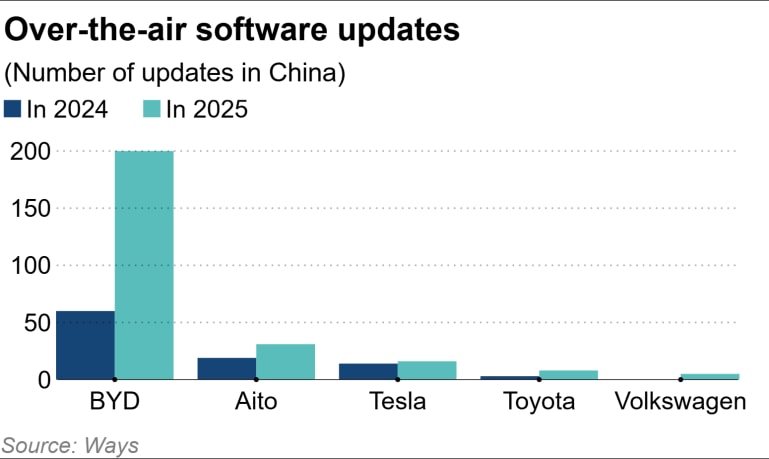
According to data from research firm Ways, BYD leads the market with 200 software updates for its Ocean and Dynasty models in 2025. This capability stems from BYD's complete self-reliance in semiconductor design, operating systems, and hardware execution. Company representatives assert that designing all components in-house allows for faster and more accurate update deployment.
| Car company | Number of updates (in 2025) |
|---|---|
| BYD | 200 |
| Renault | 16 |
| Toyota | 8 |
| Volkswagen | 5 |
Changing the mindset about the vehicle lifecycle and business model.
Over-the-air (OTA) technology is fundamentally changing the concept of the automotive lifecycle. Instead of waiting 6 to 7 years for a complete redesign, software-defined vehicles (SDVs) can receive continuous feature upgrades, similar to smartphones. Isao Sekiguchi, CEO of Dongfeng Nissan, believes that today's consumers demand continuous vehicle development via OTA to maintain freshness.
Toyota is also leveraging this technology to extend the new car sales cycle for its flagship models from 7 years to 9 years. Improving performance through software without changing physical components helps maintain the resale value of the vehicle, thereby reducing the financial burden on users when they need to upgrade their car.
Challenges in generating revenue from software
While OTA updates offer many benefits, transforming this technology into a stable revenue stream remains a challenge. In China, most updates are still offered for free. However, automakers like Tesla and XPeng are pioneering the subscription model.
Tesla currently offers a full self-driving system for $99 per month in North America. Meanwhile, XPeng CEO He Xiaopeng plans to charge users once the company achieves Level 4 autonomous driving capabilities. This is seen as a strategy to maintain stable revenue amidst signs of saturation and fierce price competition in the global electric vehicle market.


