
The race for the Elysée Palace: Many surprises from the preliminary rounds.
(Baonghean) - The unexpected victory of right-wing and centrist candidate Francois Fillon, President Francois Hollande not seeking a second term, Prime Minister Manuel Valls officially announcing his candidacy… These events show that the race for the Elysée Palace is becoming increasingly unpredictable.
On December 6th, Manuel Valls submitted his resignation as Prime Minister of France to President Francois Hollande after announcing his candidacy for the French presidency in 2017. Earlier, on the afternoon of December 5th in Evry, Valls officially announced his joining the ranks of candidates vying to represent the left in the race for the Elysée Palace. A new government will be formed immediately after Valls's resignation to lead France in the remaining months before the presidential election.
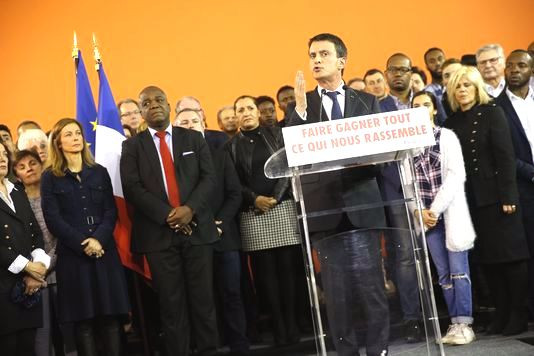 |
| Manuel Valls announced his presidential candidacy in Evry, the city where he previously served as mayor and member of parliament. (Photo: Le Monde) |
According to many commentators, Prime Minister Valls's candidacy was predictable since President Hollande unexpectedly announced on December 1st that he would not seek a second term. Hollande is reportedly the first incumbent president not to seek re-election since the founding of the Fifth Republic in 1958.
Currently, according to the latest polls among left-wing voters, Valls is considered one of the strongest candidates among the seven left-wing and Socialist Party (PS) candidates. Despite his high regard, Valls still needs to garner more support from other factions within the left wing. Without the right strategies, his chances of winning the left-wing elections on January 22nd and 29th, 2017, could be jeopardized.
However, if he becomes the representative of the left, the next challenge for Valls will still be internal divisions, as the two candidates Jean-Luc Melenchon and Emmanuel Macron have announced they will not participate in the left-wing primary but will run directly for president. This means that left-wing voters will be severely divided in the presidential election in April 2017.
Currently, right-wing candidate Francois Fillon, National Front candidate Marine Le Pen, and Emmanuel Macron are considered stronger contenders than Valls in the election. However, no one can be certain whether a comeback will occur in the remaining months, given that the 2017 race for the Elysée Palace has been full of unexpected surprises from the start.
Chu Thanh
(According to Le Monde and Le Figaro)


