
A strange journey
(Baonghean)A journey that was already strange, seemingly hopeless and bleak, suddenly became simple and full of good fortune.
After the Nghe An Weekend Newspaper published the story of an American named Thomas who came to Nghe An on a journey to revisit the old battlefield where his father, a former "enemy pilot," was captured alive by the people of Thanh Tien, Thanh Chuong, after parachuting there, many readers showed interest in the story and were pleased with the happy ending.
Our story seemed to end with the image of the American veteran's son returning home, filled with overwhelming emotion and gratitude. Those who remained smiled contentedly, having helped the son fulfill part of his father's wish. A journey that was already strange, seemingly hopeless and uncertain, suddenly became simple and full of good fortune. But things didn't stop there. These days, Thomas is excitedly informing us that this December, he will return to Vietnam to meet more people and see more new evidence. The circle of surprises widens, the forgotten parts of the past are revived, and the path of gratitude deepens even further...
Enhancing memories
Readers interested in this story will surely remember that, in previous articles, we – the storytellers, as well as the people we met: Mr. Bui Bac Van and Mr. Nguyen Van Thu – the first people present and involved in capturing Lieutenant Colonel Walter Eugence Wilber, the American pilot, when his plane was shot down in the Thanh Tien field (Thanh Chuong district) on June 16, 1968 – all thought that this "old lady" F4 plane was shot down by anti-aircraft fire.
But, quite by chance, on one occasion, a special guest, also a friend of the Director of the 4th Military Region Museum, visited and donated artifacts to the Museum. After hearing the story of Thomas's journey recounted by Colonel Nguyen Cong Thanh, the guest unexpectedly revealed: "I know very well about that air battle, and I know even more about the person who shot down the plane piloted by Lieutenant Colonel Walter Eugence Wilber and the deceased pilot Bernard Francis Rupinski."
For a moment, Colonel Nguyen Cong Thanh was stunned, then he connected with Thomas – the son of the American pilot from years ago, who was on the other side of the globe. This special guest spoke to Thomas using his fairly fluent English, honed during his time in the military. And the story from nearly 50 years ago, which seemed to have ended, was unexpectedly continued.
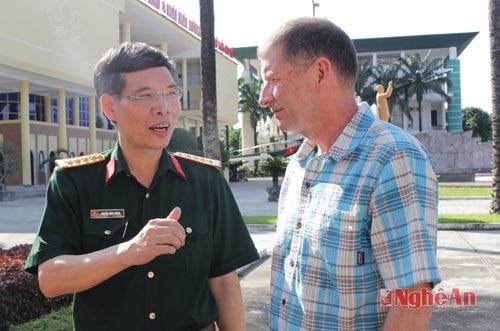 |
| Colonel Nguyen Cong Thanh, Director of the Museum of Military Region 4, and Thomas, son of the American pilot officer shot down over Thanh Chuong on June 16, 1968. |
The special guest we want to mention here is Colonel Nguyen Van Suu, a pilot. Colonel Suu is from Hung Nguyen, but currently lives with his family in Hanoi. He is a veteran pilot of the Vietnamese Air Force. The allure of this journey of gratitude made it impossible for us to ignore this crucial link in the story. So we visited Colonel Nguyen Van Suu's home one late afternoon. The man, now over 60, still exuded the steadfast and proud demeanor of someone who confidently mastered the skies. At the age of 20, Colonel Suu graduated to fly MiG-17s in the Soviet Union, returned to Vietnam, and joined the revolutionary service. With 43 years of military service, including 40 years as a pilot, he had a thorough understanding of everything about the life of the Vietnamese Air Force at that time.
In his small house on Hoang Van Thai Street, Mr. Suu recounted fragments of his memories, telling me about the downing of the plane on June 16, 1968. The person who shot down the F4 piloted by Thomas Wilber that day was Colonel Dinh Ton – a talented pilot whose name is admired, even legendary, by fighter pilots then and now. He was the first Vietnamese pilot to fly over the homeland under the red flag with a yellow star in mid-1958. In December 1973, Colonel Dinh Ton was awarded the title of Hero of the People's Armed Forces.
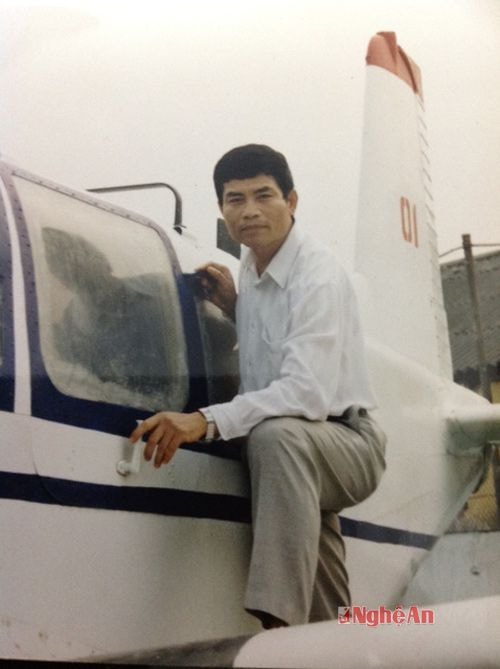 |
| Colonel, former pilot Nguyen Van Suu |
The legend of the talented pilot
Colonel Dinh Ton (born in 1935), whose real name was Nguyen Dinh Ton, was from Hoai Thanh commune, Hoai Nhon district, Binh Dinh province. He joined the army at the age of 17. In 1954, he went to North Vietnam, and four years later, he went to Czechoslovakia to study sports aviation, becoming one of the first seven Vietnamese pilots. In 1961, he went to the Soviet Union to study transport aviation, and after two years, he returned and went back to the Soviet Union to study Gi-1 aircraft. He was both a student and the leader of that trip. Upon his return, Dinh Ton was one of the four best pilots after three years of training in the Soviet Union.
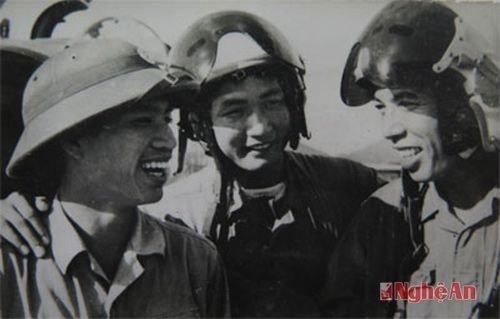 |
| Pilot Dinh Ton (far right), considered the "elder brother" of the Vietnam Air Force. |
In February 1968, Dinh Ton returned to Vietnam. In his first combat mission, this air force officer shot down a drone. In the following months, April, May, and June, he shot down an enemy fighter jet each month. In particular, in the June 1968 sortie, Dinh Ton shot down an F4 piloted by Thomas Wilber. Speaking about Dinh Ton, Mr. Suu couldn't hide his pride and admiration for this exceptionally talented air force officer, one of the most skilled fighter pilots of that time. His eyes sparkled with gratitude, and he always referred to Dinh Ton as "our elder brother."
"In the battle on June 16, 1968, our side participated with two aircraft. Dinh Ton piloted aircraft number 1, and Nguyen Tien Sam (later the Director of the Vietnam Aviation Authority), who was very young at the time, only about 23 or 24 years old, piloted aircraft number 2. The F4 aircraft that Thomas's father was piloting was shot down by Dinh Ton," Mr. Suu said. However, according to the documents that Mr. Suu searched for and researched, there are conflicting accounts of that air raid. In the memoir "60 Years of the Air Force" by Lieutenant General Pham Phu Thai – a comrade-in-arms with Dinh Ton – it is recounted that: "Ton piloted the MiG aircraft and moved at a very low altitude, making it impossible for enemy aircraft and radar to detect. When they managed to detect our aircraft, Ton shot down the enemy aircraft before they could react."
However, the book "Air Battles in the Skies of Vietnam (1965-1975)" published by the People's Army Publishing House states that on that day, there were four American planes circling in the sky. When Dinh Ton suddenly raised his plane, three fled, leaving only the plane piloted by Wilber to turn back. And before they could do anything, Dinh Ton shot them down.
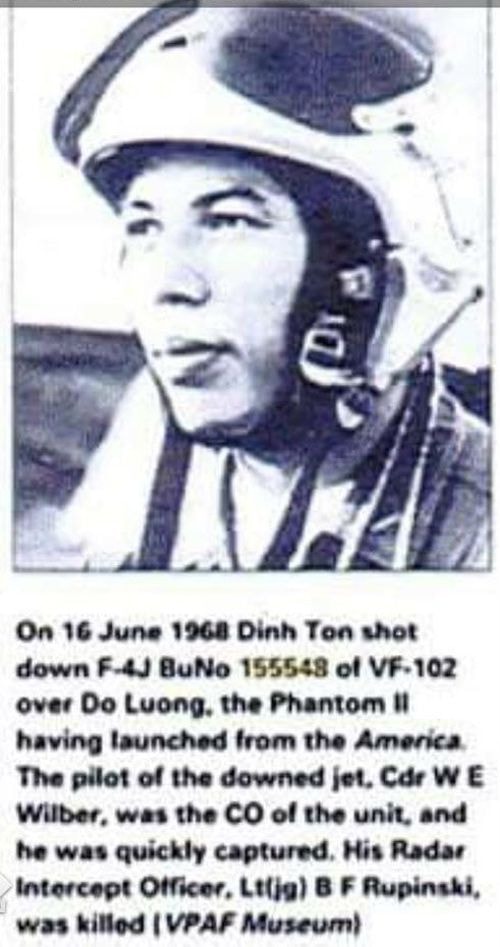 |
| Pilot Dinh Ton and the documentary accounts of the battle on June 16, 1968, published in foreign newspapers. |
Mr. Suu's story prompted us to diligently research more about Hero of the People's Armed Forces Dinh Ton. Although very little information has been published, we were fortunate to find information about Colonel Dinh Ton in the book "The Talented Pilot" by writer Le Thanh Chon. In this book, the writer reveals: "In 1998, J. Pual, a two-star general who commanded one of the American aircraft carriers that fought in Vietnam, sent me a letter. The letter asked me to introduce him to some North Vietnamese pilots who had shot down many American planes so that he could meet and interview them directly for his book about the air battles in the skies over Vietnam."
Among those famous pilots, there is a name at number 7: Dinh Ton, Mig 21 pilot. He particularly noted the battle on June 16, 1968, at Do Luong at 11 a.m. This battle is also vividly recounted by the author in his book. Some sources claim that Dinh Ton was a war martyr, but Mr. Suu and other sources say that he was actually still alive and healthy after the war ended. A little-known fact is that while studying in the Soviet Union, doctors discovered that pilot Dinh Ton showed signs of leukemia, yet it wasn't until after the war, when he had accumulated thousands of flight hours, that the disease worsened and he passed away.
Deeply rooted in the path of gratitude and obligation.
When Colonel Nguyen Van Suu recalls the brutal years in the skies – years when life and death were separated by only a breath – the pain and losses seem to be the most profound. The wounds of war are still etched on his limping legs, forever unhealed.
Yet, the first time Mr. Suu contacted Thomas, he said, "I am a former pilot, but don't forget that I am also a son and a father." From the bottom of his heart, Mr. Suu wanted Thomas to understand that he was ready to put the wounds and losses of war behind him, that he respected his father's wishes and Thomas's desire to fulfill his filial duty. And with all his sincerity, he would wholeheartedly help Thomas on his journey to rediscover that past.
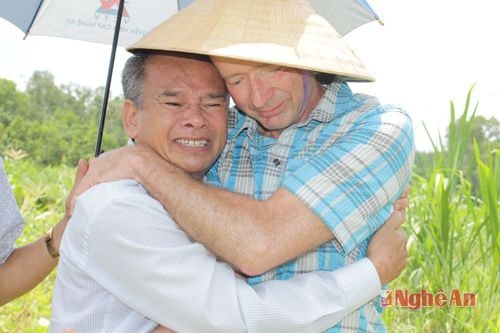 |
| A touching moment between Mr. Bui Bac Van, the man who captured the pilot.Walter Eugence Wilber in 1968and Thomas, the son of that very pilot. |
In Mr. Suu's small living room, books and documents were stacked high. He smiled softly and said that for the past month, his nephew had read countless books and searched for every link on the internet. A man with reading glasses diligently reading and searching for more information to help a stranger, without any reward, what was there besides a sincere and compassionate heart?
With his decent English skills, he meticulously translated every piece of information, every number and date, to ensure that what he knew was as accurate as possible. For the past month, he has practically stopped all his unfinished work to focus solely on this task for Thomas and the planned meeting with this stranger in December.
For Thomas, these days are filled with joy and anticipation. He's happy to have learned such valuable information about his father, and excited about what surprises and wonders await him on this trip to Vietnam. We know that Mr. Suu, like Mr. Thu and Mr. Van, will be three of the millions of Vietnamese people ready to embrace the pain of war, even though some wounds haven't fully healed yet.
We also believe that not only the Vietnamese people on this journey, but anyone among us would be willing to help Thomas with all their sincerity. We asked Thomas why he so desperately wanted to know about the person who shot down his father's plane, and he said: "Those people helped awaken in the former lieutenant colonel the realization of the futility of the war on this land. And peace and love are what we need to do for each other..."
T.Vinh- Q.Hoa
| RELATED NEWS |
|---|


