
A new tiered retail electricity pricing system will be implemented later this year.
This tiered electricity pricing system is based on international experience, is realistic, and reduces cross-subsidization among consumers.
According to Mr. Nguyen Anh Tuan, Director of the Electricity Regulatory Authority (Ministry of Industry and Trade), the new tiered electricity pricing structure for residential customers is currently being studied by a consulting firm and will be finalized in September.
"The new tiered retail electricity pricing scheme is expected to be implemented in October. After that, we will consult with ministries, agencies, and the public before submitting it to the Prime Minister for consideration and decision at the end of this year," Mr. Tuan said at a meeting on key energy projects of the Ministry of Industry and Trade.
The Director of the Electricity Regulatory Authority affirmed that this new tiered electricity pricing structure will draw on lessons learned from previous implementations (in 2015), international experience, and reflect actual electricity usage, while also reducing cross-subsidization among consumers.
|
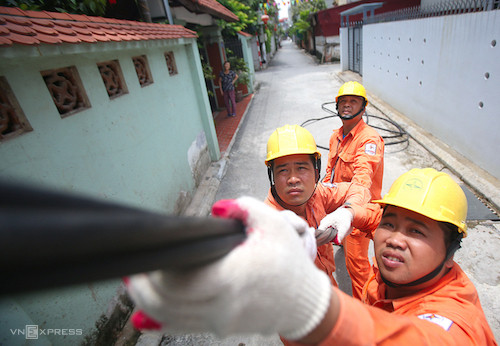
Hanoi Electricity workers repair power lines in Long Bien district.Photo: Ngoc Thanh |
Minister of Industry and Trade Tran Tuan Anh requested the Electricity Regulatory Authority to "ensure that the proposed draft electricity tariff structure is submitted for public consultation in October as scheduled."
"The six-tiered electricity pricing system, which was in place before, has not been adjusted appropriately. This is a major lesson and a responsibility we bear for not being proactive and responsive to real-life situations in order to make timely adjustments, leading to public dissatisfaction recently," Mr. Tuan Anh said.
From March 20th, the average retail electricity price increased by 8.36%, reaching 1,864.44 VND per kWh (excluding VAT). According to the retail electricity price schedule for household consumption under Decision 24/2014, the lowest price is 1,678 VND per kWh and the highest is 2,927 VND per kWh. These prices exclude VAT. The increase in the average retail electricity price and the maintenance of the six-tiered retail electricity price structure for household consumption are partly responsible for the sharp increase in household electricity bills in the following months.
According to Tran Viet Ngai, Chairman of the Vietnam Energy Association, the progressive pricing system is applied in most countries because electricity is a special commodity, with production and consumption not occurring simultaneously, and it cannot be stored, thus requiring economical use. However, in Vietnam, after 5 years of applying the 6-tiered retail electricity pricing system under Decision 24, it is no longer suitable for the practical lives of the people and the development of the electricity market, and a recalculation is needed to propose a new plan.
Mr. Ngai said that reducing or increasing the number of tiers, or dividing them into smaller tiers to closely match the needs of each electricity user, needs to be carefully calculated and must still ensure the principle that the more electricity used, the more one should pay for the higher tiers.
He also noted that the retail electricity pricing structure needs to take into account the impact on the poor, who currently account for a very large proportion of electricity users. Under current policy, poor households receive electricity subsidies for the first 30 kWh in the tariff tier.
In fact, in early 2015, the Ministry of Industry and Trade proposed amendments to the progressive electricity pricing system after more than a year of implementation. At that time, the draft proposed three options for improving the retail electricity pricing system for household consumption. First, maintaining the current six tiers. Second, establishing a single electricity price for household consumption (a flat rate). Third, simplifying the tiered electricity pricing system from six to three (or four) tiers according to five scenarios. However, after much consideration, the six-tier progressive pricing system remains in effect to this day.


