
Japanese tycoons and the 'rescue' of Nghi Son Refinery
Idemitsu and its partner KPI's plan to distribute petroleum products from the Nghi Son Refinery could be seen as a way out for PetroVietnam, which is concerned that the project's products are not competitive enough.
InformationIdemitsu Kosan Group (Japan) andKuwait International Petroleum (KPI) announced its plan to distribute petroleum products in the Vietnamese market last weekend, raising expectations of changes in Vietnam's retail petroleum market, which suffers from many shortcomings due to a lack of competition. With this distribution...all productsComing from the Nghi Son Refinery and Petrochemical Complex (Thanh Hoa), the joint venture named Idemitsu Q8 could also provide the answer – a long-standing problem – to the output of this project.
With a total investment of US$9 billion and the largest production capacity in Southeast Asia, the Nghi Son project is jointly funded by Idemitsu and KPI, each holding 35.1%, PetroVietnam holding 25.1%, and another Japanese partner, Mitsui Chemicals, contributing 4.7%. The plant is expected to begin commercial operation in 2017, primarily producing cement.RON 92, RON 95 gasoline, diesel fuel, kerosene, liquefied petroleum gas, plastics, benzene, sulfur…
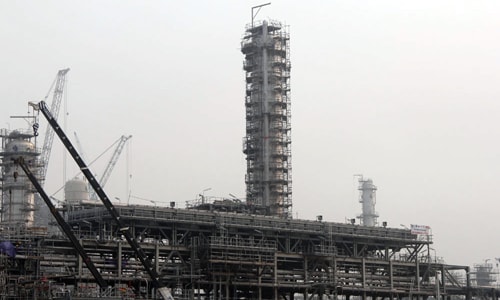 |
Despite receiving significant incentives, Nghi Son Refinery and Petrochemical's products still struggle to compete. Photo: Le Hoang |
As a key project, Nghi Son enjoys many special incentives such as retaining 3-7% of import tax on petroleum products, receiving subsidies (from PetroVietnam's funds) during the period 2017-2027 if the general tax rate applied in the market is lower than the preferential tax rate, and being exempt from corporate income tax for 4 years (only having to pay an average tax rate of 10% for the following 70 years)...
Another significant incentive is that PetroVietnam will commit to purchasing Nghi Son's products for 15 years, at a wholesale price equivalent to the import price at the same time plus an import tax incentive of 3-7%. This, along with Vietnam's increasing commitments to reduce international tariffs (which lowers the price of imported gasoline), has led to...PetroVietnam is extremely worried aboutThe price competitiveness of Nghi Son petroleum products compared to similar imported products., as well as the corporation's financial responsibilities once this project becomes operational.
In a report submitted to ministries and agencies earlier this year, PetroVietnam estimated that if crude oil prices were at $75 per barrel, the corporation would have to spend up to VND 75 trillion annually to pay incentives to Nghi Son as soon as the plant became operational. The higher the crude oil price, the larger this amount would be.
"The consumption of Nghi Son's products is facing difficulties due to its inability to compete with imported petroleum products in the Vietnamese market. Meanwhile, major distributors are increasing their import volumes because of tax incentives," PetroVietnam stated.
| According to the General Department of Customs' Q1/2016 data, key petroleum import businesses mainly imported from Singapore with 1.39 million tons, an increase of 30.4%, and Malaysia with 451,000 tons, 3.4 times higher than the same period. |
Benefiting from tax differentials and the recent drop in world oil prices, many domestic petroleum distributors have actually only signed short-term contracts of 2-3 months, reducing the volume of domestically produced petroleum products purchased due to high prices. Even Petrolimex has only signed short-term contracts with limited volumes.
Along with high prices, the supply and demand problem is also extremely challenging.PetroVietnam forecasts that when Nghi Son becomes operational in 2017 and reaches its maximum capacity in 2018, the domestic supply of petroleum products will increase to 17.6 million m3 per year, coming from the Dung Quat Refinery (7.3 million m3), Nghi Son Refinery (9.6 million m3), and four gasoline blending facilities from condensate (690,000 m3).
Meanwhile, domestic demand for petroleum products was only 17.3 million cubic meters in 2018. Including imported petroleum products, the supply is expected to exceed demand by approximately 821,000 cubic meters, with a significant surplus of diesel. Therefore, PetroVietnam faces the added concern of not being able to fully market all products from Nghi Son and warns of significant risks if the government does not control imported petroleum products.
While the authorities have yet to make a decision to completely resolve these difficulties, theThe two foreign shareholders, Idemitsu and KPI, planning to distribute products for Nghi Son could be considered a viable solution for this project..In the case of major petroleum distribution units such asPetrolimex, Saigon Petro, or Military Petroleum...By rejecting products from Nghi Son due to their higher price compared to imports, Idemitsu Q8 can distribute its products itself through its domestic store network.
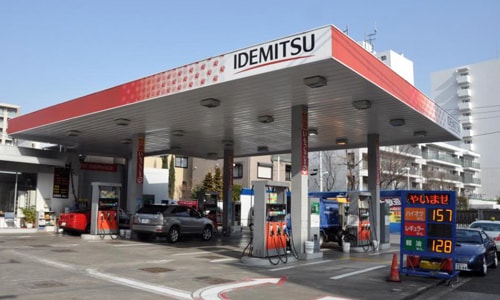 |
Establishing retail outlets in Vietnam could help Idemitsu and KPI directly sell Nghi Son's products. |
This helps them link production to distribution, while also taking advantage of import tax incentives. According to the commitment with the Government, within 10 years, PetroVietnam will have to compensate for the 7% import tax incentive on gasoline and 3% on petrochemical products, even if Nghi Son sells its products to other entities.
"According to current regulations, Nghi Son still enjoys import tax incentives when they proactively export a portion of their products or a third party exports them abroad after purchasing petroleum products from Nghi Son," PetroVietnam stated. Furthermore, with the advantage of having a partner from...Kuwait – an oil-rich nation where gasoline is sold at the equivalent of 4,800 VND per liter – being allowed to import a certain amount of petroleum products (to blend with products from Nghi Son) also creates a significant advantage for Idemitsu Q8.
TPrevious exchange with VnExpressThe leaders of the Ministry of Industry and Trade also affirmed that the retail sale of petroleum products by Japan and Kuwait in Vietnam is part of the agreement.The government's commitment to investors when Idemitsu and KPI participate in the project.
Accordingly, to help sell Nghi Son's products, investors are granted certain rights regarding import and distribution, corresponding to their capital contribution to the project.The General Department of Energy is reviewing and addressing these issues.Outdated customs for Idemitsu Q8.
This official also acknowledged that Decree 83 on petroleum business does not address the participation of foreign traders as retail distributors, but left the possibility open by stipulating that if any issue arises that Vietnam is involved in an international treaty, it should be handled according to the Law on Participation in the Signing of International Treaties.
The quality of gasoline and diesel fuel at Nghi Son does not meet standards. According to reports, PetroVietnam acknowledges that compared to the Vietnamese standards, Nghi Son's petroleum products do not meet Level 4 standards (equivalent to Euro 4 standards) in some aspects. Approximately 1.5 million tons of diesel fuel only meet Level 3 standards for sulfur content. According to the off-take agreement between the corporation and Nghi Son, the products supplied to the market must meet Level 4 standards. In case of failure, both parties must work and renegotiate with Nghi Son regarding the fulfillment of the off-take agreement or the addition of specific conditions. |
According to VNE


