
Universities wishing to achieve national accreditation must undergo evaluation and meet seven criteria.
The Ministry of Education and Training has just issued Circular No. 24 stipulating national standards for higher education institutions. Accordingly, there will be 7 standards for universities to meet national standards.
Those seven standards are: facilities and equipment, teaching staff, training program, finance, scientific activities, quality assurance and ranking, student satisfaction, and employer satisfaction.
Of the seven standards mentioned above, the first condition for being allowed to build a higher education institution is to ensure that the land, facilities, and equipment meet the required standards.
Specifically, the land area allocated to higher education institutions must ensure at least 25m²/student, and the floor area of buildings directly serving training must reach at least 3m²/student.
The information technology infrastructure connects all relevant units, ensuring the availability of information; the website contains all the information required to be publicly disclosed by law, as well as other necessary information about the organizational structure and activities of the higher education institution for students and interested parties to access.
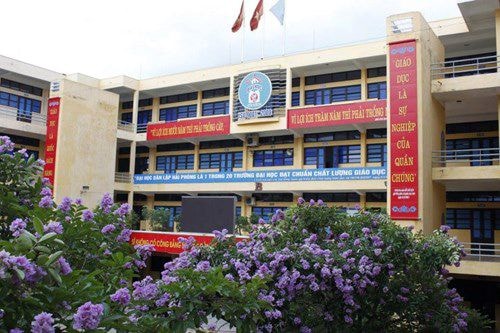 |
| Hai Phong University of Technology. (Image for illustration purposes only, from the university's website.) |
Secondly, the school must ensure that its full-time faculty, full-time researchers, visiting lecturers, and administrative staff meet the standards for each position as stipulated in relevant legal documents.
The student-to-full-time faculty ratio is determined by training program, ensuring it does not exceed 10 students per faculty member for arts and sports disciplines; 15 students per faculty member for medical and pharmaceutical disciplines; and 20 students per faculty member for other disciplines.
For research-oriented higher education institutions, the proportion of faculty and researchers holding the titles of professor and associate professor among the total number of full-time faculty and researchers with doctoral degrees must be at least 30%.
The third standard concerns training programs and training activities. Higher education institutions must have a scale, disciplines, and training levels that conform to the regulations on the stratification of higher education institutions and meet the training and human resource development requirements of the locality and the whole country at each specific stage.
Training programs are regularly updated; the content of training programs and the sources of reference programs are publicly available on the training institution's website.
Schools must publicly disclose the learning outcomes of their training programs; they must have tools and methods for assessment that ensure the quantification of the committed learning outcomes criteria.
The circular stipulates that the structure of training and science and technology activities of higher education institutions must comply with regulations on stratification, ranking framework, and ranking standards for higher education institutions. Each training discipline must have at least one teaching-research group ensuring close integration between training, scientific research, and technology transfer.
Higher education institutions are required to ensure that at least 80% of their recurrent expenditures are covered by revenue from their professional activities and other sources as stipulated by law.
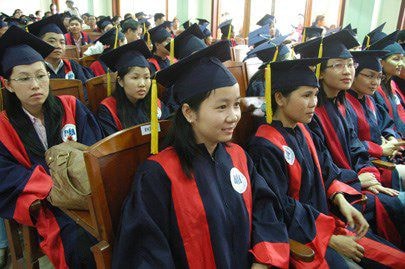 |
| University graduates are excited about graduation day. |
Ensure that at least 50% of investment expenditures for strengthening infrastructure, improving faculty capacity, scientific research, and other activities are funded from operational revenue and other sources as prescribed by law.
A new standard added in this circular is the requirement for educational quality accreditation. The circular requires that the academic results of students at higher education institutions must undergo university-level educational quality accreditation as prescribed by the Ministry, and the quality certification must be valid at the time of consideration for national accreditation of the higher education institution.
Universities must be ranked 1st according to the current higher education institution ranking framework at the time of applying for national accreditation and maintain that ranking for the duration of the national accreditation.
Finally, there is the satisfaction of students and employers. This standard is assessed over a 12-month period leading up to the time the higher education institution submits its application for national accreditation.
At least 70% of graduates must find suitable employment. 80% of final-year students are satisfied with the training program and the learning and research environment. 80% of alumni surveyed from the three most recent graduating classes expressed satisfaction with the practicality of the training program and the adaptability of graduates to the work environment, with a sample size of at least 10% of the graduating class and no fewer than 50 questionnaires for each graduating class. 70% of employers surveyed who hired graduates in the last 3 years were satisfied with the quality of graduates, with a sample size of at least 10 for each field of study. |
According to Vietnamese Education
| RELATED NEWS |
|---|


