
What is the correct way to offer incense?
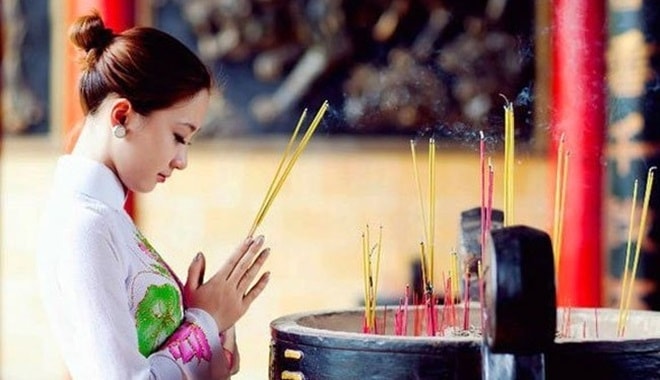
(Baonghean.vn) - The ritual of offering incense has become a custom known to almost all people in Asia. Incense sticks have become part of the cultural and religious life of Vietnamese people as a beautiful, familiar, and sacred tradition.
Although not superstitious, in the minds of most Asians, burning incense acts as an invisible bridge connecting the visible and invisible worlds. However, in terms of mystical spirituality, some still have a vague understanding, especially regarding the traditional meaning of offering incense as passed down from their ancestors...
 |
So what does offering incense mean?
"Offering" means to present something respectfully. And "fragrance" means a pleasant scent, usually referring to something burned as an offering to deities, also known as incense or agarwood.
The act of lighting incense on the ancestral altar is a beautiful and indispensable cultural tradition during ancestral commemorations, festivals, and holidays. The burning of incense brings a sense of warmth and comfort. At this time, incense is no longer just an ordinary object, but has become an essential spiritual product for the Vietnamese people. Along with other traditional customs, incense has contributed to creating and preserving the cultural identity of the Vietnamese nation.
How many incense sticks are usually lit when burning incense?
Vietnamese people have always been accustomed to choosing odd numbers (1, 3, 5, 7, 9) for the number of incense sticks offered. Or they might burn a whole bundle of incense instead of choosing even numbers (2, 4, 6, 8).
There are many different opinions about numbers.
- Number 1: represents sincerity
- Number 2: When visiting the deceased's coffin and during the mourning period, people usually light two incense sticks.
- The number 3 has many different interpretations. It could represent: the Three Jewels (Buddha, Dharma, Sangha), the Three Realms (Desire Realm, Form Realm, and Formless Realm), the Three Times (Past, Present, and Future), or the Three Uncontaminated Trainings (Morality, Concentration, and Wisdom) in Buddhism (which is why there are often three large incense burners in temple courtyards).
- The number 5 represents: the five cardinal directions of heaven and earth / the five directions of the gods. According to Feng Shui, the Five Elements are: Metal, Wood, Water, Fire, and Earth.
- The numbers 7 and 9 symbolize a person's "spirit" or "essence," when people ask for blessings for themselves (seven for men, nine for women).
In reality, 3, 5, 7, 9,... or even 1 incense stick are all the same; there is no difference in meaning. "The reason temples now encourage Buddhists to light only one incense stick is to avoid fire hazards and environmental pollution for those around." Therefore, lighting just one incense stick is sufficient. Never use fake incense (electric incense) in the incense burner.
The significance of burning incense lies in the fact that as the smoke rises to the sky, people are sending messages from the earthly realm to the higher world, to their ancestors. At this point, the incense stick is no longer just an ordinary item, but has become an indispensable spiritual product for the Vietnamese people.
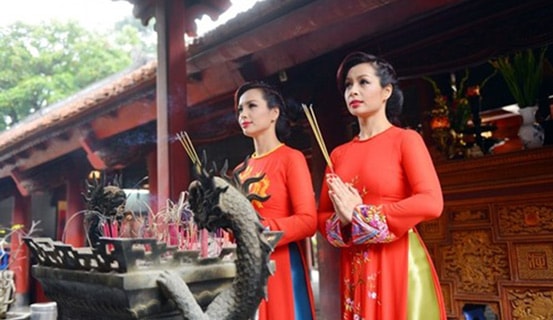
Incense is a familiar scent in the homes of millions of Asians, a special aroma associated with visiting temples on New Year's Day. We often see familiar scenes: elderly men and women, young men and women, holding incense sticks and praying for a prosperous, healthy, and long-lasting new year. This is not an act of superstition, but a beautiful cultural tradition that has existed for a very long time.
 |
The meaning of offering incense in Buddhism
In Buddhist rituals, incense is one of the six offerings (six offerings), which include: incense, flowers, lamps, tea, fruit, and food. However, many people are unaware of the profound meaning of offering to Buddha and prepare a lavish feast of food and drink, which is wasteful, time-consuming, and distorts the true meaning.
According to Buddhist belief, sincerity is expressed through the fragrant smoke of incense; there is no need for lavish feasts with meat, fish, pork, chicken, etc., because the true meaning of offering to Buddha is that fragrant incense, bright lamps, fresh flowers, good fruits, and clean water are sufficient.
The Buddha is not on an altar or in statues, but in the heart of every human being. Besides burning incense sticks with a hot flame, we can also use our faith to light up "incense of the heart"—that is, incense from within.
Therefore, there are five kinds of incense used to offer to the Buddhas: the incense of precepts; the incense of concentration; the incense of wisdom; the incense of liberation; and the incense of liberating knowledge.
One thing we must remember is that each time we offer incense before the altar: we must not only offer incense with sincere reverence, but also with mindfulness (concentration). We should place each incense stick with both hands and ensure it is straight, symbolizing an upright heart, unwavering despite storms and tribulations, maintaining the character of a virtuous person with a pure heart, leaving behind a good reputation that spreads far and wide…


