
Behind Putin's decision to appoint a new chief of staff.
By appointing a new, young Kremlin chief of staff with few political connections, Russian President Vladimir Putin may be aiming to reshuffle his circle of power.
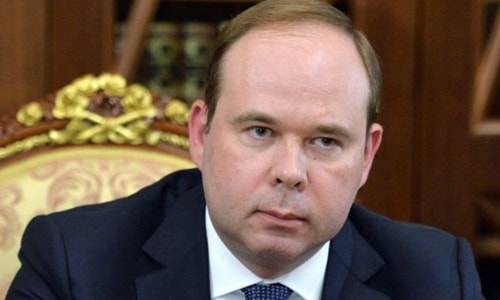 |
Anton Vaino, the newly appointed Kremlin chief of staff. Photo: BBC. |
Russian President Vladimir Putin unexpectedly dismissed his longtime Kremlin chief of staff Sergei Ivanov on August 12 and appointed Anton Vaino to replace him. Vaino's main duties include ensuring the smooth running of the president's work, drafting legislation for Putin to present to parliament, overseeing law enforcement, and analyzing domestic and foreign affairs for the president, according to Reuters.
Vaino, born on February 17, 1972, is a relatively unknown official in Russia. He graduated from the Moscow Institute of International Relations (MGIMO) and previously worked at the Russian Embassy in Japan. Vaino's work became more closely involved with the government apparatus from 2003 when he took on the role of advisor to the Presidential Protocol Department, and was promoted to head of the department in 2008. Prior to his appointment to this new position, Vaino held the position of Deputy Chief of Staff to the President.
According to several sources familiar with the matter, Vaino was never mentioned in political scandals or involved in power struggles. He also had few connections with the powerful groups or businessmen within President Putin's circle of influence.
Experts believe that the aforementioned personnel reshuffle, while seemingly a routine administrative adjustment, will have significant implications for Russian politics.
Sputnik quoted political consultant Evgeny Minchenko as saying that with this move, President Putin seems to want to consolidate the loyalty of technocrats within the government because Vaino had previously worked for the presidential office as a promising candidate for advancement.
According to Minchenko, the fact that Vaino had little connection with former government officials or not many personal ties to President Putin also carries significant meaning.
"What matters most is the effectiveness of the work, not loyalty to any particular group," Minchenko said.
Furthermore, analysts also argue that dismissing or appointing anyone to a position within the government is simply a natural process aimed at refreshing the system.
"President Putin has the responsibility of nurturing and developing new cadres, a task he has focused on in recent years," Minchenko said.
Konstantin Kalachev, head of a policy institute in Moscow, emphasized that Vaino "represents a new generation of Russian officials" with extensive experience and a commendable career path.
"Sergei Ivanov was once seen as a potential successor to President Putin, much like Prime Minister Dmitri Medvedev. Ivanov is an old-school figure, a good organizer, steady and steadfast. As head of the presidential office, he has shown himself to be a highly capable official," Kalachev commented. "But it seems time for a change. We need new people, which means a new approach. Ivanov doesn't come from the security forces. He graduated from MGIMO, so he will have more diplomatic skills and capabilities."
On the other hand, according to Kalachev, Vaino's appointment also shows that the Russian government apparatus is developing, personnel are changing, and young people now have more opportunities for career advancement.
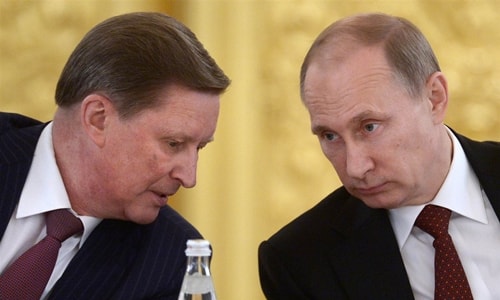 |
Russian President Putin (right) and former Kremlin chief of staff Sergei Ivanov in 2014. Photo: AP. |
Political analyst Alexei Makarkhin assesses the decision to appoint a new Kremlin chief of staff as part of a broader transformation within President Putin's inner circle of power.
"Putin simply doesn't want to surround himself with officials who are too old," Makarkhin commented.
However, Timothy Ash, a strategist at the bank,Nomura, Japan,He had a different way of thinking. According to him, the PresidentPutin may fire his chief of staff.Ivanov appointed a new person out of concern about the possibility of declining approval ratings ahead of the 2018 presidential election.
The personnel changes were made against the backdrop of Russia facing numerous domestic and international problems, particularly an economic downturn stemming from plummeting global oil prices and Western sanctions imposed on Moscow in connection with the crisis in eastern Ukraine.
"Putin is drawing closer to those who are wholeheartedly devoted to him and distancing himself from those who somehow harbor ambitions of running alongside him," political scientist Tatyana Stanovaya recently wrote in a commentary for the Carnegie Moscow Center. "He doesn't need advice; he needs people who will obey orders."
But according toAlexei Makarkin,analysts atMoscowWith the replacement of his inner circle with younger people, hePutin, who is 63 years old, probably simply wants to avoid presenting himself as an aging leader.
Russian President Putin "wants to refresh his team with people he can completely trust and who are always close to him. That's why he chose people from his security detail and the presidential office," Makarkin said.
According to VNE
| RELATED NEWS |
|---|


