
Driving training will undergo several changes starting July 1, 2026, and the driving test will be more difficult.
Driving training and testing will undergo significant changes starting July 1, 2026. The number of theoretical questions will double, and those who fail the theory test will not be allowed to take the driving test (on-campus or highway).
Two new regulations are reshaping the field of driver training.
From July 1st, 2026, the field of driver training and testing will undergo significant changes. The Ministry of Construction has just issued Circular 17/2026 regulating driver training, refresher courses, and testing, applicable to training facilities nationwide. Simultaneously, the Ministry of Public Security is finalizing a draft of a new circular to replace Circular 12/2025 on driver's license testing.
Notably, the new regulations bring about significant changes to both the training program and the examination format. Students will have fewer practical training hours, but the theoretical exam will be much more difficult, and the criteria for recognizing exam results will be much stricter.
Why is the simulation learning component still included even without a driving test?
According to Circular 17/2026 of the Ministry of Construction, trainees will continue to study and be tested on simulated traffic situations as currently required. Specifically, trainees must study for 4 hours covering 120 simulated scenarios. Each test consists of 10 scenarios.
Driving schools will conduct exams to determine course completion. The exams will include theory, traffic simulations, practical driving on a training course, and driving on public roads.
However, the draft circular from the Ministry of Public Security eliminates the simulation test from the driver's license examination. If the regulation is issued as planned, trainees will still have to study and pass the simulation test at the training facility, but this content will no longer be tested in the driver's license examination.
Explaining the continued inclusion of simulations in the training program, the Vietnam Road Administration stated that this is an essential skill. According to the agency, simulated situations help trainees identify potential hazards and risks when participating in traffic. From there, learners know how to handle situations appropriately to ensure safety.
The Department of Road Transport also stated that not all content in the training program is included in the examination. Therefore, the absence of a topic from the exam does not mean it is unnecessary in the learning process.
Reduce the duration of practical driving lessons for a Class B vehicle.
In addition to the simulation content, Circular 17/2026 also adjusts the duration of practical training for Class B students.
Students learning to drive a Class B automatic car only need 60 hours of practical training, a reduction of 7 hours compared to the current requirement. For manual transmission cars, the practical training time is reduced to 76 hours, also a reduction of 7 hours.
The number of theoretical exam questions has doubled.
This is the most notable change in the draft from the Ministry of Public Security. The number of theoretical questions and the time allotted for the test have both increased significantly, and the requirement for the number of correct answers has also been raised.
For category B driving license, candidates must answer at least 54 out of 60 theory questions correctly within 30 minutes to pass. Currently, candidates only need to answer 27 out of 30 questions correctly within 20 minutes. The number of questions has doubled, the time limit has increased, but the requirement for correct answers is also higher.
For the C1 driver's license exam, the number of questions has increased from 35 to 70, and the exam time has increased from 22 to 35 minutes. Candidates must answer at least 63 out of 70 questions correctly to pass.
For category C, the exam number increased from 40 to 80 questions, and the time allotted increased from 24 to 40 minutes. The passing requirement is answering 72 out of 80 questions correctly.
The D1, D2, and D categories also increased from 45 to 90 questions. The exam time increased from 26 to 45 minutes. Candidates must answer at least 81 out of 90 questions correctly.
Specifically, the C1E, CE, D1E, D2E, and DE categories have the highest number of questions, increasing from 45 to 100. The exam time has increased from 26 to 50 minutes. Candidates must answer at least 90 out of 100 questions correctly to pass.
Summary table of the number of questions and time allotted for the theory test.
| Content | Lane B | Class C1 | Class C | Classes D1, D2, D |
|---|---|---|---|---|
| Number of multiple-choice questions | 60 | 70 | 80 | 90 |
| Time allotted for the test (minutes) | 30 | 35 | 40 | 45 |
| Scoring scale | 60 | 70 | 80 | 90 |
| Minimum passing score | 54 | 63 | 72 | 81 |
Tighten the scoring method for the driving test section.
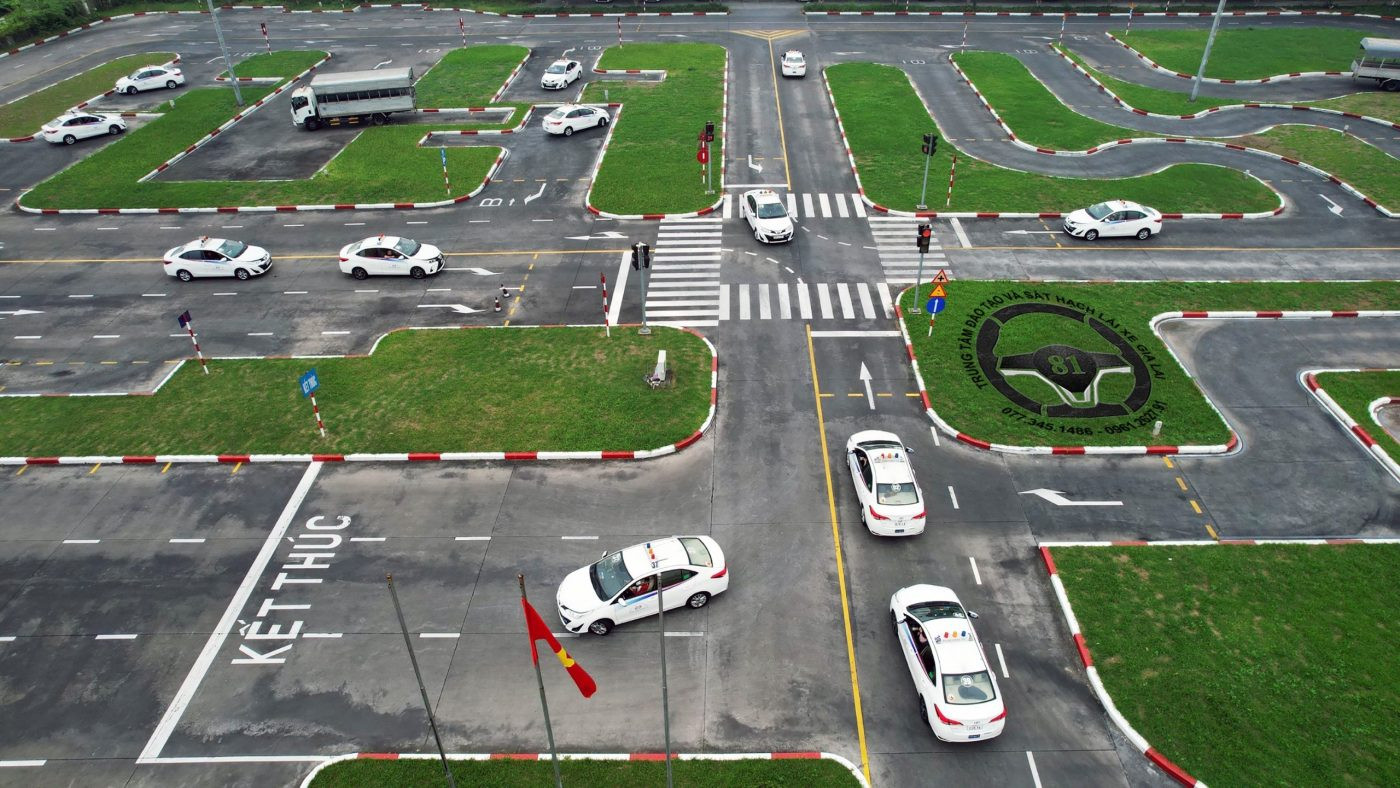
The driving test section has also been tightened according to the new regulations. Currently, many students, when performing the test of stopping before the pedestrian crossing line, often stop far from the red light to avoid having points deducted, also known as "skipping the test".
According to the new regulations, candidates must stop their vehicles no more than 500 mm before the designated line. Stopping too far will result in a 5-point deduction. This regulation aims to prevent candidates from intentionally stopping too far to avoid difficult situations.
New regulations on recognizing examination results.
The new regulations regarding the recognition of examination results are a notable change. Under current regulations, candidates are allowed to take all sections of the exam. If they fail any section, they only have to retake that section.
The new draft regulations stipulate that if a candidate fails the theory test, they are not allowed to take the practical driving test on the driving course. If they fail the practical driving test on the driving course, they are not allowed to take the road driving test. This linear process forces candidates to pass each section in order.
However, the draft allows candidates to retain the results of previously passed sections for one year from the date of passing the exam. Therefore, candidates do not have to retake the entire exam if they only fail a section.
Regarding the scoring scale and minimum passing score, the minimum passing score for categories B, D1, D2 and C1, C, D is 100 points, with a minimum passing score of 80 points.
Table of results for each driving category
| Content | Lane B | Class D1, D2 | Classes C1, C, D |
|---|---|---|---|
| Scoring scale | 100 | 100 | 100 |
| Minimum passing score | 80 | 80 | 80 |
The examiner's job is to sit in the car.
According to the draft circular from the Ministry of Public Security, examiners will sit with students during the road driving test. The role of the examiner is specifically defined with many responsibilities.
The examiner's job is to observe traffic conditions to issue examination instructions. Instructions are given to candidates via buttons on the control panel or a display screen.
In addition, the examiner is also responsible for driver's license insurance to ensure safety during the exam. They also monitor the technical condition of the test vehicle to promptly detect any technical safety issues.
In addition, examiners will monitor the candidate's performance during the test to record any violations through the vehicle's control system.


