
Signs that China is building its first nuclear-powered aircraft carrier.
Satellite imagery analyzed by the National Institute for Fundamental Policy Research (NIPPR) reveals structures at the Dalian shipyard resembling the reactor area of a US nuclear aircraft carrier, coinciding with the expansion of infrastructure at the Qingdao base.
According to Defence Blog, citing an analysis by Japan's National Institute for Fundamental Policy Research (NIPPR), satellite imagery suggests China may have begun construction of its first nuclear-powered aircraft carrier at a major shipyard in the northeast. If confirmed, this project could bring the Chinese Navy closer to US aircraft carrier capabilities by the early 2030s, although this is currently only an assessment based on satellite imagery.
Evidence from satellite imagery of the Dalian shipyard.
According to NIPPR, satellite imagery of the Dalian shipyard in Liaoning province shows that construction of a large vessel is underway. The institute noted that new features appearing there are consistent with the construction of a nuclear-powered aircraft carrier, which were not previously observed during the construction of China's conventionally powered aircraft carriers.
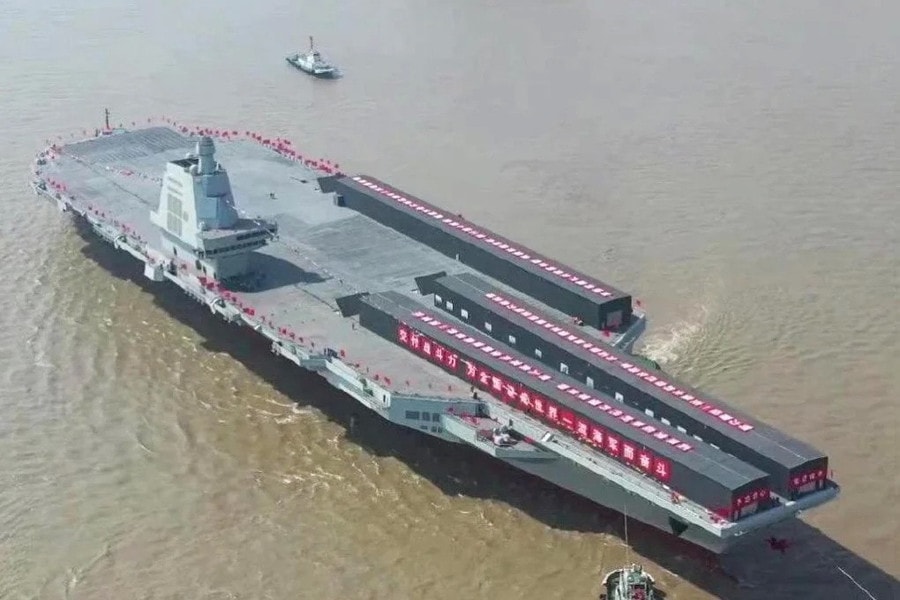
Japanese media reported that the shipyard in question belongs to Dalian Shipbuilding Industry Company, the company that assembled the Shandong aircraft carrier – China's first domestically built aircraft carrier. This raises the possibility that the site will be used for subsequent aircraft carrier programs.
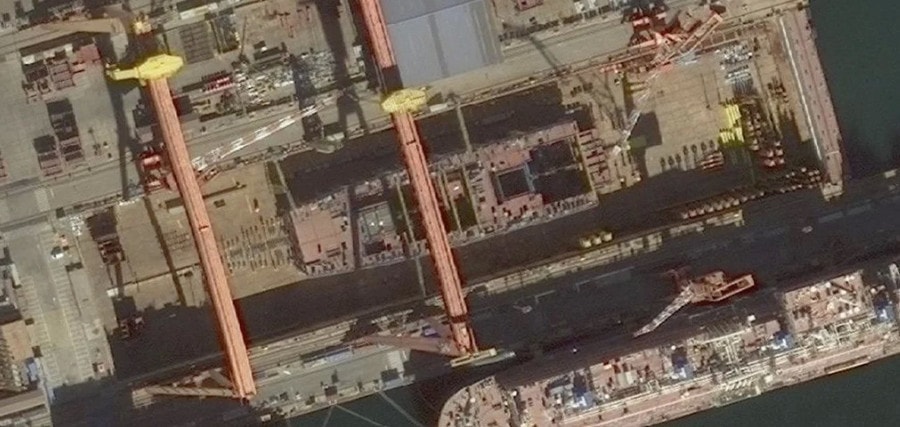
According to NIPPR, since February, analysts have observed the installation of keel support blocks – large steel beams used in shipbuilding – stretching over 270 meters. This length suggests preparations for a ship comparable in size to an aircraft carrier.
In satellite images taken on November 10, a section of a ship's hull, approximately 150 meters long and 43 meters wide, is visible inside a dry dock in Dalian. Within this structure, two rectangular frames, each measuring approximately 16 meters by 14 meters, are visible. Reports indicate that similar structures were not observed during the construction of the Shandong aircraft carrier or China's third aircraft carrier, the Fujian.
Comparison with Newport News shipyard and US aircraft carriers
NIPPR researchers compared satellite imagery from Dalian with images of the Newport News shipyard in Virginia, where the U.S. Navy's nuclear-powered aircraft carriers are being built. According to experts, the nuclear aircraft carriers under construction there show two frames of similar size, approximately 16 m x 13 m, positioned where the reactor containment tanks are installed.
Maki Nakagawa, a researcher at NIPPR, noted that this similarity is remarkable. She argued that the size and shape of the frames confirmed in the images from the Dalian shipyard closely resemble those seen on nuclear-powered aircraft carriers under construction in the United States, and that these are frames for reactor compartments.
The report cites an assessment suggesting that "the Chinese military could possess an aircraft carrier with capabilities comparable to leading US aircraft carriers by the early 2030s." This assessment is based on the assumption that the nuclear-powered aircraft carrier at Dalian will be completed and commissioned on schedule.
Expanding the Qingdao base and preparing for a fourth aircraft carrier.
The Japanese Ministry of Defense previously stated there were indications that China planned to build a nuclear-powered aircraft carrier in the future. According to NIPPR, new satellite imagery now sufficiently reinforces this assessment, revealing preparations for the rear-line infrastructure.
At the Chinese naval base in Qingdao, Shandong province – the home port of the aircraft carrier Liaoning – construction and expansion work has been observed. Analysis suggests the expansion of the docks and the construction of demagnetization facilities to minimize the ship's magnetic signature.
Near this base, a new naval airfield has been constructed, complete with facilities for carrier landing training and fighter jet hangars. NIPPR assesses these developments as potentially preparations for the deployment of China's fourth aircraft carrier.
According to that scenario, if Qingdao becomes the home port of the new aircraft carrier, Chinese aircraft carrier operations in the East China Sea could increase. The operational range is predicted to expand from the first to the second island chain in the Western Pacific.
Impact on the Chinese Navy's offshore operational capabilities.
This context unfolds as China increasingly conducts naval exercises beyond the first archipelago, including operations in the broader Pacific region. The emergence of a nuclear-powered aircraft carrier, according to analysis, especially when equipped with an electromagnetic catapult system, would allow for longer operational time at sea compared to conventionally powered carriers like the Fujian.
According to Ms. Nakagawa, China's aircraft carrier capabilities are currently inferior to those of the United States. However, once its fourth aircraft carrier becomes operational, China could further intensify its naval activities around Japan. This would force the Japan Self-Defense Forces and the United States to constantly monitor, gather intelligence, and formulate appropriate responses.
Level of certainty and information limitations
These assessments are primarily based on NIPPR satellite imagery analysis and previous assessments by the Japanese Ministry of Defense. There has been no official announcement from China regarding the start of construction of a nuclear-powered aircraft carrier.
Nevertheless, a series of evidence, including the large hull structure with two rectangular frames resembling reactor compartments, the history of the Dalian shipyard in aircraft carrier construction, and the expansion of naval bases and airfields in Qingdao, suggests that China may be entering a new phase in its aircraft carrier program. According to Defence Blog, if this trend continues, the commissioning of a fourth aircraft carrier – most likely nuclear-powered – could significantly impact the regional naval balance.


