
To make Vinh City a hub and highlight of the region (*)
(Baonghean) - Baonghean Newspaper publishes excerpts from an article by Mr. Tran Ngoc Chinh - Chairman of the Vietnam Urban Planning and Development Association.
Resolution 26-NQ/TW of the Politburo clearly states: Vinh City – a Class I urban area, is the nucleus of the urbanization process and the driving force for economic and social development of Nghe An and the North Central economic region. Vinh must establish itself as the regional center of the North Central region in finance, trade, tourism, science and technology, information technology, high-tech industry, healthcare, culture, sports, education and training, and as an important transportation hub for the entire region. Therefore, when considering the development goals for Vinh City, it must be placed in the spatial relationship with Cua Lo town, the Southeast Economic Zone, and Nam Dan, the birthplace of President Ho Chi Minh. Furthermore, the spatial context of the banks of the Lam River, as directed by the Government in the planning for the construction of South Nghe An - North Ha Nam, must also be considered.
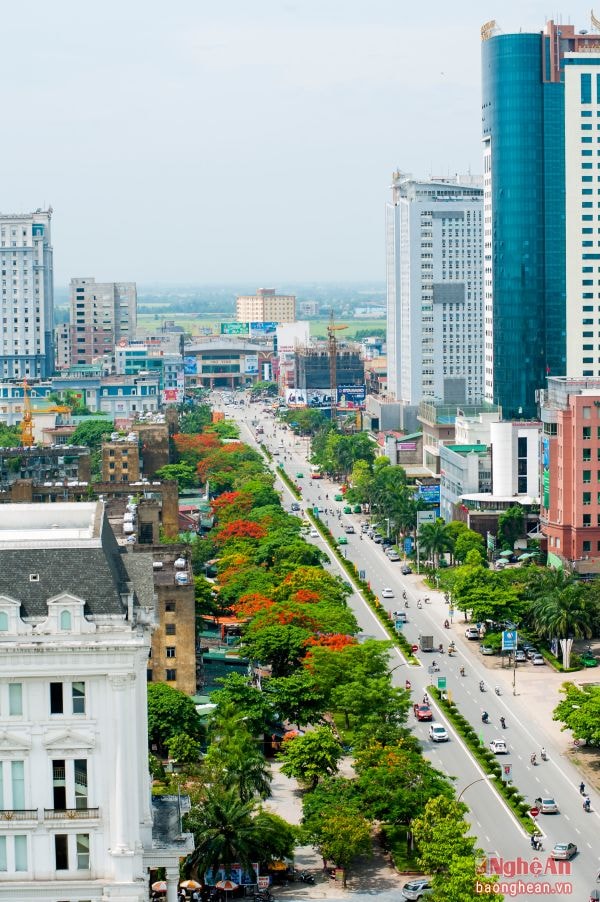 |
| Vinh City is emerging as a major center in the North Central region. Photo: Thanh Cuong |
My personal view is that Vinh City should first and foremost become a regional and international transportation hub in the North Central region. This is crucial for promoting regional connectivity, as Vinh will connect with Cua Lo town in the future to become a coastal city. Based on this, it is necessary to upgrade and improve National Highway 1A and the North-South Expressway, and complete the coastal transportation axis connecting with the Cua Hoi bridge via Ha Tinh. The North-South National Highway will serve as a transportation hub connecting the East-West National Highway, the Ho Chi Minh Highway, and the road to the Thanh Thuy border gate, linking with Laos, Thailand, Myanmar, and other ASEAN countries.
This external transportation system connects with the external transportation system of Vinh city and with Cua Lo seaport, Vinh International Airport, and Vinh railway station. Regarding railways: Upgrading the entire line, including the existing railway, and in the future, a transnational high-speed railway line. Vinh station is a crucial station; the goal is to develop Vinh station into one of the five most important and modern railway stations in Vietnam (Hanoi - Vinh - Da Nang - Nha Trang - Saigon).
Regarding waterways: The Vinh - Cua Lo - Cua Hoi - Song Lam urban area is connected to the waterway transportation system, and the planning and construction of the Cua Lo international seaport (a national hub port of type I) is aimed at reaching 10-12 million tons/year (serving as an import-export port and a specialized container port with international functions with Laos and Thailand...).
Regarding air transport: Currently, Vinh Airport is a 4C-class airport with a runway length of 2,400m and a width of 45m. It serves both civil and military purposes. Vinh Airport has a capacity of 2.5 million passengers per year and operates international flights to Laos and Bangkok (Thailand). The goal is to upgrade the airport to a 4E-class airport by 2020, accommodating approximately 3 million passengers per year and serving domestic flights, as well as flights to Southeast Asia and Northeast Asia.
Regarding the development of a financial and commercial center, a clear zoning plan is needed, combining contemporary life with the traditional culture of Nghe An province. My initial idea is that in Vinh, the Quang Trung and Tran Phu streets, centered around Vinh Market, should be re-planned into large commercial complexes similar to Vincom in Hanoi and Ho Chi Minh City; modern, large-scale banks should be built to create a financial-banking-commercial city (which would become a unique and attractive center). Simultaneously, according to urban planning, residential areas within the city should have commercial centers and banks serving the communities, as well as wholesale markets and centers serving the city's gateways.
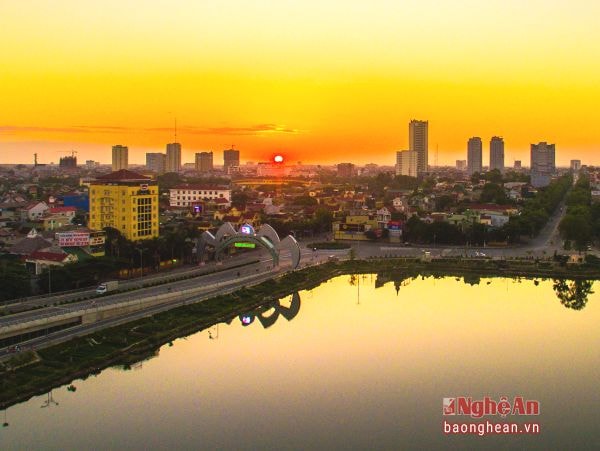 |
| Sunrise over Vinh City. |
Regarding tourism, Vinh needs to connect destinations effectively, exploiting the potential of tourism services, resorts, and cuisine. Vinh's tourism can also be linked to other activities as it becomes a regional science and technology center, information technology center, high-tech industrial center, regional medical center, cultural and educational center, and sports center for the North Central region.
Developing Vinh into a regional center of the North Central region is a crucial and challenging task. The implementation process must focus on two aspects: the socio-economic development of Nghe An province, linked to the city of Vinh. The urban space of Vinh, along with Cua Lo town, forms a continuous space; this is a core value for the city's development, connecting towards the East and fully exploiting the marine economy (seaport, tourism, services, etc.), thereby increasing Vinh's strengths and competitiveness compared to many other cities in Vietnam.
During its development, Vinh City also needs to consider and address the issue of exploiting the Lam River section passing through Vinh, connecting it with the southern bank where Tien Dien village in Nghi Xuan district (Ha Tinh province) is located, the birthplace of Nguyen Du - a world-renowned cultural figure. Thus, with development and connectivity, Vinh will become a modern city with a coastline and river, boasting a rich history and unique culture.
(*) Title provided by Nghe An Newspaper
TNC


