
Proposal to temporarily use Chinese-made T-14 Armata tanks.
Currently, the T-14 Armata main battle tank is still in the testing phase; however, progress is quite slow due to numerous unresolved issues.
The T-14 Armata is Russia's most advanced main battle tank (MBT), considered to have revolutionized MBT design and manufacturing due to its modular turret, which is completely separate from the hull.
According to Russian advertising, the T-14 Armta's armor is strong enough to withstand the destructive force of a 120 mm artillery shell fired directly at the front, sophisticated sensor systems help it detect threats early, and its "brain" is a sophisticated fire control system that allows the tank to fire accurately while moving at high speed in all weather conditions.
With its outstanding advantages, the T-14 chassis has also been used to develop the T-15 infantry fighting vehicle, the T-16 recovery vehicle, and most recently, the TOS-2 Armtata thermobaric rocket launcher.
|
| Two members of the Armta family - the T-14 tank and the T-15 infantry fighting vehicle. |
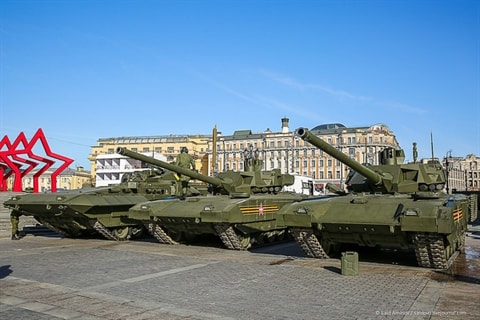
However, the Russians' ambitions didn't stop there. Having determined that their tanks were "superior" to all NATO tanks, both present and future, the 125 mm 2A82 cannon wasn't enough; the Armata's main gun had to be upgraded to 152 mm, like the Object 292 in the past.
In addition, the T-14 tank is equipped with the Afghanit active protection system (APS), a very necessary weapon, especially since the M1 Abrams tanks have integrated the Trophy system, while the Chinese ZTZ-99 will have the GL5; therefore, the Armata cannot afford to fall behind.
While developing these two weapons is challenging, it is still within the Russians' reach; the only major obstacle is that the heart of the T-14 has yet to be defined.
Weighing over 50 tons when fully loaded with weapons and equipment, the Armata's engine must have a minimum power output of 1,500 and an optimal 2,000 horsepower to help this steel monster reach speeds of 70-90 km/h.
|
| The VT4 (MBT-3000) main battle tank - the export version of the ZTZ-99. |
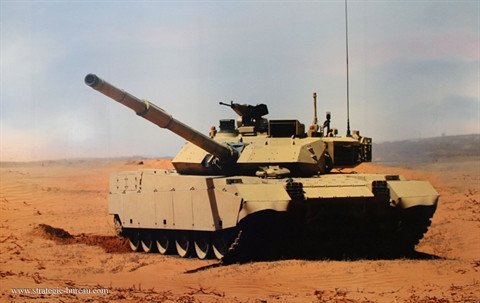
Unfortunately, the Russian defense industry cannot currently replace Ukraine's shortcomings because key infrastructure remains in Kyiv. Russia has the capability to fill the void, but not in the near future, while the deadline for mass production of the Armata is fast approaching.
Therefore, just like the Buyan-M missile boats are having to temporarily install Chinese turbocharged diesel engines, there have been suggestions that Russia should buy the "heart" of the VT4 tank to integrate into the Armata.
The VT4 tank's engine, manufactured by China using German technology, boasts a relatively high level of reliability. While not yet meeting requirements, it is still better than the current A-82-2's 1,200 horsepower engine.
Given the urgent need for mass production, if the development of the 152 mm cannon and the Afghanit APS system is completed ahead of schedule, the prospect of Russian tanks being fitted with Chinese engines in the first production batches is entirely possible.


