
Ip Man - the Wing Chun master - is a legend of the silver screen.
Master Bruce Lee, with his tumultuous life, became a screen legend through a series of blockbuster films across Asia.
Life is full of ups and downs, following the changing times.
Ip Man was born in 1893 in Foshan (Guangdong) into a wealthy family. His parents owned a large estate and a house as long as a street block in the city center. At the age of seven, the skinny boy broke open his piggy bank and took out three silver ingots to apprentice under Chan Wah Shun (the seventh-generation successor of Wing Chun). At this time, the master was 70 years old, so Ip Man mainly learned skills from Chan Wah Shun's second disciple, Ng Chung Tso. After Ip Man studied with him for three years, Chan Wah Shun passed away. His last wish was for Ng Chung Tso to continue teaching Ip Man because the boy showed a natural aptitude for martial arts.
At the age of 16, Ip Man left mainland China for Hong Kong to attend high school. In Ip Man's memory, he was a boisterous, arrogant student who often got into fights with his European classmates at the school exclusively for the wealthy.
In their fights, the diminutive Ip Man often won thanks to his superior martial arts skills. One defeat changed his life. One day, an old man named Leung came to see Ip Man to inquire about martial arts. The two exchanged a few moves, and Ip Man was defeated. The old man revealed himself to be Leung Bik, the senior disciple of Chan Wah Shun and Ip Man's uncle. After that encounter, Ip Man learned martial arts from Leung Bik.
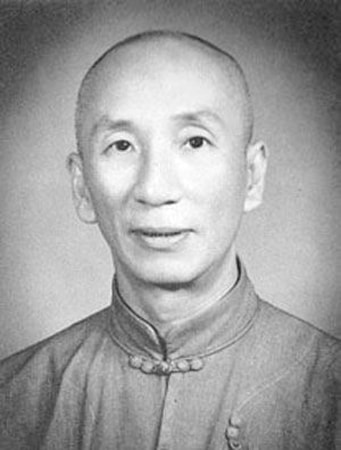 |
| Master Ip Man. |
At the age of 24, Ip Man had mastered Wing Chun, returned to his hometown of Foshan, and became a police officer. For over 20 years, from 1914 to 1937, Ip Man rose to fame after a series of martial arts duels. In his free time, he often socialized and exchanged knowledge with other martial arts masters to improve his skills. Although he taught martial arts to many friends, subordinates, and relatives, Ip Man did not open a martial arts school – as was the tradition of previous generations of the school. He also had no intention of passing on his skills to his two sons.
When the Japanese fascists occupied southern China in 1937, Ip Man's family began to decline. Ip Man, a former policeman, refused to submit to the puppet regime and foreign rule, so he joined a guerrilla group fighting against the Japanese. For eight years, his family lost everything and often faced starvation. After Japan surrendered to the Allies in 1945, Ip Man, at the age of 52, had to abandon martial arts and work for three years to make a living. In 1949, the life of the 55-year-old martial artist took a new turn when the Chinese Communist Party came to power. His family had all their property confiscated and had to flee to Hong Kong.
Upon arriving in Hong Kong, Ip Man initially worked in a restaurant and gradually befriended fellow martial artists in the martial arts association. Thanks to his renowned skills from mainland China, the slender martial arts master opened his own martial arts school after only a year. His first course consisted of eight students from various professions. During his later years teaching martial arts in Hong Kong, Ip Man challenged many international masters from Japan and the West to spar. He defeated them all and earned great respect. In 1967, Ip and his senior disciples founded the Hong Kong Wing Chun Gymnastics Association, uniting Wing Chun practitioners and promoting the martial art to the world.
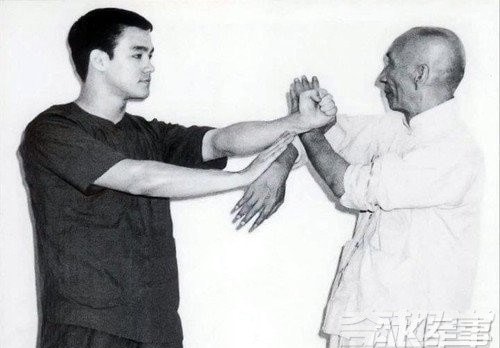 |
| Bruce Lee and his master, Ip Man. |
Although Ip Man's most highly regarded student was Leung Sheung, Bruce Lee is even more world-renowned. Bruce Lee sought to learn Wing Chun from Ip Man around 1956 at a martial arts school on Linda Street. Lee was naturally gifted in martial arts and diligent in his training, progressing rapidly. Unfortunately, due to emigration to the United States, he was unable to complete his Wing Chun training.
In 1972, Ip Man died of lung cancer, seven months before his student Bruce Lee passed away. Towards the end of his life, he was believed to be addicted to opium.
A grand master lives on screen.
After Ip Man's death, he became a martial arts icon in Hong Kong and China. Filmmakers were interested in recreating his image on screen. In 1998, filmmakers Lau Chun-wai and Shi Xiaofu planned to make a film about Ip Man's life, but their film company closed down and the project was abandoned.
Later, renowned Hong Kong producer Wong Ho-yin developed his own story about Ip Man. With the consent of the martial arts master's two sons, he went to Foshan to study his master's life and Wing Chun for an extended period. In 2007, director Yuen Woo-ping was invited to direct the film, and Donnie Yen played the lead role.
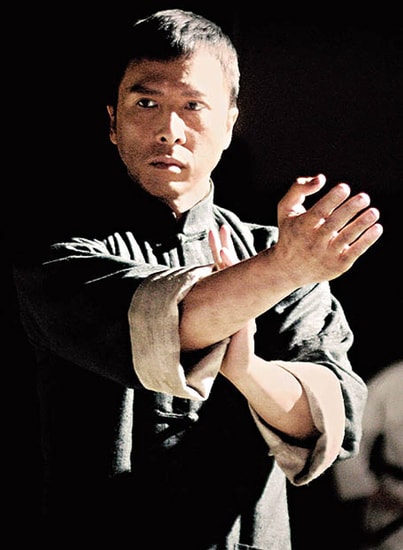 |
| Donnie Yen's name is closely associated with the image of Ip Man on screen. |
Embodying a real historical figure, Donnie Yen admitted: "This is the most difficult role of my career. The psychological scenes are very demanding." Donnie Yen spent several months preparing for the role. He ate only one meal a day, practiced Wing Chun, and visited the homes of Ip Man's sons to learn about their master's life. While training for the fight scenes, the martial arts star injured his left eye and right shoulder, making it difficult to lift his arm several times. On set, the actor immersed himself so deeply in the role that even after filming wrapped, he maintained the same lifestyle as when he played Ip Man, wearing loose robes, walking, and speaking exactly like the character.
Released in 2008, Ip Man became a phenomenon in Asian martial arts films. The film, with a budget of $11 million, grossed $21 million. It was critically acclaimed. Donnie Yen's dynamic martial arts scenes captivated viewers with the Wing Chun style. The image of the actor practicing Wing Chun with a wooden dummy became deeply ingrained in audiences. The film's success led to the opening of hundreds of Wing Chun schools across China and Asia. Donnie Yen is credited with popularizing this traditional martial art to the public. Ip Man's eldest son, Ip Chun, expressed his gratitude to the actor for helping to spread his father's legacy to the world.
Following the success of the first part, the second part was released in 2010, and the third part just premiered on December 31, 2015. Both parts were a sensation, although not as outstanding as the first.
Based on the life of Ip Man, Donnie Yen's trilogy is a semi-biographical work. Many plot details deviate from reality in order to achieve dramatic effect. In the first part, the film tells the story of Ip Man from the time his wealthy family fell into hardship due to the Sino-Japanese War. The film ignores the fact that Ip Man was a police officer, and the scene of Ip Man challenging a Japanese general is fictional. Parts two and three focus on the period when Ip Man moved to Hong Kong after 1949 and both exploit dramatic fight scenes to satisfy the audience.
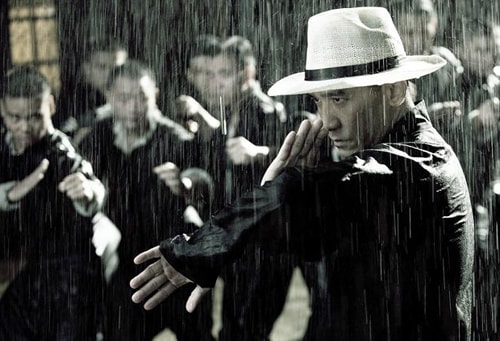 |
| Tony Leung plays Ip Man in the film "The Grandmaster". |
The trilogy of Ip Man films transformed the former grandmaster into a legend today. Besides this film, many other cinematic stories have also immortalized Ip Man. In 2008, the television series The Legend of Bruce Lee featured Ip Man as Bruce Lee's master. In 2010, the film The Legend Is Born depicted Ip Man's life. In 2013, Ip Man: The Final Fight focused on Ip Man's time in Hong Kong, with his eldest son playing a small role. Also in 2013, a television series about Ip Man aired in China and garnered significant attention.
While the Ip Man trilogy is a commercially successful series about the Wing Chun master, Wong Kar-wai's *The Grandmaster* is considered an impressive auteur film about the martial artist's life. Starring Tony Leung as Ip Man, the film focuses on the years before the Sino-Japanese War – the decline of Chinese martial arts. Compared to Donnie Yen's *Ip Man* trilogy, *The Grandmaster* focuses less on dramatic scenes and more on questioning the martial arts philosophy and life of the grandmaster. The film is favored by art film enthusiasts.
According to VNE
| RELATED NEWS |
|---|


