
Huu Le Ancient Temple
(Baonghean) - In Tao Son commune (Anh Son district), amidst the hustle and bustle and many changes, anyone would be amazed to see a communal house with a history of over 400 years. That is Huu Le village communal house.
From National Highway 7, taking a ferry across the Lam River, the ferryman, a man in his sixties, jokingly said: "Upon reaching the center of the commune, you'll witness many changes in this land. But people like me don't want to change anything that belongs to history." And we carried the old ferryman's words with us as we visited the ancient Huu Le communal house.
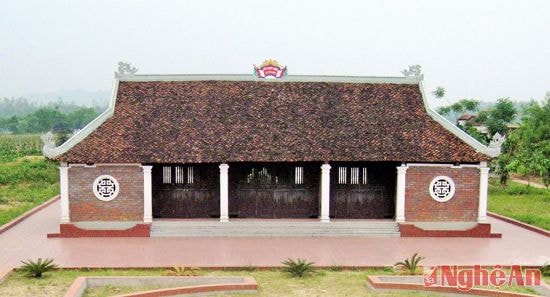 |
| Huu Le communal house relic. |
The communal house (comprising the upper and lower sections) was built in the early 17th century. Over 400 years have passed, marked by countless historical ups and downs, yet the communal house retains its original, ancient features. The entire structure consists of three bays and two wings, with a yin-yang tiled roof. The wooden structure, made of ironwood, is elaborately and delicately carved with dragon and phoenix motifs. The upper section comprises one bay and two side wings; the worship hall has three bays and two side wings, measuring 14 meters long and 8 meters wide.
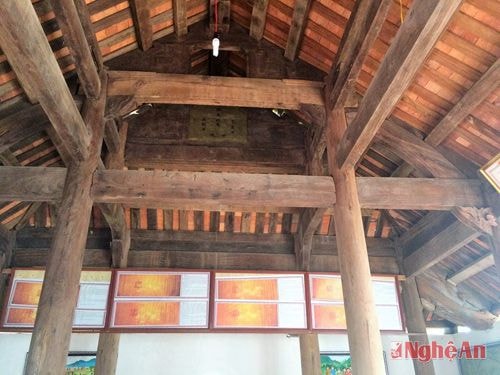 |
| Inside Huu Le communal house. |
According to the elders in the village, the temple used to have a three-arched gate, with two mythical creatures (Nghê) flanking the border, and four dragons guarding the four corners in the style of dragon, lion, turtle, and phoenix, with coiled dragons and seated tigers. Originally, the temple was located at the site of the houses of Mr. Nguyen Van Thuong and Mr. Hoang Van Dien in what is now Hamlet 3; around 1978-1980, Huu Le Temple was used as a food storage warehouse for the cooperative. During this period, Huu Le Temple was moved to the grounds of the former Tao Son Commune People's Committee (in what is now Hamlet 4).
Notably, Huu Le communal house still preserves intact 16 royal decrees from the Nguyen dynasty, including those of Tu Duc, Dong Khanh, Minh Mang, Duy Tan, and Khai Dinh. Mr. Le Van Kien (from village 6), 90 years old, said that he was born and raised on this land, so the communal house is an integral part of his being. He also mentioned that during the war, the communal house served as a base for revolutionary activities of local cadres and a place to hide weapons for the resistance army. In peacetime, the communal house is a place for community activities, meetings, and important ceremonies of Huu Le village.
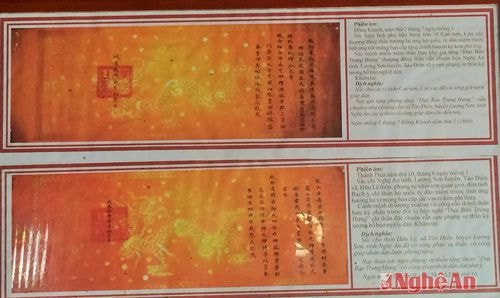 |
| Royal decree from King Đồng Khánh for the communal house. |
Mr. Tran Hai Thanh, a cultural officer of Tao Son commune, said: “After the war, Huu Le village communal house was severely dilapidated. In 2011, the People's Committee of the commune organized a campaign to mobilize people to contribute nearly 500 million VND to rebuild and restore the historical relic of Huu Le village communal house. This activity has the significance of further strengthening the pride of generations of people here.”
Dao Tho
| RELATED NEWS |
|---|


