
Djokovic breaks Federer's record at Roland Garros: A great peak and the worries of turning 39.
After defeating Valentin Royer in four sets, Novak Djokovic officially became the player with the most appearances in a single Grand Slam tournament, despite signs of declining physical fitness.
Novak Djokovic has officially etched his name into the history of world tennis after a dramatic victory over Valentin Royer in the second round of Roland Garros 2026. By completing his 120th match in Paris, the Serbian player not only secured his place in the next round but also officially broke the record of his great rival Roger Federer to become the player with the most appearances in a single Grand Slam tournament.
An unprecedented record at the Philippe-Chatrier stadium.
The match lasted 4 sets with scores of 6-3, 6-2, 6-7(9), 6-3 was not just a purely professional victory. This was the moment Nole affirmed his unique position in terms of endurance. With 120 matches at Roland Garros, he surpassed the milestone of 119 matches that Roger Federer had set at Wimbledon. In addition, this was also the 82nd time Djokovic participated in the main draw of a Grand Slam tournament, officially surpassing both Federer and Feliciano Lopez (81 times) to hold the world record alone.
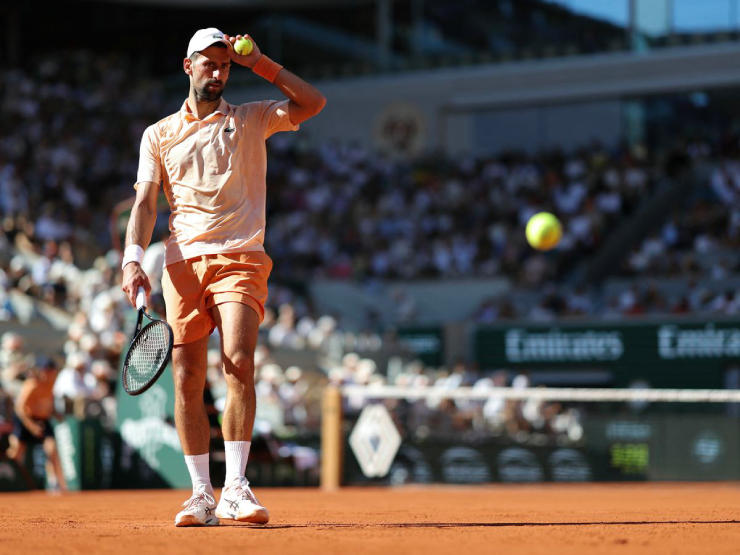
Notably, the victory over Valentin Royer also extended the absolute dominance of the number 3 seed against French opponents. With 30 consecutive unbeaten matches against home players right here in Paris, Djokovic demonstrated the mettle of a true "king," despite the suffocating pressure from all sides of the stadium.
Red alert regarding the physical limits of the 39-year-old legend.
However, behind the impressive statistics lies a harsh reality that Djokovic is facing. The 3-hour and 28-minute match under the sweltering heat of Paris revealed cracks in his previously flawless playing style. In particular, his second-serve crisis, with nine double faults – an unusually high number – showed that Nole's ball control and shoulder power are seriously compromised.
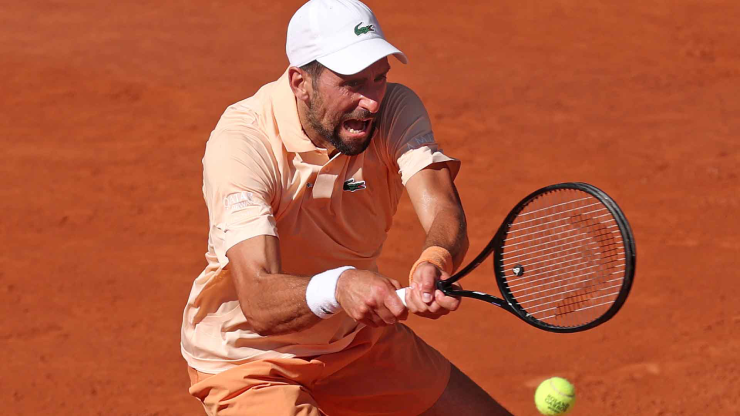
Allowing a lower-ranked player like Royer to come back and win the third set, despite having broken serve twice to take the lead, is the clearest evidence of Djokovic's fatigue at crucial moments. The body of a 39-year-old athlete has begun to show negative reactions when the intensity of the match is pushed too high.
A plea and the will to survive.
In the post-match press conference, Djokovic openly admitted his fatigue. He made a rare request to the tournament organizers: to only schedule him for daytime matches (Day Session). Nole acknowledged that at his age, recovering from matches that last until 2-3 am is almost impossible if he wants to advance deep into the tournament.
To compensate for his declining physical fitness, Djokovic employed his brilliant mind to the fullest. He proactively suffocated his opponent with rallies of more than five touches, directing the ball deep into both corners of the court to wear down Royer's youthful energy. With 6 out of 9 break points successful, Nole showed that his ability to capitalize on opportunities remains his sharpest weapon.
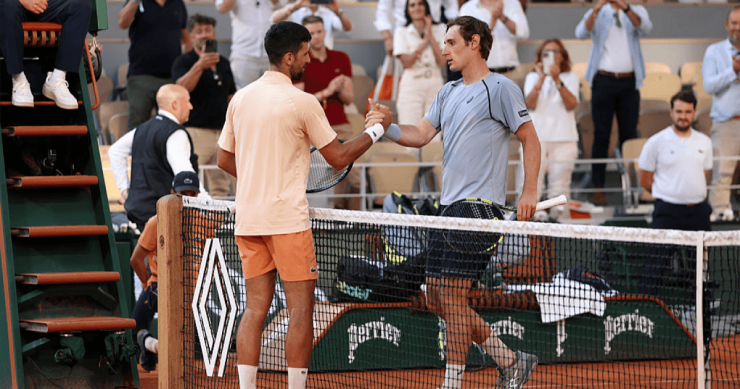
Ending the match with a triumphant violin gesture directed towards the Parisian crowd, Djokovic sent a powerful message: He may be getting older, but his fighting spirit and desire to win his 25th Grand Slam title have never waned. The real challenge awaits him in the third round, where the prodigy Joao Fonseca is poised for a historic upset.


