
Vietnamese businesses are aiming for AEC 2015.
That was the theme of a forum organized by the Vietnam Chamber of Commerce and Industry (VCCI) in collaboration with the Inter-Ministerial Steering Committee on International Economic Integration, Ministry of Foreign Affairs, held on the morning of December 13th in Hanoi.
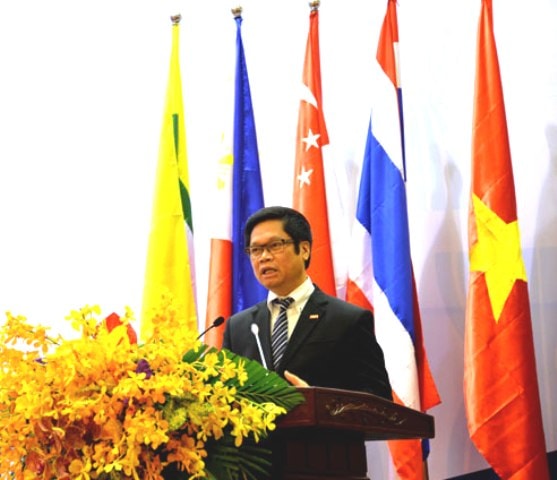 |
| Mr. Vu Tien Loc speaks at the forum. |
In his opening remarks at the Forum, Dr. Vu Tien Loc – President of VCCI – stated: Only two weeks remain until the official formation of the ASEAN Economic Community (AEC) (January 1, 2016). According to Dr. Vu Tien Loc, the AEC consists of four elements: ensuring the free movement of goods, services, investment, and capital.
The Chairman of VCCI stated that the ASEAN Economic Community (AEC) inherently lacks a tightly structured framework and high compatibility. The AEC is an integration process, not an agreement; it is an aspiration, not a mandatory requirement, for the ASEAN Economic Community. Therefore, the AEC is a process, and the announcement of its formation on January 1, 2016, marked the beginning of building the ASEAN Economic Community. Building an economic community similar to the EU will require a considerable amount of time.
According to the VCCI Chairman, among the FTAs, the tariff reductions within the ASEAN Economic Community are currently the highest, even higher than the TPP and other FTAs. Regarding the free trade of goods and services, the commitments are also the highest. The opportunities for businesses when the AEC is formed include opening up many markets, creating new momentum and impetus for businesses… However, the AEC also brings many challenges such as businesses having to compete intensely with goods due to lower levels of development and similar levels of development, lower service levels, labor mobility, and challenges in managing capital flows.
According to Mr. Le Trieu Dung, Deputy Director of the Multilateral Trade Policy Department (Ministry of Industry and Trade), there are four main reasons for countries to participate in the AEC community integration: expanding markets for export goods; creating favorable conditions for investment; creating jobs; and promoting effective domestic reforms.
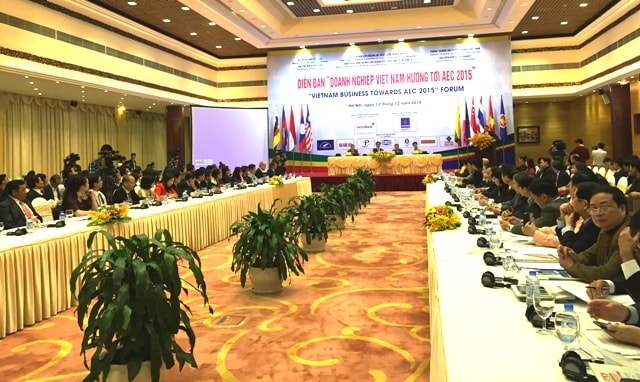 |
The forum attracted a large number of representatives from relevant ministries and departments. |
Presenting on the ASEAN Economic Community and Vietnam's participation, Mr. Nguyen Hong Cuong, Director of the ASEAN Department, Ministry of Foreign Affairs, emphasized that the formation of the ASEAN Community in 2015 and the implementation of the ASEAN Community Vision 2025 create both intertwined opportunities and challenges for Vietnam. Generally, the opportunities are essentially the benefits gained from participating in ASEAN cooperation over the past 20 years, but will be greater and more specific, while the challenges will also be more numerous and direct.
For businesses, the main opportunities include a broader and more favorable business environment, a larger product market, and the chance to enhance competitiveness through scale, productivity, and reduced production costs; it also offers more favorable conditions for investing in other ASEAN countries. However, businesses will also face fierce competition, even within the Vietnamese market; some businesses with low competitiveness will find it difficult to participate in high-value and profitable supply chains.
For the people, there will be practical benefits such as: living in a peaceful, secure, safe, friendly, and mutually understanding environment; having more choices of goods and services at lower prices and higher quality; having more opportunities to find skilled jobs in ASEAN countries;... However, people also face some challenges, especially having to compete for skilled jobs, even in Vietnam – Mr. Cuong said.
Overall, through the forum, participating delegates were able to grasp and understand the positive aspects and impact of the ASEAN Trade in Goods Agreement (ATIGA) on eliminating tariff barriers with zero tariff rates for member countries, as well as in many regional trade agreements (RTAs), bilateral free trade agreements (FTAs), and the Trans-Pacific Partnership (TPP). In addition, strategists will jointly plan ways and methods to enhance the effectiveness of cooperation between Vietnamese businesses and businesses in ASEAN countries in the future. Based on this, Vietnamese businesses will be encouraged to strengthen cooperation and expand economic liberalization with member countries, facilitating the movement of goods within ASEAN, contributing to building and consolidating Vietnamese product brands in the process of regional cooperation and international integration.
According to the Communist Party of Vietnam
| RELATED NEWS |
|---|


