
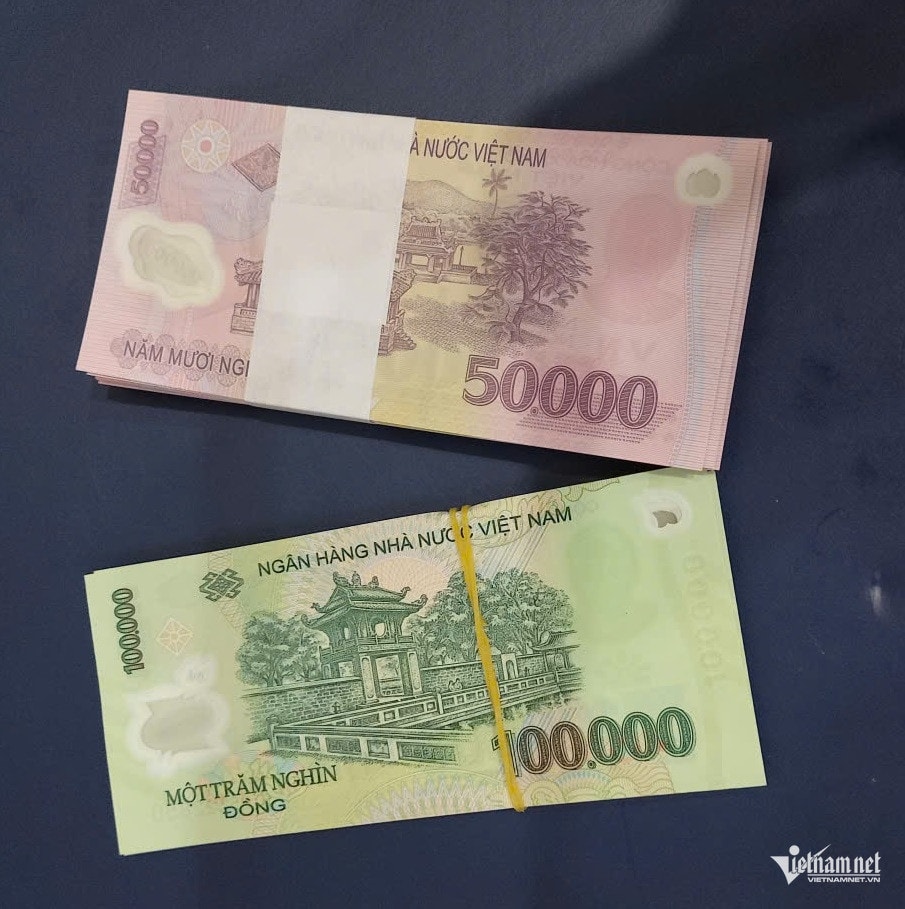
Where can I exchange small denominations or new banknotes without breaking the law?
With the Lunar New Year of the Horse 2026 fast approaching, the demand for exchanging old banknotes for new ones and smaller denominations for giving lucky money is increasing. However, these services carry many risks of losing money for both parties, and may even violate the law.
Beware of currency exchange scams.
In reality, the exchange of small denominations and new banknotes is currently very active online. People who need to exchange small denominations or new banknotes can easily find advertisements on social media offering money exchange services at low fees.
However, exchanging money through strangers always carries many risks, such as receiving less money than promised, receiving money that doesn't meet the promised quality, or even counterfeit money. In fact, there have been cases where customers transferred deposit money but were later blocked from contact and had the entire amount stolen.
Besides the risk of losing money, illegal currency exchange also carries the potential for violating the law. According to Decree 88/2019/ND-CP, the act of exchanging money in violation of regulations can be fined from 20 to 40 million VND.
The State Bank of Vietnam also clearly stipulates that only the State Bank (Trading Office, Branches), credit institutions, branches of foreign banks, and the State Treasury are allowed to collect and exchange banknotes that do not meet circulation standards.
The law does not permit individuals or organizations to arbitrarily exchange new banknotes or small denominations to charge a fee for the difference. Therefore, illegal currency exchange transactions will not be protected by law in the event of disputes or complaints.
Given this situation, people should be more vigilant and avoid using online services for exchanging new banknotes or small denominations during the Lunar New Year holiday.
Currency exchange should be carried out at banks and credit institutions in accordance with legal regulations to ensure safety and protect legitimate rights.
The State Bank of Vietnam advises that when people discover acts of exploiting currency exchange activities for fraud, profiteering, or circulating counterfeit money, they should promptly report them to the authorities for handling.
The more you rush, the more you need to slow down.
Besides scamming through services like exchanging small denominations and new banknotes, fraudsters are also increasingly employing money transfer scams during the period leading up to the Lunar New Year.
Speaking at the seminar "Using Money Wisely and Making Secure Payments During Tet" organized by the Banking Times, Mr. Tran Hoai Nam - Director of TPBank's Digital Banking Center - stated that using money wisely is not just about cashless payments or applying digital technology, but more importantly, about being mindful and cautious in every financial transaction.
In reality, banks have observed that fraudsters often exploit two common mindsets of the public to profit.
First and foremost is the psychology of compliance. Information that is "mandatory," such as updating VNeID, changing citizen identification cards, or adding tax identification numbers, easily makes people worry about violating regulations, leading them to hastily comply, clicking on links or messages from unknown sources.
"Just one careless action can lead to device hijacking, personal information theft, and account funds being completely drained," warned Mr. Tran Hoai Nam.
According to Mr. Nam, the "profitable" mentality, or the feeling of getting a "good deal," is also a reason why many people fall into these traps. Offers such as "receive rewards," "receive money," "receive thank-you gifts," and "Tet holiday promotions" appear frequently at the end of the year, especially on social media. Regardless of which psychology they target, the common thread in these schemes is creating time pressure: If people don't act immediately, they will "lose their benefits" or "be penalized for non-compliance."
"Therefore, the message that banks constantly emphasize is: The more urgent the situation, the more you must slow down. When faced with urgent requests, people need to calmly check and verify information; absolutely do not click on strange links, do not provide OTPs, do not share your citizen identification number, phone number, or any personal information via text messages, calls, Zalo, or online platforms without clearly identifying the contact person," Mr. Tran Hoai Nam advised.


