
The Soviet Union's 'suicidal' attempt to sink a US aircraft carrier.
The Soviet Union once planned to deploy 100 Tu-22M bombers carrying missiles for a suicide attack on a US carrier strike group.
The Tu-16 squadron served as the eyes and ears for the missile attack.
In the late 1970s and early 1980s, the Soviet Union lacked the capacity to compete with the United States in the aircraft carrier race. This led Moscow to secretly develop a deterrence strategy by destroying American aircraft carriers, based on Japan's suicide attack tactics from World War II, according to WATM.
During World War II, the Soviet Union recognized Japan's formidable fleet of warships, but the emergence of the American carrier strike group completely altered the nature of naval warfare. Most Japanese warships were sunk by American fighter planes in the final stages of the war, leaving them with no way to counter American warships.
The only way for Japan to counter the US was to launch a preemptive strike that would severely damage the aircraft carrier, rendering fighter jets unable to launch and neutralizing the US Navy's most powerful weapon. This forced Tokyo to employ the suicide "Kamikaze" tactic, using bomber aircraft to crash directly into US warships.
The Soviet strategy for destroying American aircraft carriers also relied heavily on air power, with this force stationed at bases near the coast. While this plan didn't mimic the Kamikaze tactic, the Soviets estimated that each unit attacking an American aircraft carrier would lose up to 50% of its personnel during the mission.
According to the plan, the Soviet naval air force would deploy 100 Tu-22M bombers equipped with anti-ship missiles to attack the US carrier strike group. Soviet strategists wanted to neutralize the air defense system of the carrier group's escort, creating a "golden moment" to launch a missile attack.
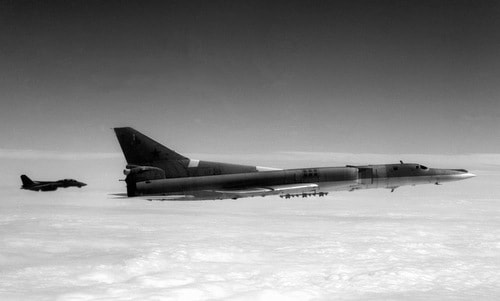 |
US F-14 fighter jets escorting Soviet Tu-22M bombers. Photo: Wikipedia. |
The Soviets knew that the American interceptor squadrons operated based on air traffic control instructions. They would try to deceive the air traffic controllers, overloading the sensor systems and preventing American warships from reacting in time to an all-out attack.
Soviet naval pilots also did not trust target designation data from satellites or intelligence. Their most reliable source of information was the scout ships that constantly shadowed the American fleet, sending live, real-time data.
Even the crews on the shadowing ships knew they would be annihilated if war broke out. "As soon as a declaration of war was announced or orders were received from above, the captain would relay the position of the American fleet to the bombers via radio, then fire on the flight deck and the command tower of the aircraft carrier. The ship could also ram directly into the American aircraft carrier," revealed Maksim Y. Tokarev, a former Soviet naval officer.
Soviet bombers would launch a barrage of missiles from the furthest distance to create a diversion, while two others would...reconnaissance aircraftThe Tu-16s would attempt to infiltrate the center of the American formation to visually locate the aircraft carrier. They would then relay its precise location to the rest of the force via radio. The Tu-16 crew understood that this was a suicide mission, with no hope of a safe return.
Once the location of the American aircraft carrier was identified, the main Soviet force would simultaneously launch anti-ship cruise missiles. Bomber squadrons would attack from different directions and altitudes, aiming to overwhelm the enemy's air defenses. The critical moment for attack lasted only one minute to maximize effectiveness. "If, during the exercise, the attack lasted longer than one minute, the strike would be considered a failure," Tokarev stated.
According to Soviet calculations, it would take 12 conventional anti-ship missiles or one nuclear warhead to sink a US aircraft carrier.
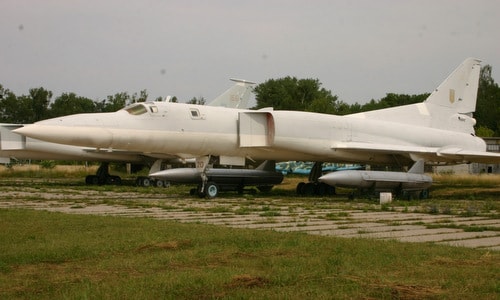 |
The Tu-22M aircraft carrying missiles were the focus of the "suicide strike". Photo: Wikipedia. |
Due to the extreme difficulty and high casualty rate of this plan, Soviet naval bomber crews often considered themselves suicide squadrons. They also calculated that the escort ships would only survive the first 20-25 minutes of a battle with a US carrier strike group. The heavy losses and the lack of guaranteed effectiveness in sinking the aircraft carrier led the Soviet Union to abandon the plan.
According to VNE
| RELATED NEWS |
|---|


