
Supporting the development of tea cultivation in resettlement areas.
(Baonghean) - Baonghean newspaper had a dialogue with Comrade Nguyen Van Que - Deputy Secretary of the District Party Committee, Chairman of the People's Committee of Thanh Chuong district - on some issues related to the industrial tea plantation project in the resettlement area.
PV:Tea plants have been identified by Thanh Chuong district as the key crop to stabilize and improve the lives of people in the resettlement communes of Thanh Son and Ngoc Lam. So, what are the results of the implementation so far, Comrade?
Comrade Nguyen Van Que:In 2006, as part of the Ban Ve Hydropower Resettlement Project, 2,123 households with 10,730 people were relocated by Thanh Chuong district to two new communes, Thanh Son and Ngoc Lam. The resettlement areas were primarily hilly and mountainous. Therefore, in addition to ensuring immediate livelihoods for the people, finding suitable crops to guarantee a stable and long-term income was a major concern for the district.
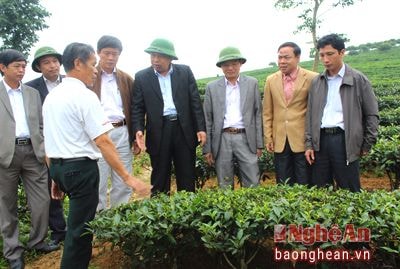 |
| Provincial leaders visit the tea garden of Mr. Vi Tuyen Quynh in Tan Lap village, Thanh Son commune. (Thanh Chuong). |
Based on an analysis of soil conditions, climate, and the characteristics of several crops, it was found that tea plants are suitable for the soil, easy to cultivate, and have a stable market. Therefore, in 2010, after stabilizing the immediate lives of the people, the district focused on directing these two communes to disseminate information, promote, and encourage people to plant tea.
Officials from the District Department of Agriculture and the District Agricultural Extension Station worked diligently, going directly to each village, with the motto of providing hands-on guidance to the people from land preparation to planting methods; instructing on care techniques at each stage of tea plant development. After nearly 4 years of persistent guidance, nearly 80 hectares of tea have been planted in these two communes, and the initial results are showing promise.
To further expand the area, the District People's Committee submitted a proposal to the Provincial People's Committee for approval of a tea planting project for the resettled people of Thanh Son and Ngoc Lam communes, which was approved by the Provincial People's Committee through Decision No. 4021/QD-UBND dated September 11, 2013. The project aims to plant 534 hectares of tea in the resettlement area by 2018; including 320 hectares in Thanh Son commune and 214 hectares in Ngoc Lam commune.
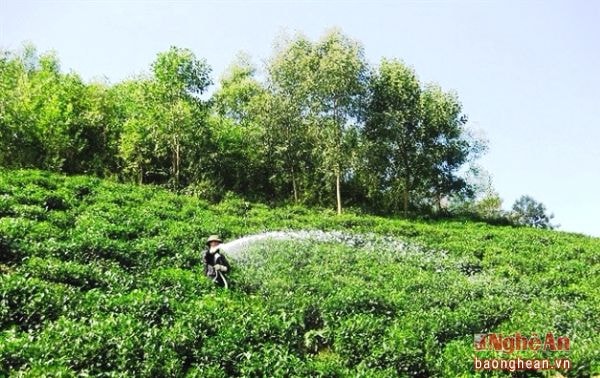 |
| Water the tea plants. |
Tea growers in Thanh Son and Ngoc Lam communes also benefit from the tea development support policy under Decision 87/2014/QD-UBND dated November 17, 2014, which applies to high mountainous areas such as Con Cuong, Tuong Duong, and Ky Son, including land preparation support of 5 million VND/ha.
PV:Tea cultivation requires advanced intensive farming techniques, while the farming practices of the people in the resettlement areas are still limited. What solutions can help tea cultivation truly take root in this region?
Comrade Nguyen Van Que:Following the Provincial People's Committee's decision approving the project, the Thanh Chuong District People's Committee established a Steering Committee, assigning the Deputy Chairman of the District People's Committee in charge of agriculture and forestry to directly supervise it; assigning specific responsibilities to the Department of Agriculture; the Department of Ethnic Minorities; district-level mass organizations: the Farmers' Association, the Women's Association, the District Youth Union; and the Chairmen of the People's Committees of Thanh Son and Ngoc Lam communes, in coordination with the Ngoc Lam Border Guard Post, to participate in the project following the principle of "hands-on guidance".
Thanks to decisive leadership and the application of proper planting and care techniques, tea plants in the Ban Ve hydropower resettlement area are generally developing well, with the tea growing area increasing year by year.
In the two communes, 140.67 hectares of tea were planted in 2014, including 70.4 hectares in Thanh Son and 70.27 hectares in Ngoc Lam; in 2015, 70.8 hectares were planted, including 26 hectares in Thanh Son and 44.8 hectares in Ngoc Lam, and the project is continuing in 2016. Currently, including tea planted before the provincial project, there are nearly 300 hectares of tea in these two communes. Dozens of hectares of this tea have been planted for 6-8 years, providing stable income for many households.
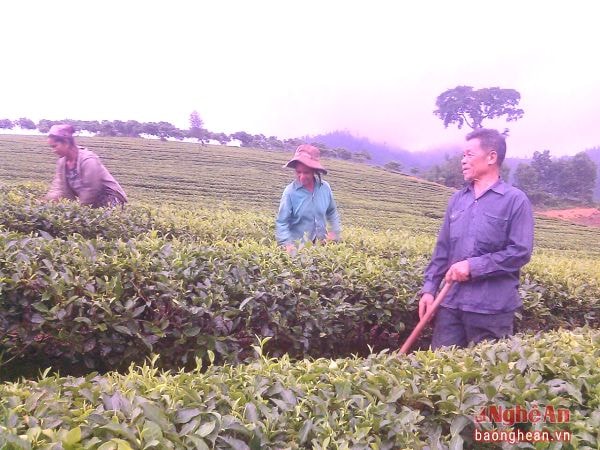 |
| The villagers are taking care of the tea plants. |
For example, the household of Mr. Vi Tuyen Quynh in Tan Lap village, Thanh Son commune, currently has a tea plantation area producing over 20 tons of tea buds per year, equivalent to 50-70 million VND per year. Similarly, the households of Mr. Luong Van Thuong, Mr. Luong Thanh Hoai, and Mr. Luong Van Thai in Muong village, Ngoc Lam commune, each harvest about 10-12 tons of tea per year, equivalent to approximately 30 million VND or more per year...
PV:The economic benefits that tea cultivation brings to the lives of people in resettlement areas have been initially proven. However, recently, some people are still not enthusiastic about planting and developing tea. So, what is the "bottleneck" here, Comrade?
Comrade Nguyen Van Que:Yes, currently some households are not enthusiastic about tea cultivation, leading to the planned tea planting area not being implemented according to the project's schedule. This problem has many causes, the main one being that the old production methods and practices of the local people have not changed quickly enough to meet the requirements of the new production process.
Secondly, due to the prolonged hot weather in recent years, especially the heatwaves of 2014 and 2015, some tea plantations have died, affecting the morale of the people.
Thirdly, the local people prefer planting acacia trees because they are less time-consuming, easy to grow, require less investment, and do not demand the same intensive cultivation techniques and procedures as tea plants.
In the coming period, the district is determined to continue strengthening propaganda and mobilization efforts to achieve a "breakthrough" in people's thinking. This is because tea plants yield harvests for 30 years and have proven effective in poverty reduction in Thanh Chuong district for many years.
Furthermore, we consistently work alongside the local people, adhering to the approved project plan, enhancing the sense of responsibility of specialized departments at the district level, local leaders, and agricultural officials in the two communes; organizing visits for the people to several successful models, combined with the application of science and technology, selecting high-yielding tea varieties that are resistant to weather conditions, ensuring stable tea plant development under all weather conditions.
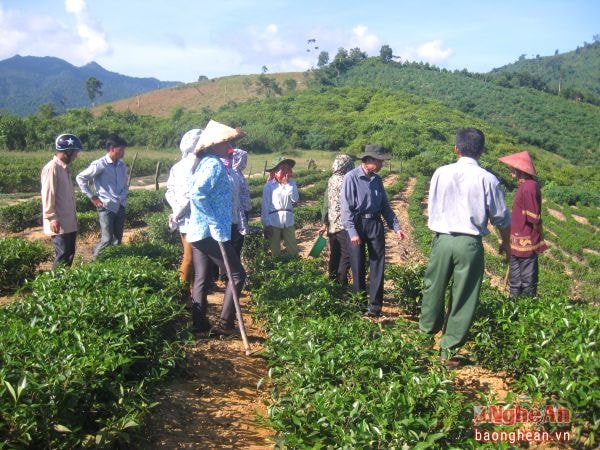 |
| The agricultural extension station instructs people on how to weed tea plants. |
When the tea plants are ready for harvest, the district also guides the people on how to harvest them, encourages households with the means to form joint ventures and partnerships to install processing lines, and calls for attracting investors to install processing lines to link production with processing and product distribution, aiming to bring stable income, increase income and improve the lives of the people.
PV:Thank you, comrade!
| Mr. Vi Dinh Tan -Chairman of the People's Council of Thanh Son Commune Because the people are accustomed to simple production practices, and tea cultivation now requires more advanced processes and scientific techniques, they are not enthusiastic about it. Furthermore, the project was developed without conducting surveys to understand the people's desires and aspirations regarding what crops to grow or what livestock to raise. Therefore, the district needs to thoroughly investigate the current situation to find appropriate solutions and provide support mechanisms for seeds and fertilizers for tea growers. Mr. Lo Huy Hung - Chairman of the People's Committee of Thanh Son Commune The consecutive heatwaves in recent years have also dampened people's enthusiasm for the tea planting project. Earlier this year, some households cut down their tea plants. When the commune learned of this, they went down to the village to educate and persuade the people not to destroy them. Mr. Vi Tuyen Quynh - Tan Lap village, Thanh Son commune Compared to acacia trees, cassava, and rice, tea remains the most profitable crop. To reassure people about growing tea, it is necessary to strengthen the role of village leaders so that people can harvest and sell their products promptly, with designated locations, and sell directly from the hills. |
Mai Hoa
(Perform)


