
Vietnam national team beat Laos 2-0, but their attack was criticized for its ineffectiveness.
Despite dominating but lacking finishing touch, Vietnam beat Laos 2-0 thanks to a 68th-minute penalty by Xuan Son and a 90+3 goal by Tuan Hai; fans debated the attacking line.
In the 90+3 minute, as Laos pushed forward in search of an equalizer, Tuan Hai sealed the match with a goal, making the final score 2-0. Vietnam secured all three points in the fifth match of Group F in the third round of the 2027 Asian Cup qualifiers, but what lingered on social media was the heated debate about the effectiveness of their attacking line.
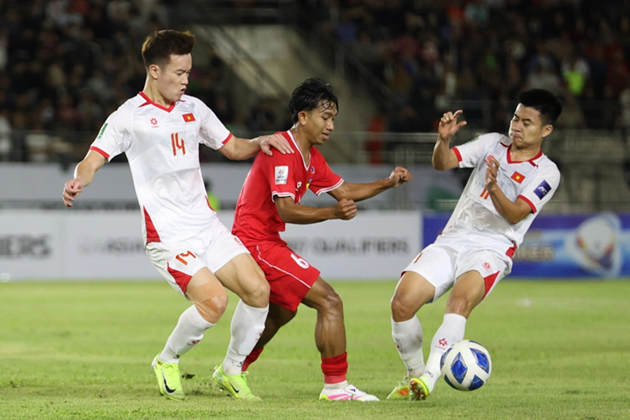
The game was dominated, but the deadlock broke in the second half.
Vietnam entered the match aiming for three points to keep pace with the top spot. The reality on the field showed that coach Kim Sang-sik's team dominated in terms of ball possession and created chances. The problem arose in finishing: many final touches lacked accuracy, leaving Laos' net untouched for most of the game.
The turning point came in the second half when coach Kim brought on Xuan Son and Tuan Hai, sharpening the attacking line. In the 68th minute, Xuan Son successfully converted a penalty, relieving the psychological pressure. As the match drew to a close, Tuan Hai sealed the victory in the 90+3 minute, putting an end to Laos' defensive efforts.
- 68': Xuan Son successfully converts the penalty, Vietnam 1-0.
- 90+3: Tuan Hai scores, sealing a 2-0 victory.
Tactical perspective: personnel adjustments change the rhythm of the attack.
In the context of ineffective finishing, coach Kim Sang-sik's decision to reinforce the attack in the second half proved crucial. The introduction of Xuan Son and Tuan Hai created more avenues to approach the goal, thereby increasing the frequency of pressure in the penalty area. From a game with many opportunities but no real deadlock, Vietnam converted their advantage with a set piece and a late shot, fitting the momentum they had been building.
Mixed reactions: praise for the Lao spirit, criticism of Vietnam's effectiveness.
Immediately after the match, regional football forums recorded many opinions. On the Asean Football fanpage, user Arsila Faisal commented: “Against a weak opponent with no motivation left like Laos, the Vietnamese team created many opportunities but only scored 2 goals. This shows that their attack really has problems.”
User Jimmy Sitthiphon commented: “The Vietnamese national team's attack still relies heavily on Xuan Son. In the first half, their forwards were almost harmless to the Laotian defense.” Fan Jinggoh predicted: “If the attack continues to perform like this, the Vietnamese national team could very well lose to Malaysia again in the return match.”
Conversely, on the Lao Football Federation's fanpage, many expressed pride that Coach Ha Hyeok-jun's team, largely composed of U23 players, only lost 0-2 to a stronger opponent. Their fighting spirit and progress were seen as highlights in the team's rejuvenation process.
Impact on Group F: 12 points after 5 matches, will face Malaysia in the final round.
With their victory over Laos, Vietnam maintained their second position in Group F with 12 points after 5 matches, 3 points behind Malaysia. In the final match on March 31, 2026, Vietnam will host Malaysia in a game considered to potentially determine the top spot in the group. This context places a clear demand on coach Kim Sang-sik's team: to continue maintaining a proactive approach while improving their ability to capitalize on opportunities – a weakness that was just exposed against Laos.
The remaining challenge: achieving a decisive victory.
Once control and opportunities have been established, the final touch is the variable that separates an early victory from a scenario that has to wait until injury time. In Laos, Vietnam scored both goals after halftime: one from a penalty, one in injury time. That was enough to secure 3 points, but also enough to reignite the debate about the quality of finishing. The answer can only come in the final matchday, where every chance is likely to be decisive.


