
Hanoi plans to charge fees for vehicles entering the inner city, plus an additional pollution surcharge.
Hanoi argues that charging fees for vehicles entering the inner city will directly impact the travel plans of commuters who need to enter restricted areas. The areas where fees are planned are routes within inner-city districts where motorized vehicles need to be restricted.
Charging a fee for entering the inner city area.
The Hanoi People's Committee has recently submitted a document to the Prime Minister proposing the consideration, amendment, and supplementation of several regulations to serve as a basis for the city to implement the Project "Strengthening the management of road transport vehicles to reduce traffic congestion and environmental pollution in the area, giai đoạn 2017-2020 with a vision to 2030".
According to the Hanoi People's Committee, motorized vehicles account for a large proportion of air pollution sources. Therefore, the current number of vehicles will be a major factor impacting air quality and significantly affecting the quality of life for residents.
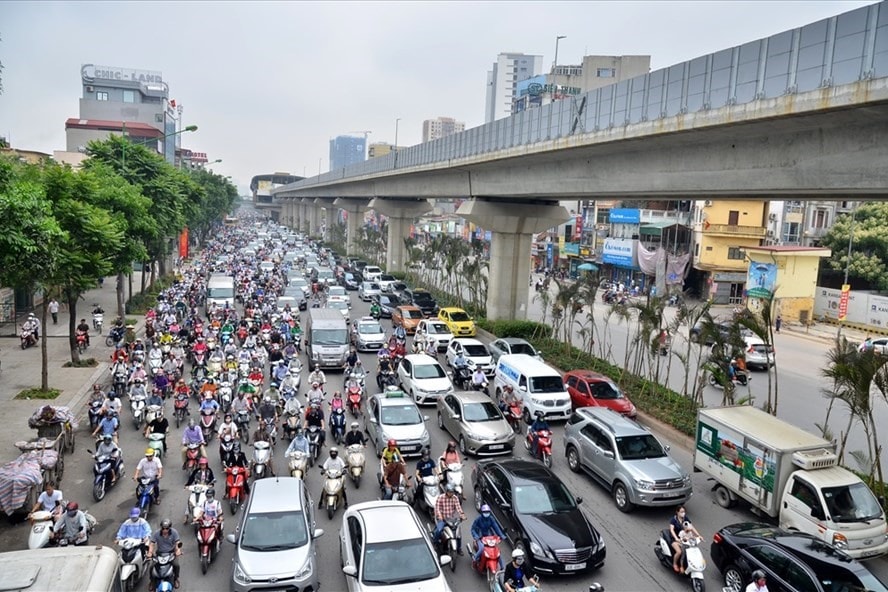
Therefore, implementing regulations to reduce traffic congestion and limit the concentration of polluting emissions is necessary.
Accordingly, Hanoi argues that charging fees for vehicles entering the inner city will directly impact the travel plans of commuters who need to travel to restricted areas. Commuters will have to consider their travel options, routes, and means of transportation more carefully.
The fee level is determined on the principle of partially offsetting the costs of ensuring traffic order and safety in the restricted traffic zone.
However, the proposal is facing difficulties because the list of fees and charges issued under the 2015 Law on Fees and Charges does not include the type of fee that Hanoi intends to collect.
Additional pollution fee
In a document sent to the Prime Minister, Hanoi also proposed another measure to reduce pollution: regulating an environmental pollution surcharge based on emission levels during vehicle inspections.
The Hanoi People's Committee explained that the increase in traffic "has reached an alarming level." If timely management measures are not implemented, traffic congestion and environmental pollution "will become serious" in the future.
It is projected that by 2020, Hanoi will have over 843,000 cars and more than 6 million motorcycles and scooters. By 2030, the number of cars will exceed 1.9 million, while the number of motorcycles and scooters will exceed 7.5 million.
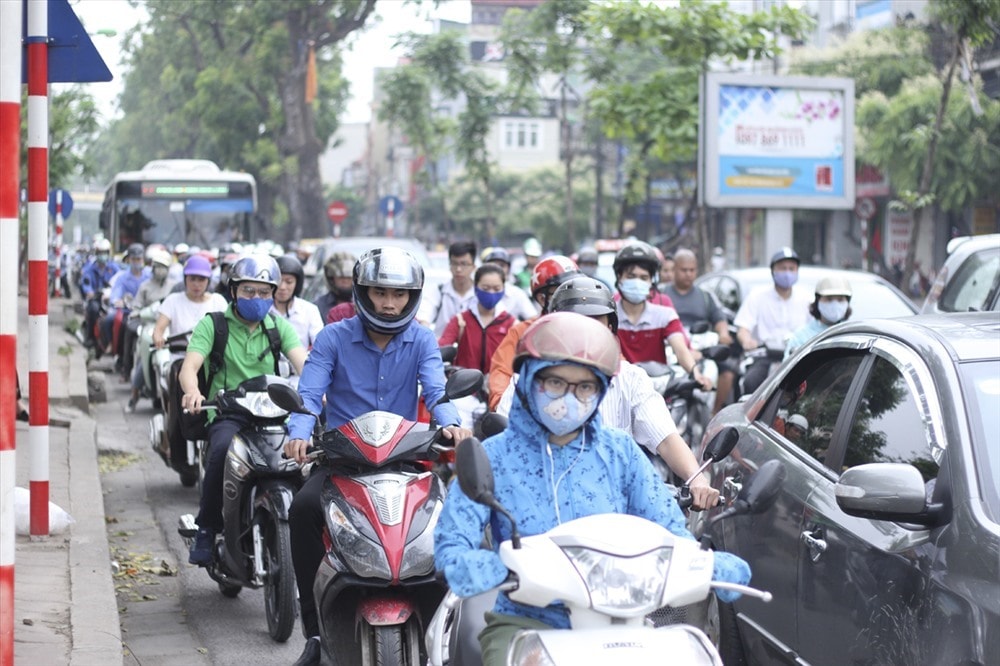
Therefore, the Hanoi People's Committee believes that regulating the environmental pollution surcharge based on emission levels during vehicle inspection "is a measure to limit the operation of old, high-emission vehicles," and is absolutely necessary.
Hanoi's plan to strengthen traffic management was approved by the City People's Council at its July 2017 session, in which the city outlined a roadmap to ban motorcycles from operating in inner-city districts by 2030.
In addition, the plan also proposes many other solutions to manage vehicles, reduce pollution and traffic congestion, such as: banning cars from operating during certain hours or days on some streets; piloting parking bans based on even and odd days; issuing regulations on the operation of taxis from other provinces, etc.
The Hanoi People's Committee also requested the Government to assign the Ministry of Transport to finalize regulations for managing electric bicycles similarly to motorcycles. This environmentally friendly mode of transport "is revealing certain limitations" when in circulation and "is becoming a hidden hazard causing accidents" in the inner city.
Hanoi currently has 7,000 electric bicycles, and it is "necessary to manage electric bicycles as motorized vehicles." However, electric bicycles are not yet classified as motorized vehicles, so Hanoi lacks the basis to implement this. Therefore, the city of Hanoi has requested the Ministry of Transport to add "electric bicycles as a category of motorized vehicles" to the revised Road Traffic Law.


