
Move the livestock farm away from residential areas in Hoang Mai.
(Baonghean) - Hoang Mai town has a policy of developing livestock farming away from residential areas, combined with planting fruit trees or forests. This approach increases economic efficiency per unit area while also helping to solve the problem of ensuring environmental hygiene.
In recent years, residents of Hamlet 5, Quynh Vinh Commune (Hoang Mai Town) have been concerned about the foul odor emanating from the pig farm owned by Mr. Nguyen Van Hoat. With an area of 300 square meters, his family has built two rows of pig pens, housing a total of 100 pigs. Due to the limited space and the lack of investment in proper waste treatment facilities, most waste is not treated thoroughly and is discharged into the environment, significantly impacting the lives of many surrounding households. Many residents have petitioned the commune authorities to relocate the farm away from the residential area, but due to land scarcity, Mr. Hoat's family has been unable to do so.
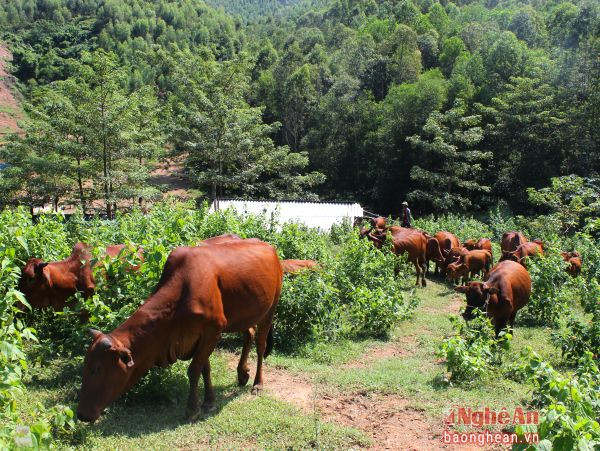 |
| Raising cattle on hillsides is one of the strengths of farmers in Quynh Vinh commune (Hoang Mai town). |
Faced with this reality, many localities have encouraged people to build livestock farms far from residential areas to minimize environmental pollution and ensure the health of the people. The family of Mr. Nguyen Cong Dong, in Hamlet 18, Quynh Vinh Commune, is one of the pioneering households to build a livestock farm combined with fruit tree cultivation in the hilly area.
In 2013, after surveying market demand and land conditions, his family partnered with households possessing land, labor, capital, and scientific and technical knowledge to build a farm. On nearly 3 hectares located far from residential areas, his family constructed a 5,000 m² livestock barn system and a 2,000 m² grazing area. Currently, the farm raises nearly 500 pigs (both meat and breeding), and a total flock of 35,000 chickens. Each year, the farm supplies over 80,000 chicks of various types, providing regular employment for 8-10 workers.
Besides livestock farming, his family also cultivates 500 fruit trees such as jackfruit, oranges, longan, and lychee, generating billions of dong in revenue each year. Most importantly, the large-scale integrated farm ensures environmental hygiene. To build a farm that meets environmental hygiene standards, his family invested over 2 billion dong in a closed-loop system. Waste is collected and flows into a filtration system and biogas digester before being discharged into the environment. The water from the final settling tank is used to irrigate the fruit trees. As a result, the surrounding air is free of foul odors, and the trees thrive.
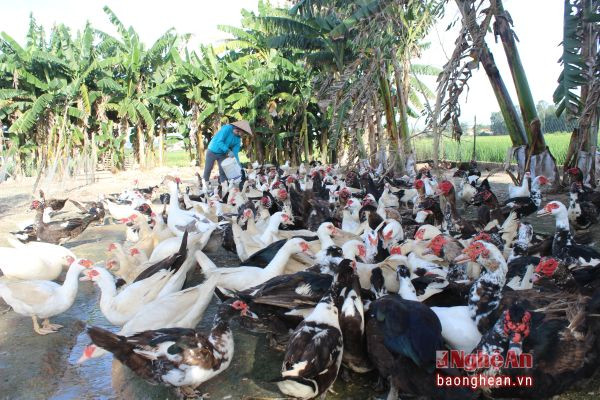 |
| These farms combine livestock farming with fruit tree cultivation. |
Many livestock and poultry farming development models are becoming a strength of Hoang Mai town. Currently, the town has 3 farms and 85 family farms, mainly raising buffalo, cattle, goats, deer, pigs, and chickens. The average annual growth rate in the livestock sector reaches 8%, with livestock increasing by 20% and poultry by 18%.
However, developing concentrated livestock farms far from residential areas still faces many difficulties. To date, most livestock farmers have not been granted farm business certificates because their land does not meet the requirements. On the other hand, when building large-scale farms and producing a lot of products, finding a market for those products is also a concern for farmers due to the volatile and unstable market.
Mr. Vu Tuan Dung, Vice Chairman of the People's Committee of Hoang Mai town, said: "Although there are still many difficulties, in the coming time, the town will actively implement specific solutions to overcome this situation, gradually moving farms and family farms away from residential areas."
Thanh Thuy
(Hoang Mai Radio Station)
| RELATED NEWS |
|---|


