
Germany develops Cobra 600 jet-powered UAV, increasing the range of IRIS-T missiles to 400km.
The Cobra 600 UAV system acts as a mobile airborne launch platform, allowing the IRIS-T anti-aircraft missile to extend its operational range up to 400km, far exceeding that of ground-based launchers.
According to a report from The War Zone (TWZ), Germany is developing a large jet-powered unmanned aerial vehicle (UAV) called the Cobra 600. This design, described as a "jet taxi," is tasked with delivering IRIS-T guided anti-aircraft missiles to firing positions far from their launch point, in order to overcome the limitations in range of traditional air defense systems.
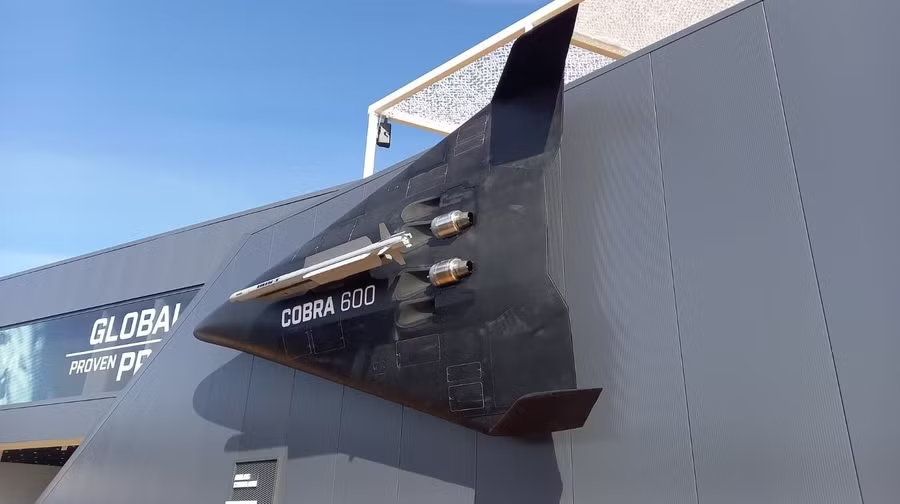
Solutions to extend the range of the IRIS-T system.
Currently, the IRIS-T SLS and IRIS-T SLM air defense systems face limitations in their operational range, at 12km and 40km respectively. To address this issue, engineers at Polaris Raumflugzeuge have integrated the missile into a UAV platform capable of traveling hundreds of kilometers before launching the projectile.
The Cobra 600 is equipped with two compact JetCat P1000-PRO turbojet engines. The airframe structure and air intakes allow for the installation of up to two additional engines to increase payload or speed as needed. Notably, its retractable landing gear allows the UAV to take off and land on conventional runways or highway sections.
Reusability and connectivity technology
Unlike suicide drones, the Cobra 600 is designed for reuse. In the event that a missile cannot be launched or the mission is aborted, the device can return to base and land safely. The weapon system uses standard pylons, similar to those used on the Eurofighter Typhoon fighter jet.
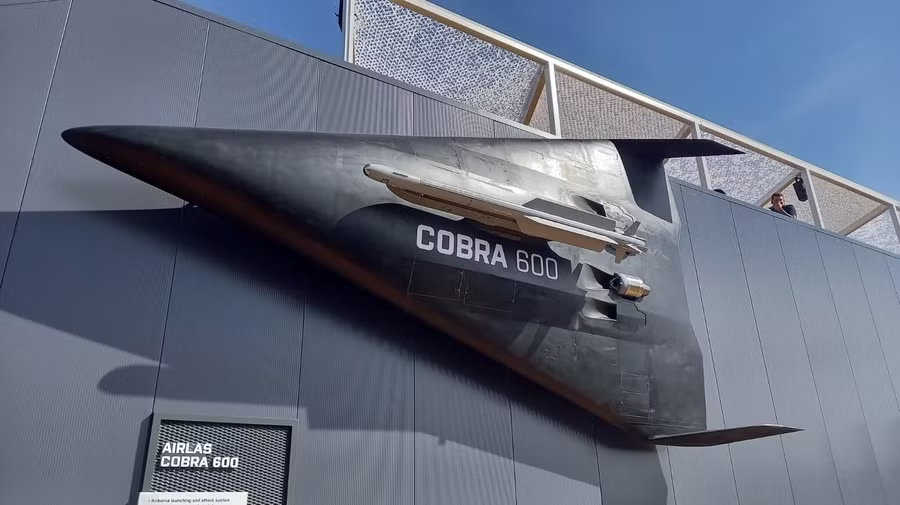
The Cobra 600 has an optimal flight range of approximately 400 km when carrying missiles. Target identification and designation are performed via a secure data link from ground systems. To maintain stable communication over long distances or in environments with strong electronic jamming, the manufacturer is considering integrating satellite internet modules such as Starlink.
Development prospects
The project is currently receiving primary funding from the defense corporation Diehl Defence. Initial flight tests with the missile prototype have been successfully conducted, confirming the project's technical feasibility. The concept of transforming UAVs into air-to-air missile launchers is becoming a new trend, similar to how Russia previously tested mounting R-60 missiles onto Shahed UAVs.


