
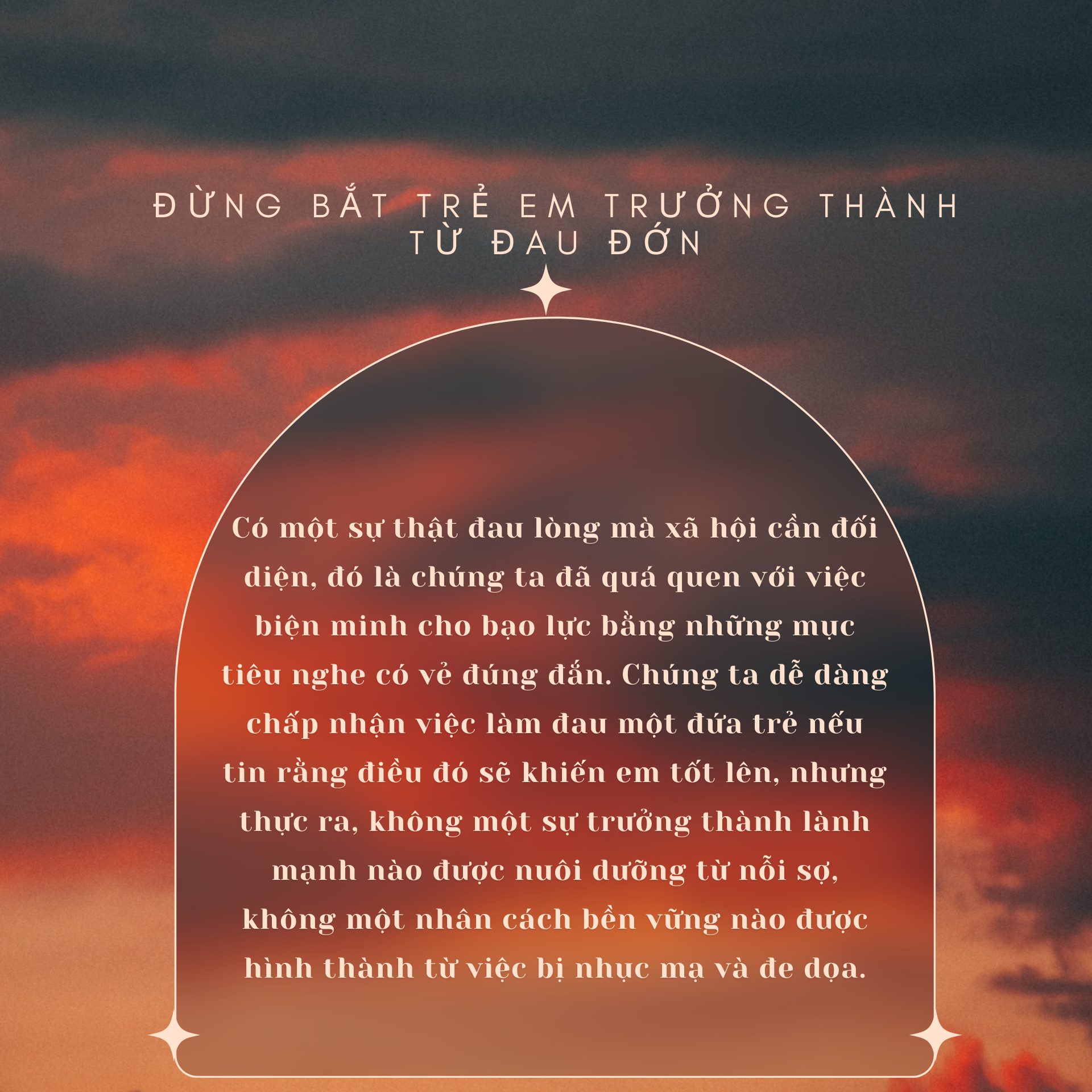
Don't force children to grow up through pain.
Education, ultimately, is not a process of subjugating a person or breaking down their character, but rather a journey to help that person understand who they are and what their value is. Education that loses even the most basic respect for human dignity is no longer education, no matter how many beautiful names it may be given.
Phuoc Anh• January 6, 2026
---------------o0o---------------
In the early days of the year, news of the incident at the Hai Ha Social Work Center in Quang Ninh shocked and angered many people. A child was brought there by their family hoping for help, correction, and guidance from the initial missteps of adolescence, but ultimately, they returned home with a bruised and lifeless body. That death ended a tender life and opened up a heavy question that society cannot avoid: What are we teaching our children?
This pain is not just the tragedy of one family. It leaves a lingering sense of unease in many adults who are parents, because everyone may have, in a moment of despair, considered sending their child to some place with the belief that strict discipline would save everything. And also because this society has long been accustomed to considering "spare the rod, spoil the child" as an essential part of education.

In the minds of many, education is still synonymous with strictness, even punishment. The more disobedient a child is, the harsher the punishment. The more rebellious a child is, the more they need to be forced into conformity. Not all children are like this, but some, before they even understand why they are wrong, are forced to learn to remain silent and submissive, even humiliated, in order to survive. Some children have never been listened to, yet are demanded to be obedient.
The line between discipline and violence, between love and coercion, thus becomes blurred. True discipline helps children understand the consequences of their actions and learn to take responsibility with respect; violence, on the other hand, only creates fear. When fear becomes a tool of education, what remains is not progress but submission. A child may sit still, may not argue, may become obedient in the way adults desire, but inside, who knows how much silent withdrawal and hurt there may be.
We are often easily satisfied with immediate results. A rebellious child becoming less reactive is considered to have changed. A child who is no longer defiant is seen as having progressed. Do we consider that this silence is sometimes simply a sign that they have learned that speaking up will bring pain, that such obedience stems from a fear of punishment?

Even more frightening is when violence is disguised as education and social work. When the perpetrator is also the one in a position to discipline, the child has almost no way out. They easily believe they deserve to be treated that way. They doubt their own feelings, their own identity, and their own family. Their families, in their helplessness at not knowing what to do with their child, easily cling to promises that "they will behave themselves."
In such circumstances, adults often forget a fundamental fact: no child is born inherently bad. Deviant behaviors are always just the tip of an iceberg of hurt, deprivation, insecurity, and alienation. When adults lack the patience and understanding to delve into and address the hidden aspects, they choose to suppress the visible part, and the quickest way to do that is through violence.
The trauma caused by violence doesn't disappear when a child leaves that environment; it stays with them for a long time, sometimes for life. Some children grow up in a state of constant vigilance, always waiting for an invisible blow. Some become emotionally numb, no longer knowing sadness or joy. Others learn to use violence against others because it's the only language they've ever been taught to solve problems.
The incident at the Hai Ha Social Work Center has prompted authorities to conduct a wide-ranging review of similar facilities. This alone shows that it's not just a case of an individual or an isolated incident, but reflects a gap in how society builds, operates, and monitors intervention models for children. Without professional standards, psychological training, and proper oversight, places established with good intentions can easily become spaces of punishment and harm.
There is a painful truth that society needs to confront: we have become all too accustomed to justifying violence with seemingly righteous goals. We readily accept hurting a child if we believe it will make them a better person, but in reality, no healthy growth is nurtured by fear, and no lasting character is formed from humiliation and threats.
Education, ultimately, is not a process of subjugating a person or breaking down their character, but rather a journey to help that person understand who they are and what their value is. Education that loses even the most basic respect for human dignity is no longer education, no matter how many beautiful names it may be given.
Sadness, anger, and sorrow are understandable emotions when discussing this incident, but these feelings will quickly fade, soon overshadowed by the daily barrage of sensational news. Therefore, the crucial question is whether society dares to confront what fostered this tragedy, whether it dares to abandon the ingrained belief that physical punishment is the only inevitable way for children to correct their mistakes, and whether it dares to acknowledge that many children don't need to be disciplined with corporal punishment but simply need to be listened to and understood.
A child can only grow up when they feel safe. Safe to express their fears. Safe to make mistakes. Safe to be treated as a complete human being, not as a "problem" to be dealt with. If society continues to confuse education with punishment, tragedies like the one at the Hai Ha Social Work Center will not be the last warning sign. Then, the pain will not be limited to just one child. It will be a lasting scar on the conscience of the entire community.


