
A Vietnamese student's path to Google.
In July 2017, 22-year-old Trinh Hoang Trieu began working at Google (USA). Trieu was a Vietnamese student recruited by Google for its artificial intelligence research program.
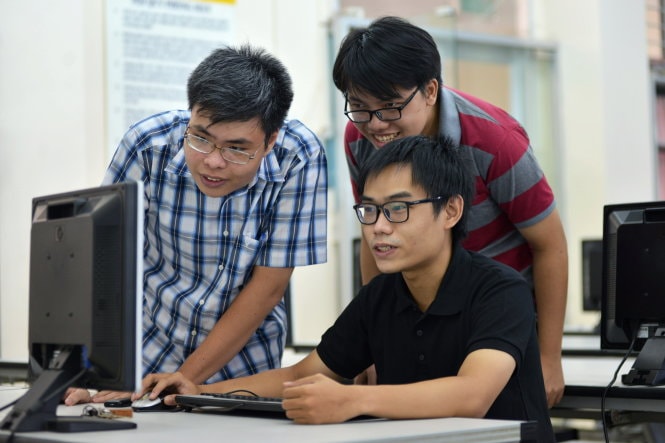 |
| Trinh Hoang Trieu (seated) discusses with his classmates in a class at the University of Science (Vietnam National University Ho Chi Minh City) - Photo: Duyen Phan |
Trieu was hired by Google while he was a student at the University of Science (Vietnam National University Ho Chi Minh City). "For me, life is simply about finding joy in doing what I love, not letting myself fall into a state of boredom or disappointment just because I'm pursuing what people often call success or passion. I think young people can find true joy in enjoying the process of self-discovery, learning, and creating useful products." - Trinh Hoang Trieu
A tiny grain of sand in the vast ocean.
* Hi Hoang Trieu, why did recruiters at Google take notice of your profile for the Artificial Intelligence Research Program (Google Brain Residency)?
In my opinion, all applications for any research-oriented program should include one of two things: either a scientific paper or a letter of recommendation; having both is even better.
My application was selected partly thanks to letters of recommendation from professors who had worked directly with and supervised me, and partly thanks to internal letters of recommendation from employees currently working at Google Brain. These internal letters significantly increased my chances of getting past the initial screening process.
* How did you pass the interview with the experts?
- The process was quite stressful. After the initial application review, I went through two more rounds of interviews focusing on research and mathematics skills, and one round on programming skills. The recorded results then went through two separate independent selection committees, not including the people who had interviewed me.
Because the US is in a different time zone than Vietnam, their interviews usually take place in the middle of the night or early morning – a time when the human brain is in its most drowsy state.
Before each interview, I usually use my "secret weapon": playing hacky sack or taking a walk to tire myself out so I can go home and sleep soundly, wake up early, and drink a cup of coffee to ensure that my mind is at its sharpest when they interview me.
Compared to others in the same field around the world, I am just a tiny grain of sand in the ocean. My acceptance and joining Google has been an opportunity to broaden my horizons, learn from leading scientists, and research and develop new products.
Create opportunities for yourself.
* We understand you've had two internships abroad. What did you do to make those opportunities come your way?
- I previously interned in Canada and Japan. My main career path has always been in scientific research. However, there are very few projects in my country that involve such significant risks in terms of both time and funding. Therefore, I chose to go abroad to fulfill my aspirations.
I consider my selection at that time to be a stroke of luck. Midway through my freshman year, I happened to enroll in a class taught by an American professor who was invited by the university to lecture to faculty, graduate students, and others.
He appreciated my abilities and said that if I wanted to study abroad later, he would help me write a letter of recommendation. So, while he still remembered me, I asked him to write a letter of recommendation for an internship in Canada. This was the starting point for my subsequent internships, and currently, my internship at Google Brain.
* When did you begin researching artificial intelligence, and what factors helped you in that research to get to where you are today?
- When I was a freshman, a classmate shared an online course from Coursera (teaching the basics of artificial intelligence). The more I learned, the more interested I became, so I started downloading advanced materials to read and registering for free online courses from major universities like MIT and Stanford. After that, I decided I would research this field in more depth.
There were two main factors that helped me in my research.
Firstly, I come from a background in advanced mathematics, so it was very easy for me to get started.
Secondly, I started researching and learning about artificial intelligence earlier than others, when it was still a relatively new field.
By the time artificial intelligence became a trend and major companies invested in and recruited for it, I already had a lot of experience.
An inspiring teacher
* Throughout this journey, who has influenced and inspired you the most?
- Associate Professor Tran Minh Triet (Deputy Head of the Software Technology Department, Faculty of Science, Vietnam National University Ho Chi Minh City) is the "behind-the-scenes hand" for many students. He not only provides professional guidance but also offers dedicated advice on career paths and encourages students...
Furthermore, I consider myself very fortunate to have come from a family that values education. Their stable emotional and financial support has allowed me to focus on various other things, especially research.
According to TTO
| RELATED NEWS |
|---|


