
Which new communes in Nghe An province does the North-South high-speed railway pass through?
The Ministry of Construction has sent a document to 15 provinces and cities (according to the old administrative unit of 20 provinces and cities) through which the high-speed railway line passes, requesting that localities proactively implement land clearance and build resettlement areas. Accordingly, Nghe An province is also urgently directing land clearance work.
The North-South high-speed railway project received investment approval from the National Assembly in November 2024, with a preliminary total investment of approximately 1.7 million billion VND (over 67.3 billion USD).
The 1,541 km long line runs from Ngoc Hoi Station (Hanoi) to Thu Thiem Station (Ho Chi Minh City), passing through 15 provinces and cities, including Nghe An. The line uses a double-track gauge of 1,435 mm, with a design speed of 350 km/h and a load capacity of 22.5 tons per axle. The entire line has 23 passenger stations and 5 freight stations, serving high-speed transport and capable of being converted to freight transport when needed. Construction is expected to begin before December 31, 2026, and be substantially completed by 2035.
The Standing Committee of the Nghe An Provincial Party Committee issued Decision No. 3995-QD/TU on June 30, 2025, establishing the Steering Committee and the Working Group assisting the Steering Committee for land clearance of the North-South high-speed railway project, the section passing through Nghe An province. The Steering Committee is chaired by the Provincial Party Secretary. The Nghe An Provincial People's Committee also recently issued Official Letter No. 5963/UBND-CN regarding the review and implementation of resettlement areas serving the North-South high-speed railway project section through the province.
Accordingly, based on the directives of Deputy Prime Minister Tran Hong Ha at the meeting on June 16, 2025, and the request of the Ministry of Construction on June 17, 2025, the Provincial People's Committee assigns the Department of Construction to take the lead and coordinate with the Department of Agriculture and Environment and the People's Committees of the relevant communes to urgently conduct on-site reviews and determine the resettlement needs of each locality, based on the basic design documents in the pre-feasibility study report and the land clearance boundary documents. Based on this, they are to compile and estimate the number, location, scale, and total investment of each resettlement area, and report to the Provincial People's Committee before July 10, 2025.
The Department of Construction is tasked with advising the Provincial People's Committee on assigning tasks to departments, agencies, and localities to implement resettlement areas, striving to commence construction on at least one area by August 19, 2025, as required by the Government and the Ministry of Construction. The Department of Construction is also tasked with developing a standardized design template for resettlement area construction (road cross-sections, sidewalks, lighting, etc.) to guide unified implementation, to be completed before July 30, 2025.
In addition, the Department of Construction continues to review inconsistencies along the route according to the basic design documents, especially those overlapping with residential areas and concentrated production and business land areas, in order to advise the Provincial People's Committee to request the Ministry of Construction to handle them promptly.
In addition, the Department of Construction will coordinate with the Department of Agriculture and Environment to advise on solutions to accelerate land clearance; review and advise on adjustments to urban and rural planning and related plans to ensure sufficient basis for the implementation of resettlement areas. The Department of Construction is also responsible for monitoring, urging, and handling land clearance work and periodically reporting to the Provincial People's Committee on progress, difficulties, and obstacles on the 15th and 30th of each month.
The Provincial People's Committee also assigned the Department of Agriculture and Environment to urgently coordinate with the Department of Construction and local authorities to conduct on-site inspections, review, and compile statistics on resettlement needs. They are to take the lead in advising on the allocation of land use targets, submitting adjustments to land use planning and plans to ensure a legal basis for land clearance, and coordinating with the Department of Construction to develop solutions to accelerate land clearance progress, completing it before July 30, 2025.
The Department of Finance is tasked with advising on the procedures and processes for implementing resettlement areas. The People's Committees of the communes and wards where the project passes through will coordinate with relevant departments and agencies to review and compile the local resettlement needs, and submit a report to the Department of Construction before July 5, 2025, for overall compilation and implementation.
According to Vice Chairman of the Nghe An Provincial People's Committee Hoang Phu Hien: Following the directives of the Prime Minister and the Ministry of Construction, the Nghe An Provincial People's Committee has instructed localities to use the route outlined in the pre-feasibility study report to disseminate information to people within the planned land clearance area, aiming to raise awareness, reduce illegal construction, and maintain security and order.
The province has also directed departments, agencies, and localities to review affected households and residential areas to determine the scale, location, and number of resettlement areas requiring investment. Currently, the province is establishing a Steering Committee and a Working Group for land clearance and compensation, and developing an implementation plan.
It is expected that Nghe An province will have more than 30 resettlement areas. The reorganization of commune-level administrative units also affects the adjustment of various types of planning, including resettlement area planning, so time for surveying is needed.
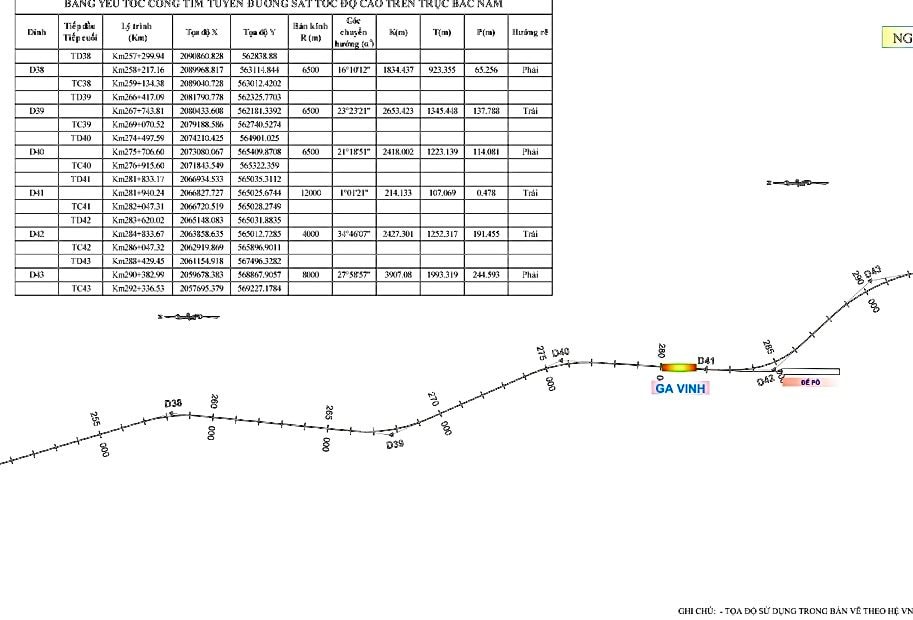
* Section 1 from the former Hoang Mai town to Than Vu mountain:After crossing Truong Lam mountain (formerly Tinh Gia district of Thanh Hoa province), the route will bypass the Hoang Mai Cement Factory area, located in Hoang Mai ward, heading west, situated between the current North-South railway corridor and the planned expressway according to local planning. The route passes through Quynh Van and Quynh Son communes (formerly Quynh Luu district) and Minh Chau, Tan Chau, Hung Chau, Duc Chau, Dien Chau, An Chau, and Quang Chau communes (formerly Dien Chau district) of Nghe An province, running parallel to the existing railway line, 100 to 400 meters to the west.
* The section from Than Vu Mountain to Lam River:The route passes through the Than Vu tunnel, now Tan Chau commune (formerly Dien Chau district) and Nghi Dong commune (formerly Nghi Loc district), bypassing the O O dam, and continues along the planned corridor of the Southeast Economic Zone.
The basic route runs parallel to the east of the North-South Expressway, then shares a corridor and lies between the expressway and the Vinh bypass. The route crosses the old National Highway 46, the current railway line, and the Lam River at Lam Thanh commune to enter Ha Tinh province.
Mr. Le Quang Thanh, Deputy Director of Nghe An Power Company, said: Nghe An is one of the provinces with a large number of power projects affected by the North-South high-speed railway, with many ongoing projects requiring adjustments.
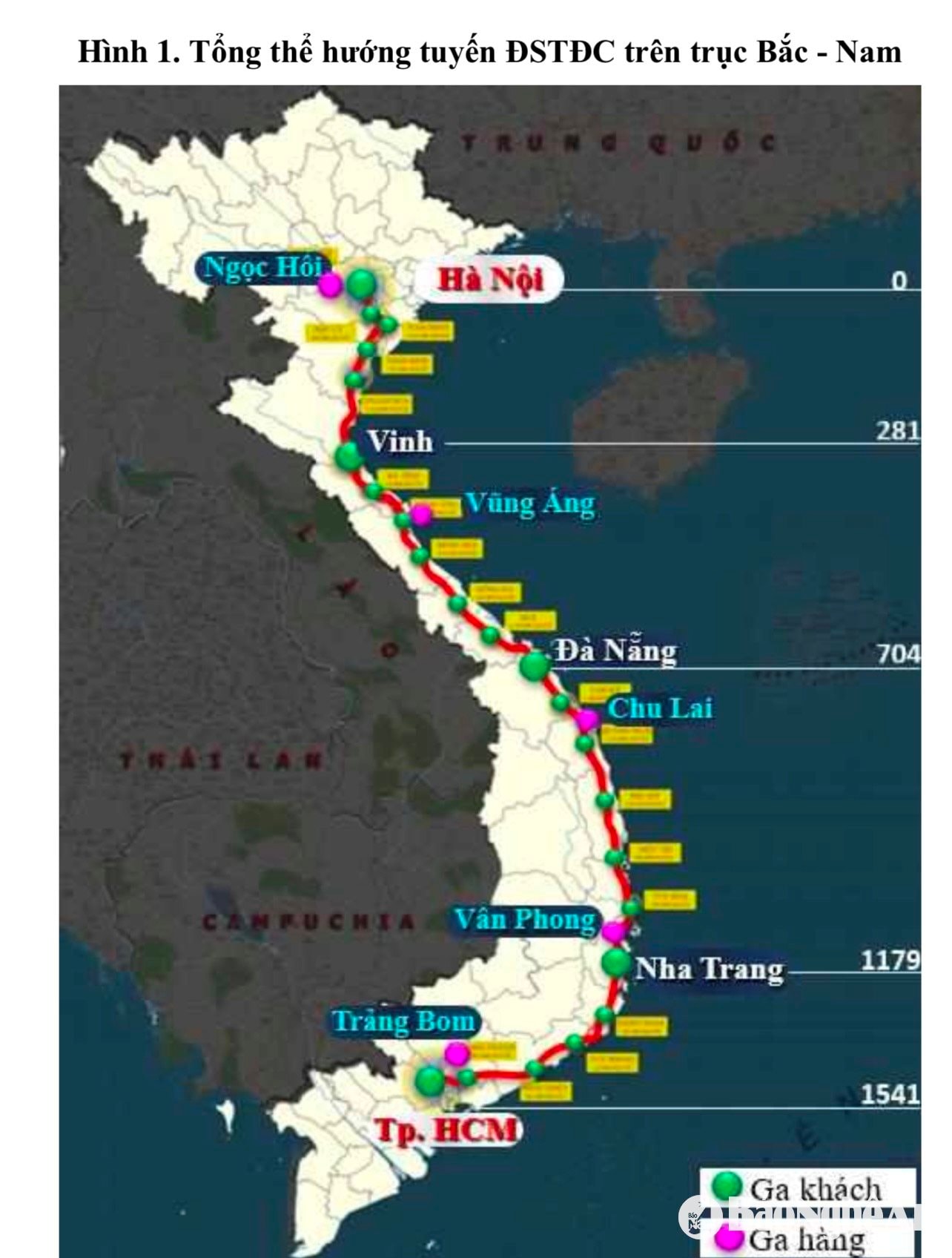
According to Resolution 172/2024/QH15, the North-South high-speed railway project has a total length of approximately 1,541 km; the starting point is at Ngoc Hoi station (Hanoi), and the end point is at Thu Thiem station (Ho Chi Minh City).
The project applies advanced and modern technology, ensuring safety, consistency, quality, and efficiency. The application of high technology in construction organization and adaptation to climate change is encouraged.
The project applies rail-based railway technology commonly used worldwide; train technology using distributed EMU propulsion; and signaling and communication systems equivalent to those currently used in countries operating high-speed rail.
The North-South high-speed railway will create a vital transportation artery, connecting key economic regions from North to South, contributing to the optimal restructuring of the transportation market share on the North-South corridor; creating a foundation and impetus for socio-economic development, and ensuring national defense and security.
The commissioning of the high-speed rail line will reduce pressure on current road and air routes, especially given the frequent congestion on roads and the persistent problem of traffic accidents. It is estimated that the high-speed rail line on the North-South axis will save approximately US$849 million in traffic accident losses by 2040 and US$1,906 million by 2050.


