
E-3 Sentry spotted near Venezuela: Military perspective
The public appearance of E-3 Sentry aircraft, along with numerous US fighter jets and warships, near Venezuela indicates an increased military presence around the country and raises concerns about escalating tensions.
A U.S. E-3 Sentry Airborne Early Warning and Control System (AWACS) aircraft was detected operating near the Venezuelan coast, alongside an increased presence of U.S. fighter jets and warships in the Caribbean region. This development is seen as a significant sign amid Washington's escalating military and economic pressure on the government of Venezuelan President Nicolás Maduro.
E-3 Sentry aircraft spotted publicly near Venezuela.
According to data from the FlightRadar24 system, a US E-3 Sentry aircraft flew near the Venezuelan coast. This is the first time in several days that this type of aircraft has appeared publicly on tracking data, whereas previously it had been almost absent or only intermittently present.
The E-3 Sentry is no stranger to the Caribbean, having participated in numerous anti-drug trafficking operations. However, its reappearance and public surveillance are considered noteworthy, as this type of aircraft is seen as a key component in any large-scale military operation targeting Venezuela.
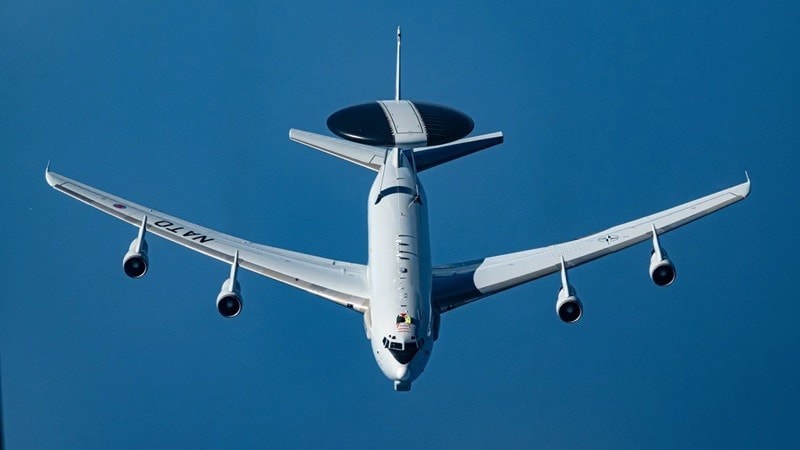
The technical role of the E-3 Sentry and a comparison with the E-2D Hawkeye.
The E-3 Sentry is an airborne early warning and control aircraft, performing early warning, data sharing, and command and control missions over a wide area. According to sources, compared to the E-2D Advanced Hawkeye, which regularly operates from aircraft carriers, the E-3 has a broader coverage area and better integration with the US Air Force.
This difference makes the E-3 a crucial tool for integrating information from multiple platforms and supporting large-scale operational command. In the context of tensions with Venezuela, the E-3's operation near the disputed area demonstrates that the U.S. maintains a high level of airborne surveillance and command capability.
US air activity has increased near Venezuelan territorial waters.
Alongside the E-3 Sentry, FlightRadar24 recorded several US fighter jets operating near the northern coast of Venezuela. Specifically, a US Navy F/A-18E Super Hornet performed multiple flyovers right on the edge of Venezuelan airspace.
In addition, the data also shows the presence of two E/A-18G Growler electronic warfare aircraft, two more F/A-18 Super Hornet aircraft, and one E-2D Advanced Hawkeye early warning aircraft. These flights were part of Operation Southern Spear.
Initially, Southern Spear was described as an anti-drug trafficking mission. However, sources indicate the operation has shifted its focus to directly pressuring the Maduro government and Venezuela's oil revenue – its primary resource. The overt flights with exposed transponders are seen as part of a pressure strategy, reflecting the increasing U.S. military presence around Venezuela.
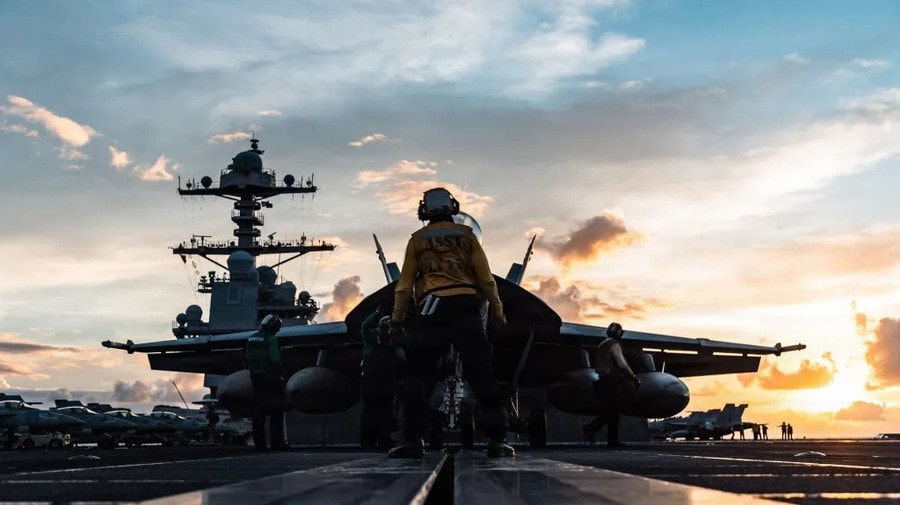
US naval task force and forces in the Caribbean
According to sources, the US has deployed at least 11 surface warships in the area, including the aircraft carrier USS Gerald R. Ford. Accompanying them are numerous naval and tactical air force units, including:
- F/A-18 Super Hornet squadrons;
- E/A-18 Growler electronic warfare aircraft;
- E-2D Hawkeye early warning aircraft;
- MH-60S and MH-60R helicopters;
- C-2A Greyhound transport aircraft;
- F-35B fighter jet and AV-8B Harrier II helicopter;
- MV-22 Osprey tiltrotor aircraft;
- MQ-9 Reaper UAV;
- AC-130 Ghostrider attack aircraft.
In addition to air and naval forces, approximately 15,000 U.S. troops are present in the Caribbean region. The combination of aircraft carriers, escort warships, early warning aircraft, fighter jets, UAVs, and amphibious forces demonstrates that the U.S. maintains a force cluster capable of conducting a wide range of military operations, from deterrence and patrols to large-scale campaigns if ordered.
Legal aspects and US actions regarding Venezuela
Amid escalating tensions, US President Donald Trump declared he was willing to notify Congress before launching a direct attack on Venezuela, but insisted this was not a mandatory obligation.
According to the 1973 War Powers Resolution, the U.S. President must report within 48 hours of deploying forces to combat. Without further congressional approval, military operations are only permitted for a maximum of 60 days. Trump's statement suggests the White House wants to maintain legal flexibility in the use of force, while also sending a deterrent signal to Caracas.
The US president also ordered a blockade of the sanctioned oil tankers, emphasizing that the US has the right to control this oil supply. Earlier, the US seized the oil tanker M/T Skipper on December 10 with the participation of the Coast Guard and the military.
Nevertheless, some ships carrying petroleum products from Venezuela's José port still depart under naval escort, heading towards Asian markets. This shows that Caracas is still trying to maintain its energy exports despite facing significant pressure from the United States.
Regional response and risk of escalation
Brazil has expressed concern over increased military activity around Venezuela. Brazilian President Luiz Inácio Lula da Silva offered to mediate between the US and Venezuela to avert a potential armed conflict.
He emphasized that diplomatic solutions are necessary to prevent a fratricidal war on the South American continent. This reflects the concerns of countries in the region about a scenario of military confrontation, in which the presence of assets such as the E-3 Sentry, carrier groups, and dozens of types of fighter, reconnaissance, and electronic warfare aircraft could quickly translate military pressure into action on the ground if tensions spiral out of control.
Assessing the military significance of the E-3 Sentry's presence.
From a technical and operational perspective, the public appearance of E-3 Sentry aircraft near Venezuela demonstrates the U.S.'s focus on command and control and early warning capabilities in all scenarios involving this South American nation. Compared to the already frequent E-2D Hawkeye flights, the addition of E-3s expands the surveillance range and enhances coordination between air and naval forces.
Combined with Operation Southern Spear, which shifted the focus from anti-drug operations to directly pressuring the Maduro government and its oil revenues, the US naval, carrier, and air force contingent in the Caribbean forms a significant deterrent. While there are no signs of direct military intervention, the level of force concentration and political and legal statements from Washington indicate that tensions surrounding Venezuela remain at a sensitive level, heavily dependent on diplomatic developments and the responses of all parties involved.


