
EU - Türkiye: Will things reach a breaking point?
(Baonghean) - After Germany, Austria, and Switzerland, now the Netherlands is also expressing dissatisfaction with Turkish politicians' visits to these countries for political campaigning. This escalating tension has led observers to believe that both sides are facing the biggest challenge in the history of their bilateral relations. So, what is the actual level of conflict between Türkiye and European countries, and will pushing too hard lead to a breaking point?
Erdogan's calculations
The heated "war of words" between Türkiye and the Netherlands was the "last straw," revealing the growing discord between Ankara and European countries. In fact, recent troubles stem from Turkey's accelerated campaigning for a referendum on constitutional reforms, scheduled for April, which would grant more power to the president.
If approved, the Turkish president would have additional powers to appoint ministers, prepare the budget, designate most senior judges, issue decrees, declare a state of emergency, dissolve parliament, and more. To achieve this desired outcome, Turkish President Tayip Erdogan needs the support of both citizens living inside and outside the country.
Meanwhile, according to statistics in Europe, the Turkish community is very large, especially in Germany (1.5 million people), France (650,000 people), and the Netherlands (400,000 people)... If he gains the support of this voter base, it would be a huge advantage for Erdogan. Therefore, Erdogan has sent his cabinet ministers to Europe to campaign in order to win this referendum.
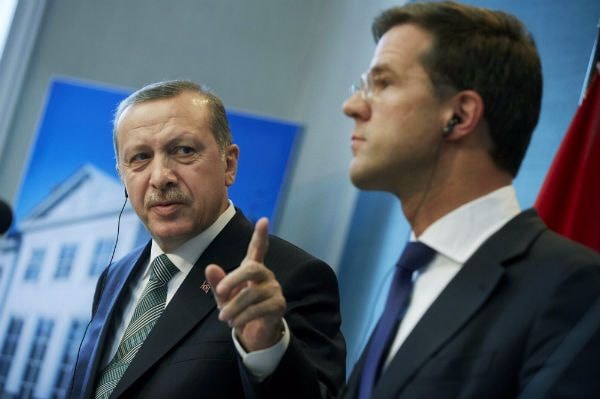 |
| Turkish President Recep Tayyip Erdogan (left) and Dutch Prime Minister Mark Rutte. Photo: AP |
However, European countries strongly opposed Turkey's calculations. Before the Netherlands, Austria, Switzerland, and Germany had already banned Turkish politicians from campaigning in their countries. The reason given by European countries was their concern about security and instability, as the current political divisions in Turkey could spread to the Turkish community in European countries. The Netherlands – a country preparing for important parliamentary elections scheduled for March 15 – certainly did not want its citizens' morale to be disrupted and misled by Turkey's political issues. Therefore, tensions between the Netherlands and Turkey reached a peak when the Dutch government prevented Turkish Foreign Minister Mevlut Cavusoglu from flying to Rotterdam.
Subsequently, the Netherlands denied Turkish Family Minister Betul Sayan Kaya entry to the Turkish consulate in Rotterdam, then escorted her out of the Netherlands and to Germany. In response to these actions by the Netherlands, Turkish President Erdogan angrily called the Netherlands "fascist remnants" and warned of the strongest possible retaliatory measures.
It remains unclear how tense the two sides will become, but it is evident that since the failed coup attempt in Türkiye last July, this is the most turbulent period in relations between Turkey and European countries.
Will "pushing too hard" break the rope?
Looking at recent European-Turkish relations, it's clear that security concerns are merely a pretext for European countries to oppose Turkish officials engaging in political campaigning. In reality, the animosity between the two sides has been simmering for some time, ever since the political upheaval in Türkiye last July. Germany, in particular, has repeatedly and strongly criticized the subsequent arrests and purges carried out by the Turkish government, resulting in the dismissal of nearly 100,000 civil servants. Europe considers this a violation of human rights and democracy.
Furthermore, Türkiye's plan to hold a referendum on constitutional reform has also displeased Europe. Recently, a group of legal experts from the Council of Europe declared that Türkiye's proposed constitutional changes to increase President Tayyip Erdogan's powers are "a dangerous step backward" for democracy in the country. Specifically, according to this body, the proposed constitutional amendment, which would allow the president to dissolve Parliament at any time, is contrary to the democratic system.
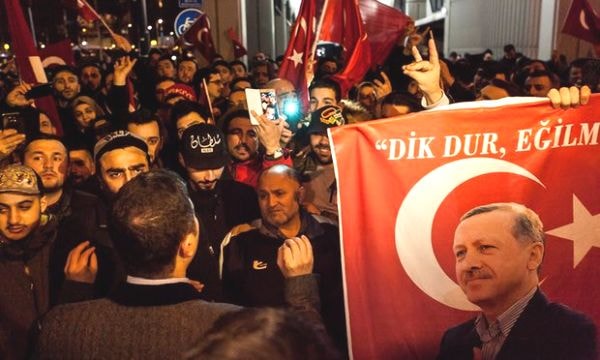 |
| Turks march in Rotterdam, Netherlands. Photo: Anadolu Agency |
Given these concerns, it's understandable that European countries are reluctant to see the Turkish president campaign in their country. Furthermore, Turkey's recent lack of enthusiasm for preventing refugees from the Middle East from flooding into Europe is also a source of unease among European leaders. The process of Turkey's accession to the European Union (EU) has been stalled partly because European countries are not entirely comfortable with the political situation of this country located at the "crossroads of the world."
In the current context, it seems unlikely that the EU-Türkiye partnership will materialize in the near future, and Turkey's journey to the EU will become even more difficult. However, despite recent conflicts, the EU and its member states must acknowledge the reality that the decades-long partnership with Turkey is extremely important to both sides. Although there have been heated exchanges, neither side will allow the situation to escalate to the point of breaking down. This is evident when Dutch Prime Minister Mark Rutte stated that he would do everything possible to de-escalate tensions with Türkiye. Similarly, earlier, the head of the German judiciary, while expressing disapproval of Erdogan's statements, also affirmed that the hardline president should not be banned from visiting Germany or that diplomatic relations with Türkiye should not be severed to avoid the risk of pushing Turkey toward Russia. Turkey has also threatened to consider joining the Shanghai Cooperation Organization (SCO) instead of the EU if the alliance does not continue negotiations.
In short, while Europe disagrees with President Erdogan's domestic policies, it cannot "cut ties" with Ankara due to its importance in NATO as well as in international and regional affairs. However, rifts between the two sides will be inevitable.
Thanh Huyen


