
US F-35A fighter jets appear in the Caribbean during the Southern Spear.
The US F-35A stealth fighter jet was deployed for the first time in Operation Southern Spear in the Caribbean, alongside numerous other aircraft and aircraft carriers present in the region.
The US F-35A stealth fighter has been deployed to the Caribbean as part of Operation Southern Spear, an intensified anti-drug trafficking campaign by Washington. This move marks the first time the US Air Force has used the F-35A in the aforementioned operation and represents a significant expansion of the US military presence in the region.
Overview of F-35A deployment in the Caribbean
According to the military news site The War Zone, F-35A fighter jets from the 158th Fighter Squadron of the Vermont National Guard have arrived at the former Roosevelt Roads Naval Base in Puerto Rico. Images and videos circulating online show the appearance of this new generation stealth fighter in the Caribbean, adding another layer of air combat capability for the US in the region.
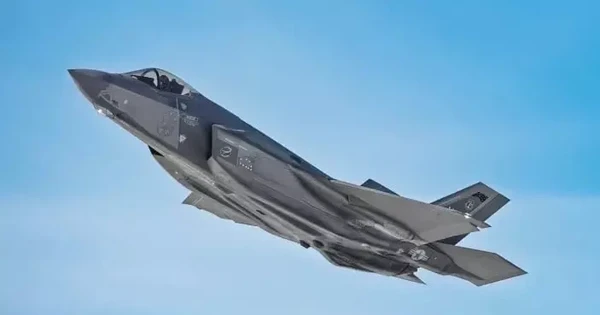
This deployment is seen as the latest US military buildup in the Caribbean, as Washington seeks to bolster its air and sea control capabilities to support anti-drug trafficking operations. The presence of F-35A aircraft in Puerto Rico also lays the groundwork for coordination with US air and naval forces already regularly present in the region.
Technical analysis: F-35A and F-35B in a Caribbean scenario.
According to sources, the F-35A is capable of carrying and dropping 900 kg of heavy guided bombs from its internal weapons bay. This configuration allows the aircraft to attack targets deep within enemy airspace while maintaining stealth capabilities, as the weapons are stored internally instead of being suspended externally on the wings.
Meanwhile, the US Marine Corps' F-35B fighters deployed in Puerto Rico can only carry 450 kg of weapons in their internal weapons bay. At the same time, the F-35B is believed to have a more limited range and maneuverability compared to the F-35A. The difference in internal weapons payload and range suggests that the F-35A is better suited for missions requiring engagement of targets at longer distances.
The US Air Force's first deployment of the F-35A in Operation Southern Spear highlighted the need for an additional tactical jet platform capable of carrying heavy weaponry in a stealth configuration. In an environment involving drug trafficking routes by sea and air, the ability to accurately strike critical targets is considered crucial, and the F-35A's 900 kg guided bomb payload is a significant advantage.
Air support forces: from CSAR to electronic warfare
Along with the F-35A, the U.S. is deploying numerous other military assets in Operation Southern Spear in the Caribbean. According to The War Zone, the area is already equipped with combat search and rescue (CSAR) aircraft, E/A-18G electronic warfare aircraft, MQ-9 Reaper drones, AC-130 Ghostrider attack helicopters, and various other helicopters. This configuration creates a broad support network, ranging from reconnaissance and attack to combat rescue.
The E/A-18G electronic warfare aircraft plays a role in jamming and electronic suppression, supporting fighter and reconnaissance squadrons when operating near enemy airspace. The MQ-9 Reaper drone enhances long-term surveillance capabilities and precision strikes against identified targets. The AC-130 Ghostrider, according to sources, serves as an attack helicopter, providing additional air firepower for operations in complex conditions.
Furthermore, the presence of combat search and rescue (CSAR) aircraft allows the US to minimize risks to pilots and crews in the event of an incident, ensuring a closed operational chain from reconnaissance – attack – rescue within the same area.
Air surveillance and suppression operations near Venezuela
Data from the flight tracking platform FlightRadar24 shows an increase in US military activity in the Caribbean. Earlier this week, a US E-3 Sentry Airborne Early Warning and Control System (AWACS) aircraft was tracked while flying near the Venezuelan coast. This type of aircraft is tasked with monitoring airspace and coordinating air combat operations.
According to FlightRadar24, a US Navy F/A-18E Super Hornet fighter jet conducted multiple flight loops near the northern edge of Venezuelan airspace. Additionally, two E/A-18G Growler electronic warfare aircraft, two other Super Hornets, and an E-2D Advanced Hawkeye airborne early warning aircraft were also observed flying near the Venezuelan coast. The number of publicly trackable military flights in this area has increased significantly recently.
The combination of E-3 Sentry, E-2D Advanced Hawkeye, F/A-18E Super Hornet, and E/A-18G Growler indicates that the US is deploying a dense network of airborne surveillance, command and control, and electronic warfare operations around the Venezuelan border. In this context, the F-35A, with its ability to carry heavy guided bombs in its internal bay, could serve as a precision strike force if required.
USS Gerald R. Ford and naval power in the Caribbean
Alongside its air operations, the world's largest aircraft carrier, the USS Gerald R. Ford, is also present in the Caribbean. Onboard are four squadrons of F/A-18 Super Hornets, one squadron of E/A-18G Growlers, one squadron of E-2D Advanced Hawkeyes, MH-60S and MH-60R Seahawk helicopters, and a detachment of C-2A Greyhound transport aircraft.
A carrier strike group with such an air wing allows the U.S. to maintain air strike, reconnaissance, early warning, electronic warfare, and transport capabilities across a vast maritime area. When coordinated with F-35A aircraft deployed from shore-based bases and other assets such as the MQ-9 Reaper or AC-130 Ghostrider, the U.S. can conduct integrated air-sea operations in the Caribbean region.
Impact on the regional security landscape
According to quoted observers, the increased deployment of US air and naval forces in the Caribbean comes as Washington continues to expand its military presence in the region, amidst complex security and geopolitical developments. The increased frequency of publicly traceable military flights, along with the appearance of modern platforms such as the F-35A and USS Gerald R. Ford, reflects the growing importance the US places on this region.
In that context, the first deployment of the F-35A in Operation Southern Spear was a significant technical and operational milestone. The combination of stealth capabilities, a 900 kg guided bomb payload in its internal weapons bay, and a support network from early warning aircraft, electronic warfare, UAVs, and naval forces created a highly flexible and deterrent force structure in the Caribbean, aligning with Washington's objectives of enhanced security control and combating drug trafficking.


