
Facebook tops the list of users violating privacy rights.
A recent report by the privacy research organization Incognito shows that Facebook tops the list of social media platforms that violate user privacy.
Concerns about privacy on social media are nothing new to users. These platforms collect vast amounts of personal data, from basic information like name, age, and email address to browsing history, interests, and even geographic location. This data is often used to personalize advertising, build detailed user profiles, and sometimes sold to third parties.
A recent study by Incogni revealed that most platforms lack effective user data protection measures. This means our personal information could be leaked, leading to serious consequences such as fraud, scams, or being used to manipulate public opinion.
To gain a comprehensive understanding of the level of privacy protection on social media platforms, Incogni researchers developed an evaluation system based on 14 criteria across five main categories: data breaches, data collection and storage, user control and consent, transparency of privacy policies, and user-friendliness.
From reviewing historical data breaches and analyzing security policies to surveying user experiences, Incogni has created a detailed ranking that accurately reflects the level of data protection offered by each platform.
Facebook, Messenger, and LinkedIn are the top three social media platforms on the list of those violating user privacy.
Incognito's research revealed a clear disparity in privacy protection levels among leading social media platforms. Facebook emerged as the platform with the most privacy violations among the 15 platforms evaluated, scoring the highest at 18.98/20.
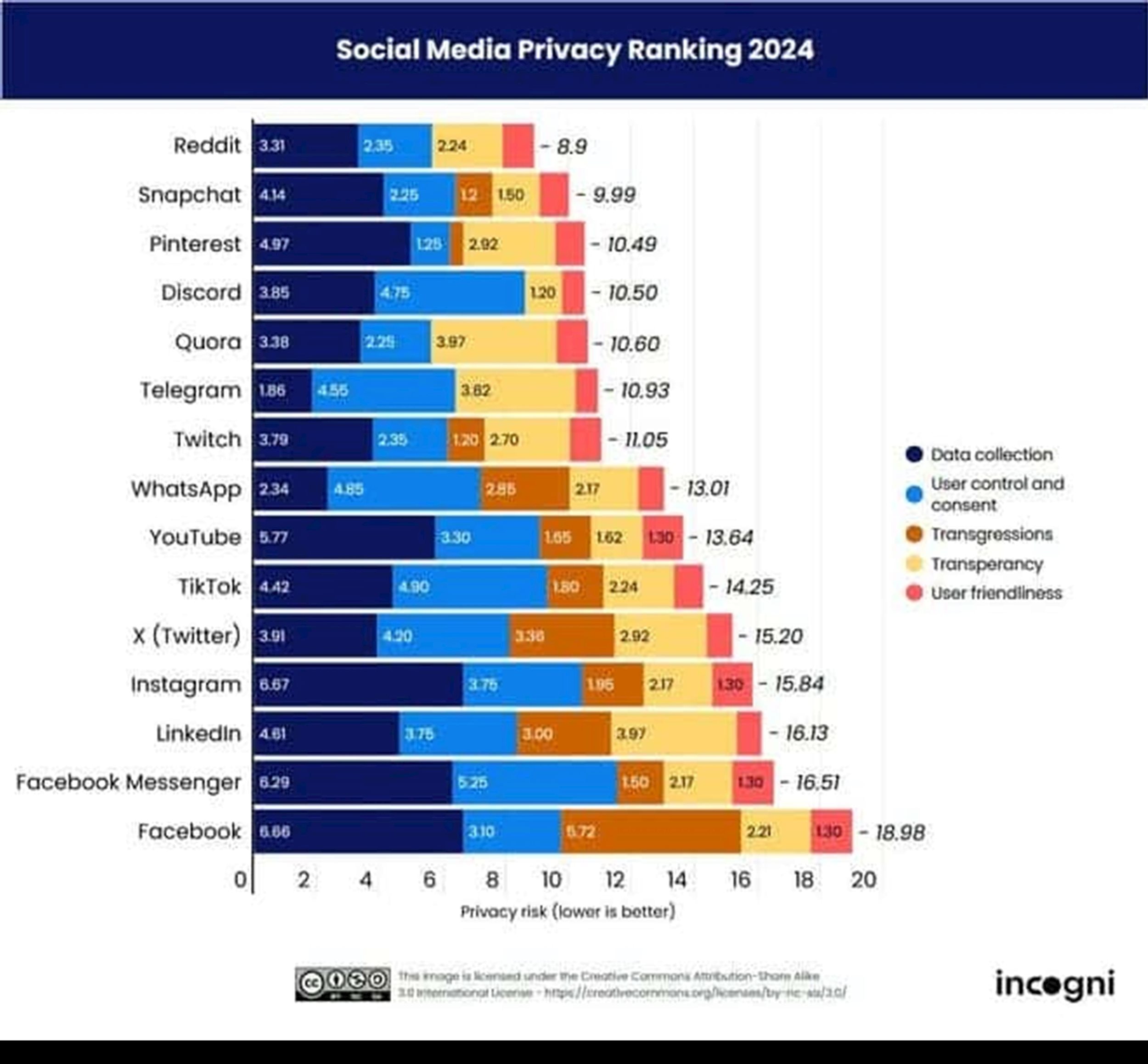
The social media platforms with the next highest levels of user privacy violations after Facebook include: Messenger (16.51/20 points), LinkedIn (16.13/20 points), Instagram (15.84/20 points), X (15.20/20 points), TikTok (14.25/20 points), and YouTube (13.64/20 points).
Meanwhile, social media platforms like Reddit, Snapchat, and Pinterest had the least level of user privacy violations, with scores of 8.9/20, 9.99/20, and 10.49/20 respectively, indicating significant efforts by these platforms to protect user privacy.
User data will be retained for up to 180 days after leaving the platform.
Most alarmingly, many social media platforms continue to store user data for extended periods after accounts have been deleted. Incognito research shows that Facebook, Instagram, Messenger, YouTube, and Discord all retain data for up to 180 days.
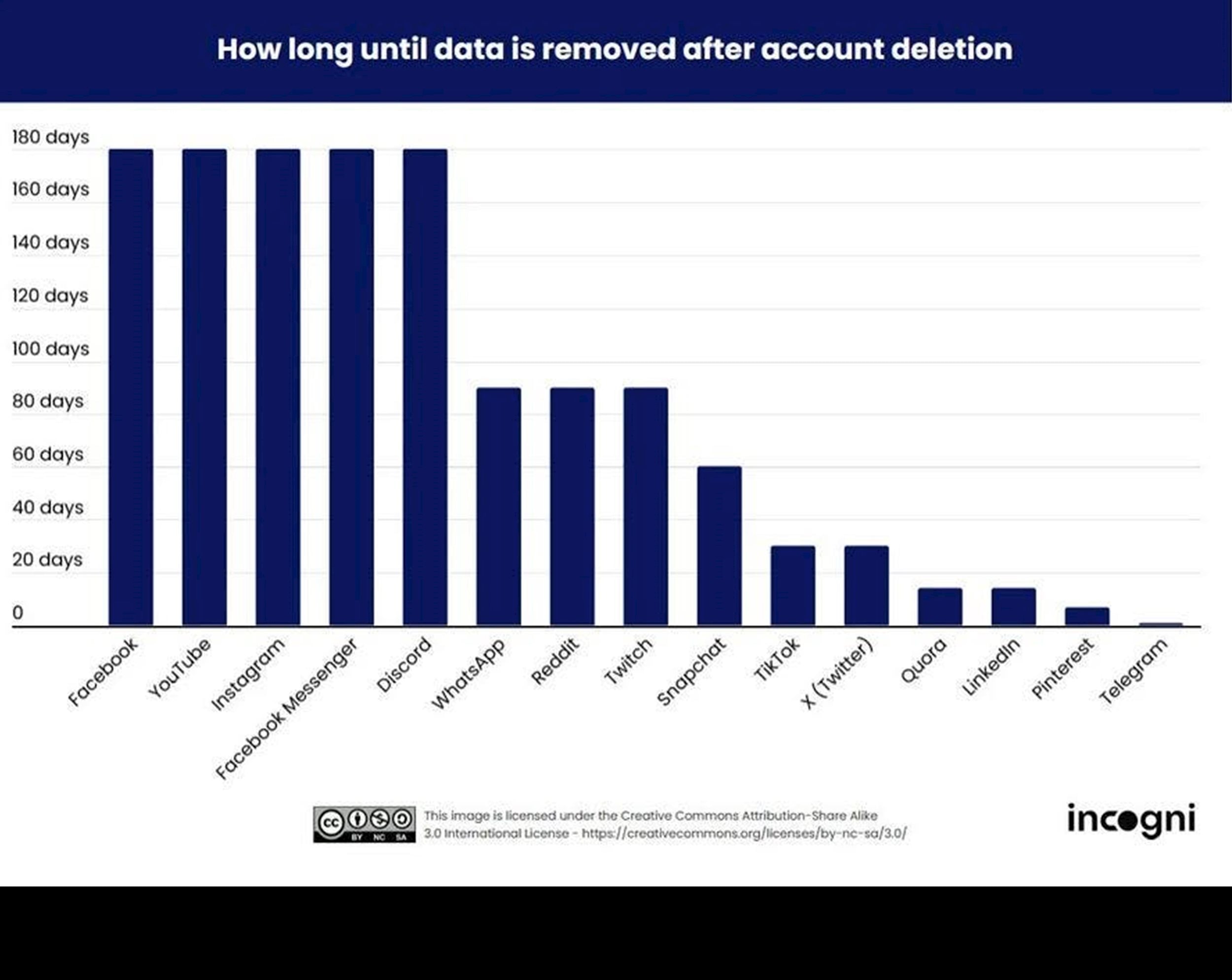
This means that users' personal information can still be accessed and misused, even after they are no longer members of that platform. In contrast, Telegram only stores data for a few days, demonstrating a stronger commitment to user privacy.
How to enhance privacy on social media platforms
Research by Incogni has shown that the most popular social media platforms, such as Facebook, Messenger, and Instagram, regularly collect user data on a large scale, share it with business partners, and use this information to personalize advertising and shape user behavior. To mitigate risks, users can adjust their privacy settings, limit the sharing of personal information, and use security tools such as virtual private networks.
To protect user privacy, Incogni spokesperson Jasinska-Dias recommends using pseudonyms whenever possible. This helps limit the possibility of being tracked, targeted advertising, and minimizes the risk of identity breaches.
Instead of using their primary phone number and email address, users can create temporary email accounts or use services that generate virtual phone numbers. However, remember that using fake information is only one part of protecting your privacy. Users should also use strong passwords, enable two-factor authentication, and avoid connecting to unreliable public Wi-Fi networks.
Jasinska-Dias emphasizes that privacy management becomes more complex when users utilize Google and Meta services. These companies possess a vast ecosystem of products and services, and they often share user data across these services.
For example, when a user searches for a product on Google, that information may be used to display related ads on Facebook or Instagram. This means that a user's use of one service can affect their experience on other services. To protect their privacy, users should take the time to review and adjust their privacy settings on each service.


